All posts
GeographyMarch 22, 20266 min read read

The Mercator Projection: Why Your Map Lies About Country Sizes

The map you grew up with has been deceiving you for over 450 years. Here's how the Mercator projection distorts the true size of countries — and why a 3D globe is the only honest way to see Earth.

The Mercator Projection: Why Your Map Lies About Country Sizes

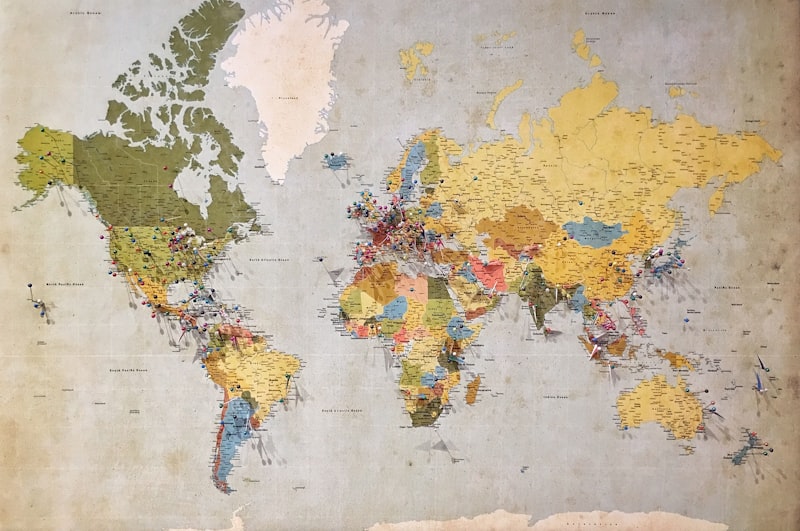
Take a look at a standard world map. Greenland appears to be roughly the same size as Africa. Russia dominates the northern hemisphere like a landmass giant. Antarctica stretches across the entire bottom of the map like a frozen continent worthy of its own hemisphere. Now here's the uncomfortable truth: almost all of that is a lie.

The culprit is the Mercator projection — the most widely used map design in history, and arguably the most misleading. It has shaped how billions of people understand the world, influenced geopolitics, and even affected how children perceive the importance of different nations. But to understand why maps are wrong, we first need to understand why the Mercator projection exists at all.

A Map Born for Sailors, Not Schoolchildren

In 1569, Flemish cartographer Gerardus Mercator published a revolutionary new world map. He wasn't trying to deceive anyone — he was trying to save sailors' lives. Navigation at sea was brutally difficult, and one of the core problems was that drawing a straight line on a map didn't correspond to a straight route on the spherical Earth. Sailors plotting a course using the wrong maps would end up wildly off course, sometimes fatally so.

Mercator's ingenious solution was to project the curved surface of the Earth onto a flat cylinder, then unroll it. The result was a map where lines of constant compass bearing — called rhumb lines — appear as straight lines. For the first time, a navigator could draw a straight line between two ports, measure the angle with a protractor, and sail that bearing with confidence. It was a genuine breakthrough in cartography and maritime safety.

I have spread out the surface of the globe into a plane so that the positions of places can be determined everywhere, correctly and with certainty, on the basis of their latitudes and longitudes.

— Gerardus Mercator, 1569

The problem? To make those angles work mathematically, Mercator had to stretch the map at higher latitudes. The closer you get to the poles, the more the map inflates everything — both horizontally and vertically — to compensate for the distortion introduced by flattening a sphere. What was a brilliant navigational tool became, when plastered on classroom walls, a deeply misleading picture of Earth's geography.

The Numbers That Will Shock You

Let's talk about map distortion with some real numbers, because the reality is staggering.

  • Greenland appears similar in size to Africa on a Mercator map. In reality, Africa is about 14 times larger. You could fit Greenland into Africa 14 times over.
  • Russia looks enormous — and it is the world's largest country — but the Mercator projection makes it look nearly twice as large as it actually is relative to countries near the equator.
  • South America is nearly twice the size of Europe, yet on a Mercator map they look roughly comparable. The distortion makes Europe appear far more dominant.
  • Alaska appears to be a giant territory rivaling the contiguous United States. In reality, it is about one-fifth the size.
  • Antarctica, stretched across the bottom of the map, looks like a continent larger than all others combined. Its actual area is about 1.5 times the size of the United States.
A satellite view of Earth from space showing the true scale of continents
Seen from space, the true proportions of Earth's landmasses are immediately apparent — something no flat map can fully capture.

The Mercator projection systematically inflates the size of countries in the global north — Europe, Russia, North America — while compressing and shrinking countries near the equator — Africa, South America, Southeast Asia. Historians and geographers have noted that this isn't a neutral distortion. For centuries, it visually reinforced the idea that wealthy, powerful, predominantly white nations were literally larger and more significant than the Global South. Whether Mercator intended this is irrelevant; the effect has been real.

So Why Is It Still Everywhere?

If the Mercator projection is so distorting, why does Google Maps still use it? Why does it still appear in classrooms, news broadcasts, and apps around the world? The answer is partly historical inertia, partly genuine utility, and partly the unavoidable physics of flattening a sphere.

For digital mapping applications, the Mercator projection has one killer feature: it preserves angles locally. When you're navigating a city street by street, the angles at every intersection are correct. Turn-by-turn navigation works beautifully. Zoom in on your neighborhood and the map is essentially accurate. The distortions only become obvious when you zoom out to a global scale — which most people do rarely, and which navigation apps discourage anyway.

There's also the problem that every flat map projection distorts something. Flattening a sphere is mathematically impossible without introducing distortion in area, shape, distance, or direction. The Mercator projection sacrifices area accuracy to preserve shape and angles. Other projections make different trade-offs. None are perfect.

Better Alternatives That Get Closer to the Truth

Cartographers have spent centuries developing map projections that handle distortion more honestly, particularly for the purpose of showing true country sizes.

  • The Equal Earth projection (2018) is one of the newest and most elegant solutions. It preserves the relative area of every landmass while maintaining a visually pleasing, natural-looking shape. Africa and South America appear in their true, massive proportions.
  • The Robinson projection, adopted by National Geographic in 1988, is a compromise projection that doesn't perfectly preserve either area or shape, but minimizes both distortions enough to give a much more accurate visual impression of the world.
  • The Winkel Tripel projection, also used by National Geographic since 1998, is widely considered one of the best balance points between area, shape, and distance accuracy for world maps.
  • The Gall-Peters projection became famous in the 1970s as a political statement against Mercator, using an equal-area design that shows Africa and South America in their true sizes — but distorts their shapes significantly.

Each of these projections represents a genuine improvement for educational and reference purposes. Yet none of them can fully escape the fundamental problem: you cannot unfold a sphere onto a flat surface without losing something. The distortion doesn't disappear — it just moves around.

The Only Truly Honest Map Is a Globe

Here's the thing that every cartographer knows but that somehow never makes it into mainstream conversation: the only truly accurate representation of Earth is a globe. A sphere representing a sphere. No projection, no distortion, no trade-offs. Every country appears in its correct size, every distance is proportional, every shape is accurate.

This is the insight that drives EarthGuessr's design. Rather than placing you in a flat, distorted map world, EarthGuessr puts you on an interactive 3D globe where you can spin, zoom, and explore Earth as it actually is. When you're trying to guess a location from satellite imagery and you drag your pin across the globe to place your answer, you're working with true geography — not a centuries-old approximation designed for wooden sailing ships.

A detailed 3D globe showing Earth's continents in accurate proportion
A 3D globe is the only representation of Earth that shows every country in its true size without any projection distortion.

The difference is striking once you experience it. Spinning a 3D globe and watching Africa dominate the view — actually seeing how enormous it is compared to Europe — is a genuinely recalibrating experience. You start to intuitively understand why so many cities and so much biodiversity exist there. You see South America stretching far further south than you expected. You see how the polar regions, freed from Mercator's stretching, are actually relatively small.

Why This Matters Beyond Maps

Map distortion isn't just a trivia curiosity. The mental model of the world that we carry around — the one shaped by decades of seeing Mercator projections in classrooms, news broadcasts, and apps — subtly influences how we think about geopolitics, development, and global priorities. When Africa looks the same size as Greenland, it's easy to unconsciously underestimate its population, its economies, its complexity. When Europe looks enormous relative to South America, it reinforces outdated assumptions about global significance.

Understanding map projection and why maps are wrong is a small but meaningful step toward a more accurate understanding of our world. The true size of countries matters. The geography we hold in our heads shapes the assumptions we make every day.

A map is not the territory it represents, but, if correct, it has a similar structure to the territory, which accounts for its usefulness.

— Alfred Korzybski, Science and Sanity, 1933

The Mercator projection is useful for the purpose it was designed for. But for understanding the world — for building an accurate mental model of where places are, how large they are, and how they relate to each other — it has led us astray for far too long.

See the World as It Actually Is

The next time you look at a flat world map, remember: Greenland is not the size of Africa. Russia is large, but not overwhelmingly so. Europe is smaller than South America. Antarctica is not a continent-spanning superstructure. What you're seeing is a 450-year-old navigational tool masquerading as ground truth.

The cure for a lifetime of Mercator conditioning is simple: spend time with a globe. Explore real satellite imagery. Place yourself in landscapes across every continent and recalibrate your sense of where things are and how big they really are. EarthGuessr's 3D globe does exactly that — every round is a small lesson in true geography, delivered through the most engaging classroom imaginable: trying to figure out where on Earth you actually are.

Ready to explore?

See the world from above and test your geography skills on a 3D globe.