There are 195 countries in the world, and most of them are vast by any reasonable definition. Russia covers eleven time zones. Canada is so large that its northern tip sees no sun for months. Brazil is bigger than the contiguous United States. And then there are the other countries — the genuinely tiny ones, where the entire nation can be crossed on foot in a single afternoon and the population is smaller than a mid-sized university. The smallest country in the world covers less area than many shopping centres. The smallest ten could be packed into a single mid-sized American county and still have room left over.
These microstates are weird and wonderful in roughly equal measure. They exist for a mixture of historical, religious, geographical, and accidental reasons. Their citizens lead lives that are simultaneously profoundly local and unusually global — most microstate citizens cross at least one international border every week, sometimes daily. Here are the ten smallest sovereign states in the world, ranked by total area, with a glimpse into what life actually looks like inside each one.
1. Vatican City — 0.49 km²
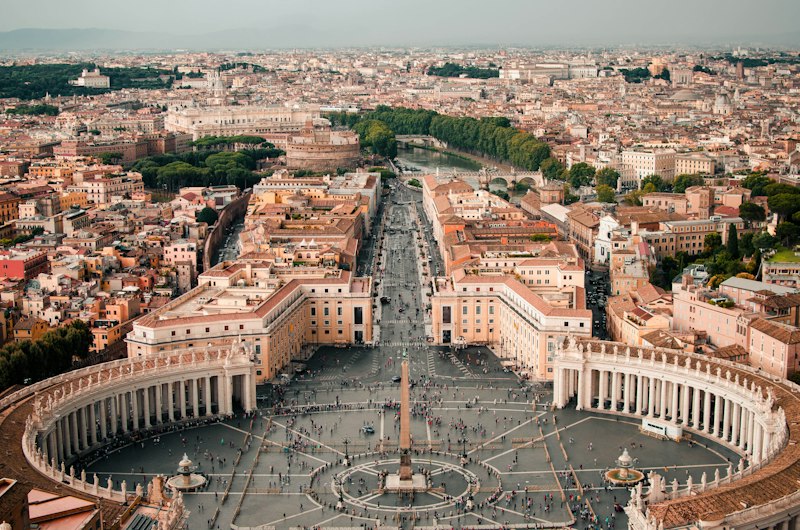
The Vatican is the smallest country in the world by both area and population. It covers less than half a square kilometre — about 70 American football fields — and has a population of around 800 people, fewer than a typical large suburban high school. It is entirely surrounded by Rome, and most of its citizens are clergy, the Swiss Guard, or families directly associated with running the Holy See.
The country has its own postal service, its own bank, its own railway station (with the world's shortest national rail network at 300 metres), its own astronomical observatory, and the Vatican Library — one of the most significant scholarly archives in the world. It also has the world's highest crime rate per capita, an absurd statistical artefact: the resident population is so small that the few pickpocketings of tourists each year produce per-capita numbers that look apocalyptic on paper.
2. Monaco — 2.02 km²
Monaco is the most densely populated country in the world. About 39,000 people live in two square kilometres of Mediterranean coastline. The country is so compressed that residents joke about traffic jams between neighbourhoods that are 400 metres apart. It is famous for two things: the Monte Carlo casino, and being the second-smallest country in the world.
Daily life in Monaco is unusual in several ways. About 30 percent of residents are millionaires, the highest concentration anywhere on Earth. There is no income tax for residents. The country has only one prison (with capacity for 84 inmates) and no airport — air travel happens via helicopter to Nice. Most Monégasques (the term for citizens born in Monaco) are actually a minority in their own country; the population is dominated by French, Italian, British, and other European nationals who have relocated for tax reasons.
3. Nauru — 21 km²
Nauru is a single island in the central Pacific, halfway between Australia and Hawaii. It has a population of about 11,000 people. The country once had the highest per-capita income in the world — in the 1980s — because the entire interior of the island was made of phosphate, formed over millennia from accumulated seabird droppings. When the phosphate ran out, the economy collapsed and the country has been searching for a new economic model ever since.
Today Nauru is largely supported by aid from Australia, in part because it hosts an Australian offshore immigration processing facility. The interior of the island is moonscape-like from the phosphate mining. There is one ring road around the coast and no national capital — Nauru is the only country in the world that does not officially have one. The de facto seat of government is in the district of Yaren.
4. Tuvalu — 26 km²
Tuvalu is nine coral atolls scattered across about 1,400 square kilometres of the Pacific Ocean, but the total land area amounts to only 26 square kilometres. The population is about 11,000. The country is famous for two things: being one of the smallest sovereign states in the world, and being one of the most threatened by sea-level rise. Most of Tuvalu sits less than two metres above sea level, and projections suggest large parts of it could be uninhabitable by the end of this century.
Tuvalu has an unexpected revenue source: its country code top-level domain is .tv, which it leases to streaming platforms and television-related companies worldwide. The lease provides a significant fraction of the national government's annual revenue.
5. San Marino — 61 km²
San Marino is a small republic surrounded entirely by Italy, perched on Mount Titano in the central Italian Apennines. It claims to be the world's oldest continuously surviving sovereign state, founded in 301 CE by a Christian stonemason fleeing Roman persecution. The country has been independent more or less continuously for 1,700 years, surviving the Roman Empire, the Holy Roman Empire, the Papal States, Napoleon, and Italian unification.
About 34,000 people live in San Marino. The country has two co-equal heads of state called captains-regent, elected for six-month terms. The historic capital, also called San Marino, sits on the top of Mount Titano with dramatic views over the Italian countryside. Both Mussolini and the Allies left San Marino independent during World War II — it remained one of the few neutral states in Europe throughout the conflict.
6. Liechtenstein — 160 km²
Liechtenstein is a German-speaking principality wedged between Switzerland and Austria in the Alpine valley of the Upper Rhine. It is one of only two doubly landlocked countries in the world (Uzbekistan is the other) — to reach the sea, you have to cross at least two international borders. The population is about 40,000. The country has no military, no airport, and no border control with either Switzerland or Austria. The reigning Prince Hans-Adam II is the wealthiest monarch in Europe.
Liechtenstein has historically been a tax haven and remains one of the most economically prosperous countries per capita in the world. There is genuinely no rural population in any normal sense — the entire country is essentially one continuous strip of Alpine valley settlement, where the largest city, Vaduz, has about 5,700 residents.
7. Marshall Islands — 181 km²
The Marshall Islands are 29 coral atolls and five solo islands scattered across the central Pacific. The total land area is 181 square kilometres but they spread across roughly two million square kilometres of ocean. The population is about 42,000. The country has a Compact of Free Association with the United States, under which Marshall Islanders can live and work in the US without a visa.
The country includes Bikini Atoll, used by the United States for nuclear testing in the 1940s and 1950s, and Kwajalein Atoll, still a US missile testing range. Like Tuvalu, the Marshall Islands face existential threat from sea-level rise — most of the country sits less than two metres above sea level.
8. Saint Kitts and Nevis — 261 km²
Saint Kitts and Nevis are two Caribbean islands in the Lesser Antilles. The total land area is 261 square kilometres and the population is about 47,000. Saint Kitts and Nevis is the smallest sovereign state in the Americas by both area and population. The country was one of the first European colonies in the Caribbean — the British arrived on Saint Kitts in 1623 — and gained independence in 1983.
Nevis has had a long-running secession movement to leave the federation with Saint Kitts. A 1998 referendum on independence for Nevis fell just short of the two-thirds majority required.
9. Maldives — 300 km²
The Maldives are 1,192 coral islands across 26 atolls in the Indian Ocean, southwest of India. Despite being one of the smallest countries in the world by land area, the maritime territory of the Maldives covers nearly 90,000 square kilometres. The population is about 540,000, the bulk of them concentrated in the capital, Malé — one of the most densely populated cities on Earth.
The Maldives is the lowest country in the world by average elevation — the average natural ground level is about 1.5 metres above sea level, and the highest natural point in the entire country is only about 2.4 metres. The country faces the same existential question as Tuvalu and the Marshall Islands: continued existence depends on dramatic action on climate change in the coming decades.
10. Malta — 316 km²
Malta is a Mediterranean archipelago south of Sicily, consisting of three inhabited islands (Malta, Gozo, Comino) and several smaller uninhabited ones. The total area is 316 square kilometres and the population is about 540,000 — making Malta the most densely populated country in the European Union. Malta has been independent since 1964 and joined the EU in 2004.
Malta's history is genuinely extraordinary: it has been ruled by the Phoenicians, Carthaginians, Romans, Byzantines, Arabs, Normans, Knights Hospitaller, French, and British across roughly 2,800 years of recorded history. The Maltese language is one of only two Semitic languages written in the Latin alphabet (the other being Maltese itself, depending on how you count — it has no close living relatives among Latin-script Semitic languages).
What Microstates Tell Us About Sovereignty
Looking at this list, a few patterns emerge. Most microstates are either island nations (Caribbean, Pacific, Mediterranean) or European mountain enclaves that survived medieval consolidation. Most are wealthy per capita, often dramatically so. Most have unusual political or constitutional arrangements that reflect their long histories. And most are vulnerable, in different ways, to changes in their physical or economic environment — climate change for the Pacific atolls, EU regulation for the European tax havens, tourism cycles for the Caribbean.
From a satellite imagery perspective, microstates are some of the hardest possible rounds in a geography game. They are too small to render distinctively at most zoom levels, and most players never look at them long enough to recognise them. Getting comfortable identifying them by their surrounding context — Monaco as a tiny inlet on the French Riviera, Vatican City as a green-and-stone enclave inside Rome's grid, San Marino as a hilltop in Italian countryside — is one of the small competitive advantages serious EarthGuessr players develop over time. More than that, though, learning about the world's smallest countries gives you a richer sense of just how many ways a piece of territory can become a nation — and how the world's political map is far stranger, and richer, than the giants alone would suggest.