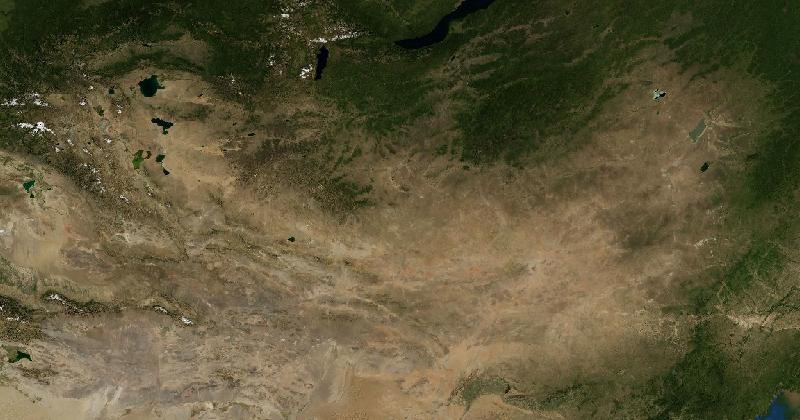
Mongolia is a landlocked giant wedged between Russia and China, and it is the most sparsely populated sovereign country on Earth. That emptiness is exactly what makes it recognizable from orbit: where most countries fill the frame with fields, roads, and towns, Mongolia mostly reads as open space.
The Steppe That Goes On Forever
Most of the country is steppe — vast grassland that runs from green in the north to dry tan further south. The giveaway is what is missing. There is almost no field geometry, because very little of Mongolia is cultivated. That sets it apart from its neighbors: the dense agricultural patchwork of northern China to the south, and the big rectangular fields of southern Siberia to the north. A frame of unbroken, unfenced grassland with no crop mosaic is a strong Mongolia signal.
The Gobi in the South
Travel south and the grass fades into the Gobi Desert. Picture gravel plains and bare rock rather than towering sand dunes — the Gobi is mostly a cold, stony desert, not a Sahara of sand seas. The gradient is the clue: a smooth transition from greener steppe in the north to pale, arid, sparsely marked ground in the south is very characteristic of Mongolia, and it runs the wrong way for most countries, which tend to get greener toward their interiors rather than drier.
Mountains and Forest at the Edges
The flat middle is bracketed by relief. The snow-capped Altai Mountains rise in the west, and the far north shades into Siberian taiga forest around Lake Khovsgol, a dark band of conifers against the open plain. If you see deep green forest and a big clear lake near a Russian-feeling border, you may be on Mongolia's northern fringe rather than in Russia proper.
The Dead Giveaway: Braided Dirt Tracks
Here is the detail that clinches it. With so few paved roads, drivers crossing the open steppe do not follow a single line — they fan out across the ground to avoid the ruts others have worn, leaving multiple parallel dirt tracks braided side by side like the strands of a rope. You rarely see this pattern at scale anywhere else on Earth. Spot a set of braided tracks wandering across empty grassland with no fences or fields and Mongolia should jump to the top of your list.
The Few Hard Lines: Rails and Mines
In all that openness, the rare straight line stands out. The Trans-Mongolian Railway runs north to south through the country as a single thin, purposeful thread linking Russia and China — almost the only continuous engineered line you will see crossing the steppe. The other hard-edged features are mines. Mongolia's economy leans heavily on mining, and huge operations such as the Erdenet copper mine and the Oyu Tolgoi complex in the south show up as sharp geometric scars — terraced pits and tailings ponds, utterly unlike anything natural around them. A lone railway or a sudden industrial gash in empty grassland is a strong supporting clue.
Cities Are Rare — Find Ulaanbaatar
Close to half the population lives in the capital, Ulaanbaatar, so urban clues are scarce and concentrated. The city sprawls along a river valley, ringed by enormous districts of gers — the traditional round felt tents — that give its edges a distinctive speckled texture unlike a typical grid suburb. Away from the capital, settlements are tiny and far apart, often just a cluster of buildings beside a track.
Seasonal Curveballs
One thing to watch: Mongolia's appearance swings hard with the seasons. In deep winter much of the country is under snow, turning the steppe a featureless white that can fool you into thinking you are far north in Russia or Canada. Lean on the structural clues that survive the snow — the braided tracks, the near-total absence of fenced fields, and the ger districts around the capital — rather than colour alone.
Put the clues together — empty steppe, a green-to-tan gradient, mountains and forest on the margins, and those braided tracks — and Mongolia becomes one of the more satisfying countries to nail. Drop into a round of EarthGuessr and see if you can call it before the timer runs out.