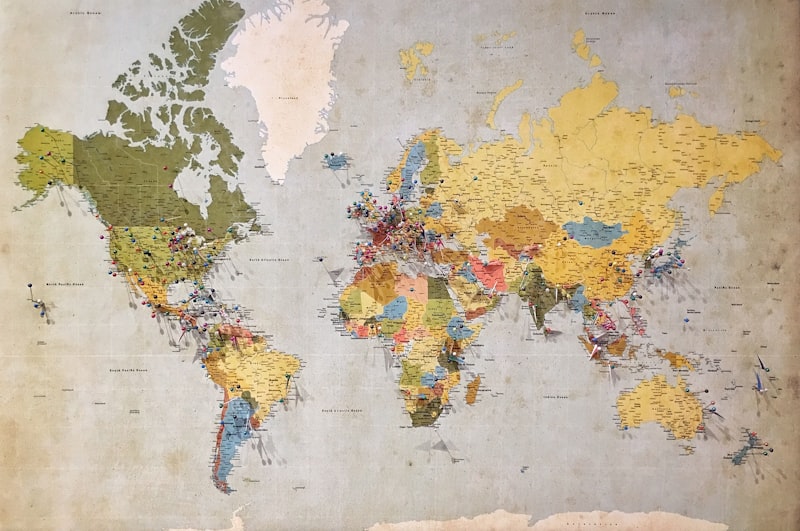
From orbit, most of the world's borders look like reasonable compromises — rivers, mountain crests, neat surveyed lines. Then there are the borders that look like a draftsman lost their mind. Tiny enclaves inside other countries' enclaves. Islands a few kilometres apart that sit on different days of the calendar. Patches of desert that no country wants. Mountain peaks where four nations meet at a single point. These are not cartographic mistakes — they are real, currently active borders that govern real lives, and most of them have stories behind them that genuinely sound made up.
Here are twelve of the strangest borders in the world, and what makes each one such a beautiful piece of geopolitical chaos.
1. Baarle-Hertog and Baarle-Nassau (Belgium and the Netherlands)
On the Belgium-Netherlands border sits a town that has been called the world's most complicated border in miniature. Baarle-Hertog (Belgian) consists of 22 separate enclaves of Belgian territory inside the Netherlands, and inside several of those Belgian enclaves are smaller Dutch counter-enclaves (parts of Baarle-Nassau). The border line cuts through houses, cafés, streets, and back gardens. Some buildings are technically half Belgian and half Dutch, with the border marked by tile lines across the floor. Houses are assigned to one country or the other based on where their front door is.
The arrangement dates back to medieval land deals between the Duke of Brabant and the Lord of Breda in the 12th and 13th centuries, and remarkably has survived essentially unchanged through every modern reorganisation of European borders. Today, you can stand in a café where the Belgian side closes at 11pm and the Dutch side closes at 1am, and locals casually slide their chairs across the tile line at the relevant hour.
2. The Diomede Islands (USA and Russia)
In the middle of the Bering Strait, two small islands sit about 3.8 kilometres apart. The larger one, Big Diomede, belongs to Russia. The smaller one, Little Diomede, belongs to the United States. The International Date Line runs between them. On a clear day, an inhabitant of Little Diomede can look across the water at Big Diomede and see, quite literally, tomorrow.
The two islands have been called "Yesterday Island" and "Tomorrow Island" because the time difference between them is 21 hours despite the actual physical distance being shorter than a typical city block. Big Diomede has no permanent population; Little Diomede has about 80 people. In winter, the strait between them sometimes freezes, and it is technically possible to walk across — though doing so is illegal under both US and Russian law.
3. The Former Cooch Behar Enclaves (India and Bangladesh)
Until 2015, the India-Bangladesh border included one of the most extraordinary tangles of enclaves anywhere in the world. There were 102 Indian enclaves inside Bangladesh and 71 Bangladeshi enclaves inside India. Some of these were counter-enclaves: pieces of one country inside the other, inside the other again. One famous example was Dahala Khagrabari, a piece of India inside a piece of Bangladesh inside a piece of India inside Bangladesh — the only confirmed third-order enclave in the world.
The enclaves were the legacy of pre-colonial land deals between local princes and survived British India, Pakistan, and the 1971 creation of Bangladesh entirely intact. The residents lived in legal limbo: they were nominally citizens of one country but physically surrounded by another, often unable to access schools, hospitals, or government services. The two countries finally settled the situation in 2015 with a major land swap that effectively erased most of the enclaves. It was one of the largest peaceful border simplifications in modern history.
4. Lesotho (Entirely Inside South Africa)
Lesotho is one of only three countries in the world that are completely surrounded by a single other country (the other two are Vatican City and San Marino, both surrounded by Italy). Lesotho sits inside South Africa, occupying a mountainous plateau in the southern African interior. It is sometimes called the Mountain Kingdom — its lowest point is 1,400 metres above sea level, making it the country with the highest lowest point in the world.
From above, Lesotho appears as an irregular oval hole punched through South Africa's eastern interior. The border is not a colonial accident — it is the result of King Moshoeshoe I's successful 19th-century strategy of preserving Basotho sovereignty by retreating into the mountains and negotiating British protection. The country has been independent since 1966 and remains entirely landlocked inside the much larger country surrounding it.
5. The Spanish Exclaves in Morocco
Most people know that Gibraltar is a small piece of British territory on Spanish soil. Far fewer know that Spain has its own equivalent on the other side of the Mediterranean: two cities and several uninhabited islets on the Moroccan coast. Ceuta and Melilla are full Spanish cities — with Spanish language, Spanish currency, Spanish EU membership — surrounded by Morocco. Morocco claims both as its own territory; Spain insists they have been Spanish since before Morocco existed as a state (they were Spanish from the 15th and 16th centuries respectively).
There is also Peñón de Vélez de la Gomera, a Spanish military island so close to the Moroccan coast that it is connected by a narrow sandbar. This makes the border between Spain and Morocco there technically a strip of sand — and it occasionally moves with the tides. After a 2012 storm, the sandbar shifted, briefly making Peñón de Vélez slightly larger.
6. Bir Tawil — The Land No One Wants
Between Egypt and Sudan lies a roughly 2,060 square kilometre patch of desert called Bir Tawil. It is one of the only pieces of habitable land on Earth that is currently unclaimed by any country. The reason is a quirk of colonial history: there are two different border lines between Egypt and Sudan — one from 1899 and one from 1902 — and each country prefers the line that gives it the larger and more valuable Hala'ib Triangle on the Red Sea coast.
By taking the line that gives them Hala'ib, both countries effectively renounce claim to Bir Tawil. Neither will accept it, because accepting it would mean accepting the other line and losing Hala'ib. So Bir Tawil sits in legal limbo. Various individuals have attempted to claim it as their own micronation — a man from Virginia famously planted a flag there in 2014 and declared his daughter "Princess of North Sudan" — but none of these claims are recognised by anyone.
7. The Caprivi Strip (Namibia)
Look at a map of Namibia. The country is roughly rectangular, except for an absurdly long, narrow strip sticking out of its northeastern corner like a tail or a finger pointing eastward. This is the Caprivi Strip, and it is roughly 450 kilometres long and 30 kilometres wide. It exists because the German Empire wanted access to the Zambezi River when carving up southwest Africa in the 1890s.
The Caprivi Strip never actually reached the Zambezi in a usable way (Victoria Falls turned out to block downstream navigation), so the geographic strategy failed. But the border lines were drawn, and they have remained ever since — leaving Namibia with one of the most distinctive country shapes on Earth.
8. The Korean Demilitarized Zone
The DMZ between North and South Korea is one of the most heavily armed borders in the world, but the strange part is what is inside the four-kilometre-wide buffer zone itself: an unintentional nature reserve. Because almost no humans have entered the DMZ for over 70 years, it has become a sanctuary for wildlife that has been extirpated elsewhere on the peninsula — including Asiatic black bears, red-crowned cranes, Amur leopards, and what may be the last remaining Korean tigers. The same land that represents one of the world's most dangerous geopolitical fault lines is also one of the most ecologically valuable patches of intact temperate ecosystem in Northeast Asia.
9. The Quadripoint at the Zambezi (Botswana, Namibia, Zambia, Zimbabwe)
Most international borders meet at tripoints — places where three countries share a single point of border. There is exactly one possible quadripoint in the world (where four countries' borders meet at a single point) and it is located in the middle of the Zambezi River where Botswana, Namibia, Zambia, and Zimbabwe come together. Or possibly it does not exist at all — the four countries disagree on whether the borders truly meet at a single point or whether there are actually two tripoints separated by a few hundred metres of river. The dispute has been quiet but unresolved for decades.
10. The Saudi-Yemen "Empty Quarter" Border
Across the Rub' al Khali (the Empty Quarter, the largest contiguous sand desert on Earth), the border between Saudi Arabia and Yemen runs in some sections as nothing more than a vague administrative line on a map. There are no border posts, no fences, no roads, no markers — just thousands of square kilometres of dunes through which Bedouin tribes have moved for centuries. The border was formally agreed only in 2000, and parts of it remain ambiguous in practice. From satellite imagery, it is invisible.
11. The Triple Frontier (Brazil, Argentina, Paraguay)
Where the Iguazu and Paraná rivers meet, three countries' borders converge at a single dramatic point — and the cities on each side have grown into a single tri-national economic zone. Foz do Iguaçu (Brazil), Puerto Iguazú (Argentina), and Ciudad del Este (Paraguay) function almost as one urban region, connected by international bridges across both rivers. Standing on the Brazilian side, you can see two foreign countries simultaneously. Walking across either bridge takes you into a completely different legal system, currency, and language within minutes.
12. The Crimea Question and Other Frozen Disputes
A surprising number of the world's borders are technically disputed but practically frozen. Kashmir is split between India, Pakistan, and China, with each country's official maps showing different boundaries. Crimea is internationally recognised as part of Ukraine but administratively controlled by Russia. Western Sahara is largely controlled by Morocco but recognised as a separate territory by most of Africa. Nagorno-Karabakh's status changed dramatically in 2023. Taiwan's status varies depending on which government's maps you are looking at. None of these are technically "strange" borders in the same sense as Baarle-Hertog, but they are reminders that the political map of the world is not the same map in every capital.
Why Strange Borders Exist At All
Most of the world's strangest borders share a common origin: they were drawn before the modern era of state administration, often as the byproducts of medieval land deals, colonial conferences, or local family inheritances. When modern nation-states inherited these borders, they tended to leave them alone — partly out of inertia, partly because changing them would require complicated negotiations that no one had much appetite for. The result is a planetary surface where most borders are straightforward but the occasional patch is a thicket of geopolitical history compressed into a few square kilometres.
From a satellite imagery game perspective, these borders are some of the most rewarding to learn about. The Caprivi Strip is unmistakable on any map. Lesotho stands out as a hole in South Africa. The Spanish exclaves are tiny but visible. Each one is a clue you can use when a round in EarthGuessr drops you near a known oddity. More than that, though, they are reminders that geography is not just topography — it is also history, congealed into lines on a map that, looked at closely, often make no sense at all.