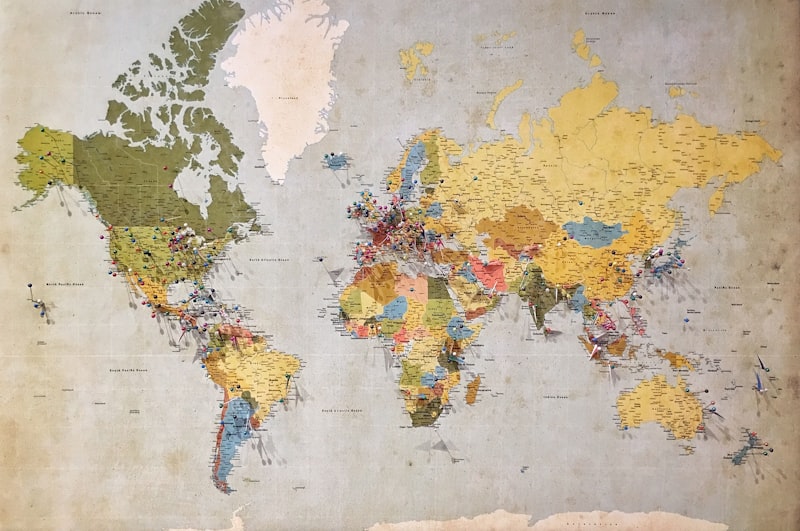
A contour map, a satellite image, and a globe show different information. A map-skills lesson can compare those representations of the same place: what is labelled, what is visible, and what has been simplified.
What Has Changed — and What Has Not
The fundamentals of spatial reasoning have not changed. Students still need to understand scale — the relationship between distances on a representation and distances in the real world. They still need to understand direction, projection, and the difference between a map and the territory it represents. These concepts are not artifacts of paper cartography; they are the underlying logic of all geographic representation, digital or otherwise.
What has changed is the landscape of geographic tools that students will actually use, and the kinds of geographic reasoning those tools require. GPS navigation, satellite imagery analysis, interactive 3D globes, GIS platforms, real-time environmental monitoring data — these are the map tools of the present and the future. Teaching only paper map skills is a bit like teaching typing only on a manual typewriter: the underlying skill transfer is real, but the tool mismatch creates unnecessary gaps.
The Core Modern Map Skills
- Satellite image interpretation: reading terrain, vegetation, land use, settlement patterns, and climate indicators from overhead imagery. This is a distinct skill from map reading and requires its own practice.
- Projection literacy: understanding that all flat maps distort reality, being able to identify common projection types, and knowing when to use a globe versus a flat map for a given purpose.
- Scale switching: the ability to move fluidly between local, regional, and global scales while maintaining spatial orientation — critical for digital mapping tools where zoom level changes constantly.
- Coordinate systems: understanding latitude and longitude as a practical system, not just a textbook definition. Can a student enter coordinates and find a location? Can they estimate a place's coordinates from context?
- Spatial analysis basics: interpreting patterns in geographic data — where things cluster, where they are absent, and what that distribution might mean.
- Digital navigation: reading turn-by-turn navigation output while maintaining an understanding of broader spatial context.
Where EarthGuessr Fits In
EarthGuessr's 3D globe interface directly addresses several of the modern map skills listed above. Placing a guess requires students to work with a globe — not a flat map — developing intuitive spatial understanding that is free from Mercator distortion. The coordinate feedback after each round connects abstract latitude and longitude numbers to real places. The satellite imagery requires active visual interpretation. And the act of reasoning about an unfamiliar location and committing to a judgment is itself a form of spatial analysis practice.
None of this replaces teaching contour lines or grid references — those skills transfer directly to topographic map reading, which remains genuinely useful. The argument is not that paper maps are obsolete, but that they are insufficient on their own. A 45-minute lesson that begins with paper map work, transitions to a structured EarthGuessr session, and ends with students locating today's round results using coordinates covers more geographic ground — and engages more kinds of spatial thinking — than either activity alone.
A Suggested Scope and Sequence for Modern Map Skills
- Grade 5-6: Basic direction, scale, and coordinate reading on paper maps. Introduction to globes as more accurate than flat maps. First exposure to satellite imagery as a geographic source.
- Grade 7-8: Map projection comparison and why flat maps distort. Satellite image interpretation as a structured skill. Introduction to digital globe tools — use EarthGuessr for structured exploration.
- Grade 9-10: GIS concepts and basic spatial analysis. Climate zone identification from satellite imagery. Deeper understanding of coordinate systems and geographic data.
- Grade 11-12: Applied geographic information — reading real-world satellite data, understanding map-based arguments in policy and journalism, using geographic tools for independent research.
Ask students to choose a map for a specific job and explain the choice. Measuring an area, tracing a walking route, and inspecting land cover may call for different sources.