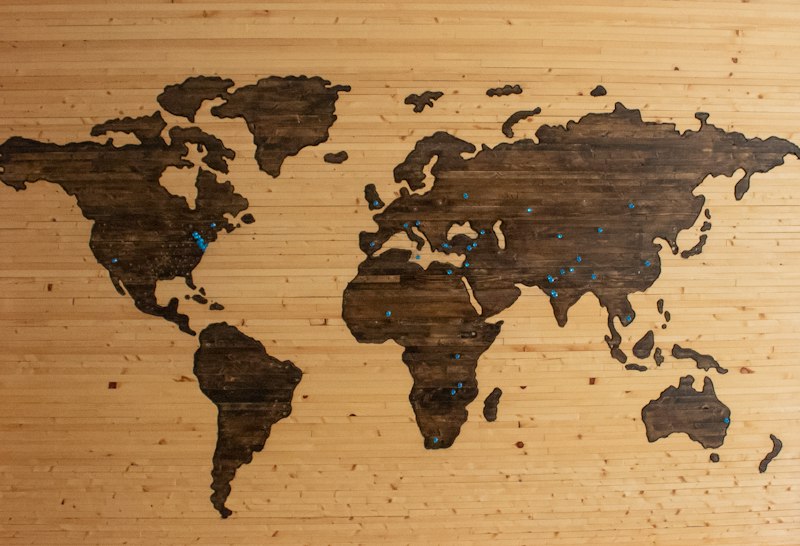
There is a particular kind of geography test that exposes how shallow most adult geographic knowledge actually is. Take a printed world map. Remove every label, every border colour, every country name. Now ask someone to point to Mozambique, or Kyrgyzstan, or Suriname. The same person who can confidently say all three are real countries will often have no idea where to put their finger.
Country-shape recognition is the geographic skill of identifying a country purely from its outline — the way its borders draw a unique silhouette on the surface of Earth. It sounds like trivia, but it is one of the few geography skills that genuinely sticks once you learn it, and it transfers directly to almost every other form of geography game: street-view guessers, satellite guessers, country-pointing quizzes, news map reading, and travel.
Better still: country shapes are surprisingly memorable once you commit to learning them. This article walks through the systematic way to do that — easy countries first, then mid-difficulty, then the hard ones, with a few specific tricks per region.
The 15 Easiest Country Shapes in the World
Some country shapes are so iconic that anyone who has spent even a few minutes looking at a world map already knows them. Lock these in first — they become anchor points for learning everything else.
- Italy — the boot. Probably the single most recognisable country outline in the world.
- Chile — the long ribbon down the western edge of South America, about 4,300 km long but rarely more than 200 km wide.
- Norway — the carved, fjord-fragmented western edge of Scandinavia.
- Japan — the elegant curve of four main islands strung along the western Pacific.
- India — the unmistakable triangular peninsula pointing into the Indian Ocean.
- Madagascar — the large island off Africa's southeast coast, like an oversized tear-drop.
- United Kingdom — the split shape of Great Britain plus Northern Ireland, with Scotland's jagged top.
- Cuba — the long, thin Caribbean island that looks like a sleeping animal.
- Sri Lanka — the rounded teardrop off India's southeastern tip.
- Australia — a continent in its own right, instantly recognisable.
- Iceland — the cracked-looking volcanic island in the North Atlantic.
- Greenland — the enormous, lopsided ice mass; deceptively large on Mercator maps.
- South Korea — the southern half of the Korean peninsula, rounded and roughly square.
- New Zealand — two long islands south-east of Australia.
- France — broadly hexagonal, with a clear coastline on three sides.
Once you can reliably identify these fifteen on a blank map, you have visual anchor points that you can use to locate harder neighbours. Italy anchors the Mediterranean. India anchors south Asia. Chile anchors South America's western edge. Japan anchors East Asia. Each anchor lets you reason about its neighbours by relative position.
Mid-Difficulty Country Shapes (And the Trick for Each)
After the easy fifteen, the next set of countries take a little more effort but reward simple memorisation tricks.
- Brazil — looks like a roughly diamond shape covering most of eastern South America. Trick: the bulge into the Atlantic on the eastern side is unique.
- Argentina — a long tapering shape down to the southern tip of South America. Trick: it almost touches Antarctica.
- Turkey — looks like a rough rectangle bridging Europe and Asia. Trick: the small European corner around Istanbul on the upper left.
- Egypt — a tidy square in the northeast corner of Africa. Trick: the Sinai Peninsula juts into Asia like a small triangle.
- South Africa — a roughly oval country at the southern tip of Africa, with Lesotho as a tiny hole in the middle.
- Saudi Arabia — a roughly rectangular block dominating the Arabian Peninsula.
- Iran — sits like a stretched rectangle in the Middle East, framed by the Caspian Sea above and the Persian Gulf below.
- Spain — looks like a near-square in the southwest corner of Europe, distinguished by the Iberian Peninsula's distinct outline.
- Mexico — a sweeping curve from the US border down to a thin southern arm pointing east.
- Russia — the largest country shape in the world, stretched across eleven time zones; impossible to mistake at any scale.
- China — a chunky rough shape covering most of East Asia; the Taklamakan desert and Tibetan plateau give it a distinct two-zone look on physical maps.
- Indonesia — a long string of thousands of islands, but the big ones (Sumatra, Java, Borneo, Sulawesi) anchor recognition.
- Philippines — an archipelago of around 7,000 islands, mostly arranged in three rough clusters.
- Vietnam — a slim, S-shaped country curving along the eastern edge of mainland Southeast Asia.
- Thailand — an unmistakable shape that looks like the head and trunk of an elephant pointing south.
The Genuinely Hard Country Shapes
Now the difficult set. These are countries whose shapes are either small, similar to neighbours, or unfamiliar to most people who grew up outside the region. The trick for these is almost always relational — you do not memorise them in isolation, you memorise them as part of a group, so the relative shapes lock into place together.
The Five Central Asian -stans
Kazakhstan, Uzbekistan, Kyrgyzstan, Tajikistan, and Turkmenistan are notoriously hard to keep straight. Trick: Kazakhstan is by far the largest, dominating the northern half of the region. Uzbekistan is the doubly-landlocked country in the middle. Turkmenistan is on the southwest, touching the Caspian Sea. Kyrgyzstan and Tajikistan are the two smaller mountain countries on the eastern edge, with Kyrgyzstan to the north and Tajikistan to the south. Memorise the layout once and the individual shapes follow.
The West African Coast
Senegal, The Gambia, Guinea-Bissau, Guinea, Sierra Leone, Liberia, Côte d'Ivoire, Ghana, Togo, Benin, Nigeria. These eleven countries are the famous West African "bulge" and they fit together along the coast like puzzle pieces. Trick: Senegal almost fully surrounds The Gambia. Nigeria is the giant on the eastern edge. Togo and Benin are the two narrow vertical countries that look like adjacent rectangles between Ghana and Nigeria. Once you can identify the start (Senegal) and the end (Nigeria), the rest fall into sequence.
The Central African Block
Cameroon, Central African Republic, Chad, Sudan, South Sudan, Democratic Republic of Congo, Republic of Congo, Gabon, Equatorial Guinea. The trick here is the Congo River basin and the heart-of-Africa shape: the DRC dominates the middle of the region. Chad has a distinctive elongated shape running south from the Sahara. Cameroon has a slim eastern "stem" that points up toward Lake Chad.
The Caucasus and the Levant
Georgia, Armenia, Azerbaijan, Lebanon, Syria, Jordan, Israel, Palestine. These are small countries packed into a small region, with strong individual shapes that get confused because they all sit close together. Trick: Lebanon is the small coastal sliver. Israel is the slightly larger coastal country to its south. Jordan sits inland from Israel. Syria curves around Lebanon from the north. Georgia, Armenia, Azerbaijan form a vertical stack in the Caucasus, with Georgia on top, Armenia tucked in the southwest, and Azerbaijan stretching east toward the Caspian.
How to Practice
Three approaches work better than any others, and combined they will move you from the first 15 to the hardest countries in a few weeks of light practice.
- Play Worldle every day. It takes two minutes and gives you a structured daily exposure to a random country shape. The Wordle-style feedback (distance and direction to the answer) trains your spatial intuition alongside your shape recognition.
- Use Seterra or another country-pointing quiz to drill country positions on a map. Shape recognition is much easier when you already know where in the world each country sits.
- Play a satellite guesser like EarthGuessr a few times a week. Satellite imagery games force you to place pins on a globe, which means you are constantly looking at country shapes in context. The skill develops as a side effect of having fun.
The combination is more powerful than any single tool. Worldle builds the daily habit and trains pure shape recognition. Seterra anchors the positions. EarthGuessr puts the skill to work in a real geographic context. Within a few months of casual practice, most players who follow this combination can correctly identify well over a hundred country shapes — a level of geographic literacy that almost no traditional school curriculum produces.
Why This Skill Is Worth Building
Country-shape recognition is one of those skills that sounds like trivia and turns out to be the foundation of broader geographic competence. Once you can recognise countries by shape, you start noticing them in news photographs, in journal articles, in travel writing, in the corner of weather maps. The world becomes more legible. You no longer have to glance at the label every time a country is mentioned — you know where it is, what shape it is, and what is around it. That is what real geographic literacy feels like, and it starts with the simple act of looking at outlines until they become as familiar as the alphabet.