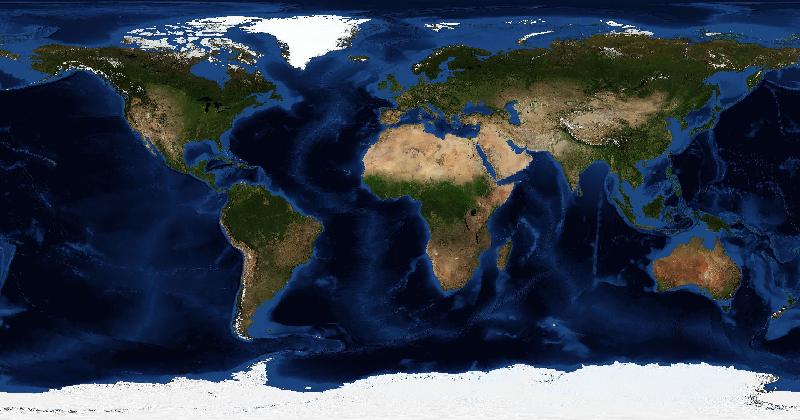
Most of us carry a mental map of the world built from classroom Mercator projections, political maps that emphasize borders over terrain, and the particular vantage points our education gave us. That map is full of errors. Countries are in the wrong places relative to each other. Continents are the wrong size. Directions are skewed in ways that feel counterintuitive until you check a globe. Here are fifteen geography facts that will force you to recalibrate the map in your head.
Size and Scale
- Africa is larger than China, the USA, India, and most of Europe combined. Africa's 30.37 million sq km dwarfs almost every comparison. Yet on a standard Mercator map, it appears roughly comparable to Greenland, which is 14 times smaller.
- Russia spans 11 time zones. Flying from Moscow to Vladivostok takes roughly the same time as flying from London to New York — and you have not left the country. Russia covers 11% of all the world's land area.
- Alaska is larger than the next three biggest US states combined. Texas, California, and Montana together are still smaller than Alaska. The Mercator projection makes Alaska look comparable to the lower 48 — it is roughly one-fifth their combined size.
- The Sahara Desert is almost exactly the same size as the contiguous United States. At 9.2 million sq km vs 9.6 million sq km, they are near-perfect twins in area — a comparison almost no one intuitively grasps.
- Australia is wider than the moon. The moon's diameter is 3,474 km. Australia's width from east to west is about 4,000 km. The country is literally wider than the moon.
Location and Direction
- Los Angeles is further east than Reno, Nevada. The coast of California runs northwest-southeast, not north-south. San Diego is at roughly the same longitude as Denver, Colorado.
- The western tip of Europe (Portugal) is at roughly the same longitude as the eastern tip of Canada. This is why Columbus's transatlantic route worked — he sailed southwest from the Canary Islands, not due west.
- South America is almost entirely east of North America. Due south of New York City is not the Amazon — it is the South Atlantic Ocean. The entire South American continent sits well to the east of most people's mental map.
- Rome is further north than New York City. Rome sits at about 42 degrees north latitude; New York at 40.7 degrees north. Most of Western Europe is at the same latitude as Canada, kept mild by the Gulf Stream.
- Cairo, Egypt, is at the same latitude as Houston, Texas — about 30 degrees north. Most people picture Cairo as being much further south than a major southern US city.
Borders and Oceans
- Canada has the world's longest coastline, at 202,080 km — longer than the next three countries combined. When you include all the islands, bays, and inlets, Canada's coastline defies easy comprehension. For comparison, the USA's coastline is about 19,924 km.
- The Mediterranean Sea will eventually close. Africa is moving northward at roughly 2 cm per year and will collide with Europe in approximately 50 million years, closing the Mediterranean and building a new mountain range.
- There are more lakes in Canada than in all other countries combined. Canada contains an estimated 60% of the world's total lake water, left behind by retreating glaciers on the Canadian Shield.
- The Pacific Ocean is larger than all the world's land masses combined. At 165 million square kilometers, the Pacific covers more area than every continent added together. It contains roughly 25,000 islands.
- Four countries share a land border with only one other country: Portugal (Spain), Denmark (Germany), Vatican City (Italy), and San Marino (also Italy). Canada and the USA share the world's longest land border at 8,891 km.
Why These Facts Matter
These are not mere trivia. The mental map we carry around shapes real-world decisions — about trade routes, about climate projections, about geopolitical relationships. When you know that Rome is as far north as New York but has a Mediterranean climate because of the Gulf Stream, you understand something fundamental about how ocean currents shape civilization. When you understand that Africa is larger than the USA and China combined, you understand why it contains more linguistic diversity, more ecological variety, and more natural resources than any other continent.
EarthGuessr is built on exactly this premise: that exploring real satellite imagery on a true 3D globe builds a more accurate mental model of Earth than any textbook or map can provide. When you are dropped above a satellite image and have to reason your way to a location, you are forced to engage with real geography — distances, scale, terrain, climate — rather than memorized facts. Every round recalibrates the map in your head a little more. After enough rounds, these 15 facts stop being surprising and start being obvious. That is when you know your geography is working.