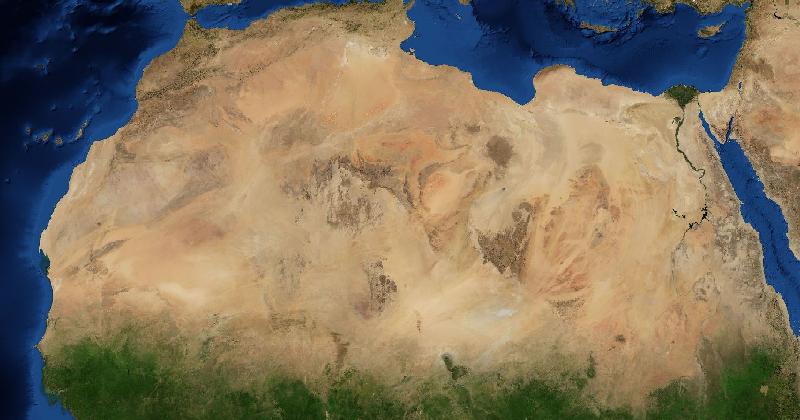
The Sahara Desert is the largest hot desert on Earth, covering approximately 9.2 million square kilometers across North Africa. That is larger than the contiguous United States. It spans eleven countries, from the Atlantic coast of Mauritania to the Red Sea shores of Sudan and Egypt, and from the Mediterranean coast in the north to the Sahel savanna in the south. From orbit, it is one of the most visually dramatic features on the entire planet — and it looks nothing like most people expect.
The popular image of the Sahara is an endless ocean of sand dunes. That image is real, but it represents less than 25% of the desert's total area. The Sahara from space is a landscape of extraordinary variety: ancient volcanic mountains, vast gravel plains, dramatic sand seas, salt flats that gleam white from hundreds of kilometers up, and hidden river valleys that speak of a wetter, greener past.
The Color Palette of the Sahara
The first thing that strikes you about the Sahara in satellite imagery is not the sameness — it is the variety of color. In a single orbit pass, you can see pale cream sand, orange-red iron-rich rock, grey volcanic massifs, white salt flats, and — in the few places where groundwater reaches the surface — vivid green oasis vegetation. The central Sahara is dominated by the Ahaggar and Tibesti mountain ranges, which rise to over 3,000 meters and appear as dark, textured masses of ancient volcanic rock completely unlike the sand-flat imagery of the surrounding desert.
The sand seas — called ergs — are the Sahara's most iconic feature. The Grand Erg Oriental and Grand Erg Occidental in Algeria, and the Erg Iguidi on the Mali-Algeria border, are among the largest. In true-color satellite imagery, they appear as warm tan or orange surfaces with extraordinarily regular wave-like patterns. Star dunes — formed where winds blow from multiple directions — can reach 300 meters in height and are visible from orbit as multi-pointed starbursts against the plain.
The Green Sahara: A Desert With a Past
One of the most remarkable things revealed by satellite and radar imagery of the Sahara is a network of ancient river valleys buried under the sand. Called paleochannels, these ghost rivers crisscross the desert in patterns that mirror the drainage networks of today's humid tropics. They are evidence of the African Humid Period — sometimes called the Green Sahara — a period roughly 11,000 to 5,000 years ago when the Sahara received far more rainfall, supported forests and grasslands, and was home to abundant wildlife and human populations.
Rock art found in the now-hyperarid interior of Libya, Niger, and Algeria depicts hippos, crocodiles, cattle, and swimming humans — animals and activities impossible in the modern desert. The radar instruments on the Space Shuttle in 1981 penetrated the dry sand and revealed buried river channels up to 10 meters below the surface, confirming what the rock art had already suggested. The Sahara is not a permanent desert. It pulses between wet and dry phases on roughly 20,000-year cycles driven by changes in Earth's orbital tilt.
The Sahara's Relationship With the Amazon
From orbit, it is possible to see one of the most consequential long-distance relationships in Earth's climate system. Each year, the Sahara exports an estimated 182 million tons of dust westward across the Atlantic Ocean. Trade winds pick up the fine particles from the desert surface and carry them thousands of kilometers, eventually depositing them over the Amazon Basin. This Saharan dust is the primary source of phosphorus fertilizing the Amazon rainforest — a nutrient that the highly leached tropical soils cannot generate locally in sufficient quantities. The world's largest desert and the world's largest rainforest are intimately connected by wind.
Human Presence in the Sahara From Orbit
Despite its extreme aridity, the Sahara has sustained human populations for millennia, and their presence is visible from space. The Nile Valley cuts through the eastern Sahara as a strip of vivid green — irrigated farmland barely a few kilometers wide threading through hundreds of kilometers of desert. Libya's vast underground aquifer system, pumped by the Great Man-Made River project, feeds circular fields of irrigated agriculture that dot the desert floor like green coins. Ancient trans-Saharan caravan routes are sometimes traceable as faint lines across the gravel plains, worn into the desert surface by millennia of camel traffic.
Recognizing the Sahara in Satellite Imagery
For players of EarthGuessr and anyone learning to read satellite imagery, the Sahara has distinctive signatures that make it identifiable even from partial views. The color is warmer and lighter than most other deserts — pale cream to orange-tan, rather than the red of Australia's interior or the grey-brown of the Gobi. The dune patterns are larger and more regular than most other sand deserts. And crucially, the Sahara's surrounding context is unique: to the north, the Mediterranean Sea and the narrow coastal green strip of Tunisia, Libya, and Egypt; to the south, the gradual transition to the Sahel's savanna; to the east, the Nile's unmistakable green corridor.
The Sahara appears in EarthGuessr rounds more often than any other desert biome, simply because of its enormous size. Learning to distinguish its internal sub-regions — the rocky Tibesti massif from the sandy Grand Erg, the Nile-adjacent eastern desert from the Atlantic-facing western Sahara — is one of the most rewarding geography skills you can develop for satellite imagery games.