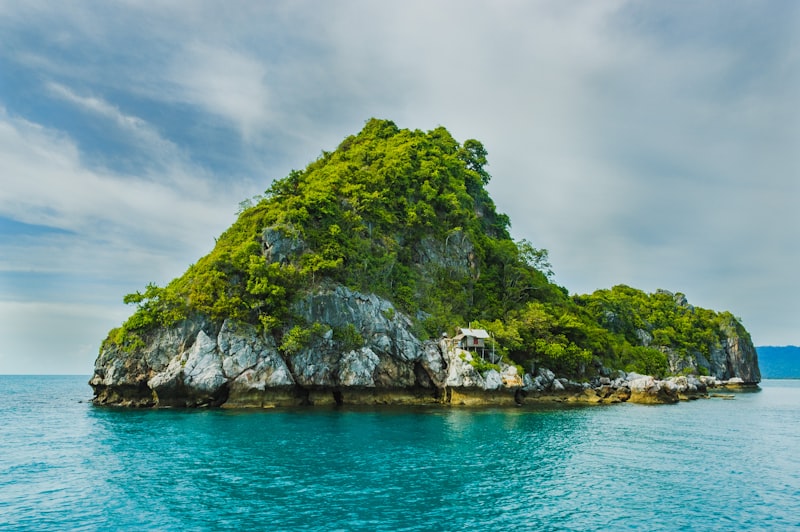
Coastlines are the most legible feature on the planet. Where ocean meets land you get one of the highest-contrast lines visible from orbit, and the shape of that line tells you almost everything about how the coast was made — by glaciers, by rivers, by waves, by tectonics, by coral. A trained eye can place a piece of coastline within a region in seconds, sometimes within a country, just from the geometry of the shoreline. This is a guide to the major coastline types, how each one forms, and what they look like from above.
Fjord coastlines
A fjord is a glacially-carved valley flooded by the sea after the ice retreated. The diagnostic features are long parallel inlets reaching far inland, steep-sided walls, deep water, and a U-shaped cross-profile when you cut across one. Fjord coastlines are unmistakable from orbit: a series of long fingers of dark blue water reaching tens of kilometres into mountainous land, often arranged in roughly parallel orientations because the ice flowed in roughly parallel directions.
The classic fjord coasts are Norway, Greenland, Chile (south of Puerto Montt), New Zealand's South Island west coast, British Columbia, southern Alaska, and Iceland. Fjords almost always sit at high latitudes — they require past glaciation, which means somewhere that was cold enough to support continental ice sheets within the last hundred thousand years. If you see a fjord-shaped coast at low latitudes, it is almost certainly not a true fjord but a tectonic ria.
Ria coastlines
A ria is a river valley flooded by rising sea levels — similar in shape to a fjord but formed by water rather than ice. Rias tend to have a dendritic (branching, tree-like) pattern, because that is the shape of a river system. They are typically shallower, less steep-sided, and located outside the glacial zones.
The defining ria coast is Galicia in north-west Spain, which gave the landform its name. Brittany in France, Devon and Cornwall in England, Chesapeake Bay in the United States, and Sydney Harbour in Australia are all ria systems. Rias are common on passive continental margins where rivers cut valleys that the sea later submerged.
Barrier islands and coastal plain coasts
Where a flat, sediment-rich coastline meets a long-shore current, the system tends to produce barrier islands — long, narrow, sandy islands running parallel to the shore, separated from the mainland by a lagoon or estuary. Barrier coasts are diagnostic of low-relief sedimentary coastlines and are remarkably easy to spot from above: a thin, almost ruler-straight line of beach with a lagoon behind it.
The longest barrier island chain in the world is the Outer Banks and the broader east coast of the United States from New Jersey to Florida. The Nehrungen of the southern Baltic — the Curonian Spit in Lithuania and Russia, the Hel Peninsula in Poland — are some of the most photogenic examples. Brazil from Rio Grande do Sul down through Uruguay has a near-continuous barrier system. So does the Gulf coast of Mexico from Texas down to Veracruz. The pattern is consistent: low-lying mainland, parallel sandy island, brackish lagoon between them.
Delta coasts
A delta is the depositional landform produced where a river loaded with sediment meets a relatively calm sea. The shape varies considerably depending on the balance between river flow, wave action, and tidal range, but all deltas share one feature visible from orbit: the river splits into multiple distributary channels that fan out into the sea, often creating a roughly triangular or arcuate shape (the word "delta" comes from the Greek letter Δ).
- Arcuate deltas have a smooth, curved outer edge. The Nile delta is the classic example — symmetrical, fan-shaped, with multiple distributaries. The Niger delta in Nigeria follows a similar pattern but on a vastly larger scale and with more visible vegetation.
- Bird's-foot deltas have channels that extend far into the sea like long fingers. The Mississippi delta is the textbook example. Bird's-foot shape requires very high sediment supply and very weak wave action.
- Cuspate deltas form where wave action is strong enough to push sediment into a single point. The Tiber delta in Italy and the Ebro delta in Spain are well-known examples.
- Tide-dominated deltas form where tidal currents redistribute sediment into long sand bars parallel to the tide flow. The Ganges-Brahmaputra delta is the largest example on the planet.
Mangrove coasts
Where tropical or subtropical sediment-rich coastlines are protected from heavy wave action, mangroves take over the shoreline. From satellite imagery, a mangrove coast reads as dark, almost black-green vegetation extending right into the water, with a fine-grained texture that looks like the coast is "fuzzy" rather than sharp. Look for visible tidal channels cutting through the mangroves in branching patterns, and look for an absence of beach — mangroves replace beach in their preferred climate.
The largest continuous mangrove forests are the Sundarbans on the India-Bangladesh border, the coastal Niger delta, the Pacific coast of Colombia, the south coast of Borneo, and much of the Caribbean and Florida coast. Mangroves are a strong climate signal: they only grow in places where the coldest month averages above about 20 °C, so seeing mangroves tells you the climate as much as it tells you the land use.
Coral reef coastlines
Coral reefs produce some of the most striking coastline imagery on the planet. A reef shows up as a bright turquoise zone of shallow water just offshore, with the deep blue of open ocean beyond. The classic geometry comes in three flavours: fringing reefs (attached directly to the shore), barrier reefs (separated from the shore by a lagoon), and atolls (ring-shaped reefs around a former island that has subsided beneath the sea).
The Great Barrier Reef off the Australian coast is the largest reef system on the planet, visible as a roughly parallel band of bright shallow water hundreds of kilometres offshore from Queensland. The reefs of the Maldives, the Tuamotus in French Polynesia, the Marshall Islands, and the Bahamas show the full range of atoll and lagoon forms. Reefs are a tropical-only feature — they require warm, clear, low-nutrient water — so seeing one tells you the latitude.
Volcanic coasts
Coastlines around active or recently-active volcanic islands have a distinctive look: dark basalt cliffs running straight into the sea, often with very little beach, and sharp angular shoreline geometry. Iceland, Hawaii, the Canaries, the Azores, Réunion, La Palma, and parts of the Aeolian islands all show this pattern. Older volcanic islands soften over time as wave action carves bays and produces black-sand beaches.
Volcanic coasts often have characteristic features visible from orbit: lava flows reaching the sea (visible as dark fan-shaped extensions of the coastline), young calderas partially flooded by the sea (Santorini being the most famous example), and circular shoreline indentations marking past collapse events.
Tectonic coasts
Where coastlines coincide with active tectonic boundaries, you get steep, fault-controlled shorelines with long straight stretches and abrupt changes in direction. The Pacific coast of the Americas — Chile, the western United States, much of Mexico — shows this pattern. So does the eastern Mediterranean, where the Anatolian and Levantine coasts are heavily controlled by fault geometry.
Tectonic coasts are typically narrow and steep, often with no continental shelf to speak of. Deep water arrives very close to shore. This is the opposite of the broad sedimentary coasts of the eastern United States or the Argentinian shelf, where the seabed slopes gently for hundreds of kilometres before reaching the abyssal plain.
Putting it all together
Any piece of coastline you see in a satellite image is some combination of the above patterns. A glaciated coast with rias inside it, a barrier system on top of an old delta, a mangrove forest hugging a coral lagoon — most real coastlines are layered. The reading is faster than it sounds: a few seconds is enough to spot the dominant pattern, which constrains the geography enormously before you start looking at vegetation, settlement, or any other cue.
For practice, pick a coastline you do not know well and try to name the dominant landform first — "this is a barrier island system" or "this is a fjord coast" — before checking. Most of the planet's coast is one of seven or eight distinct types. Once you can name the type confidently, the rest of the geography falls into place.