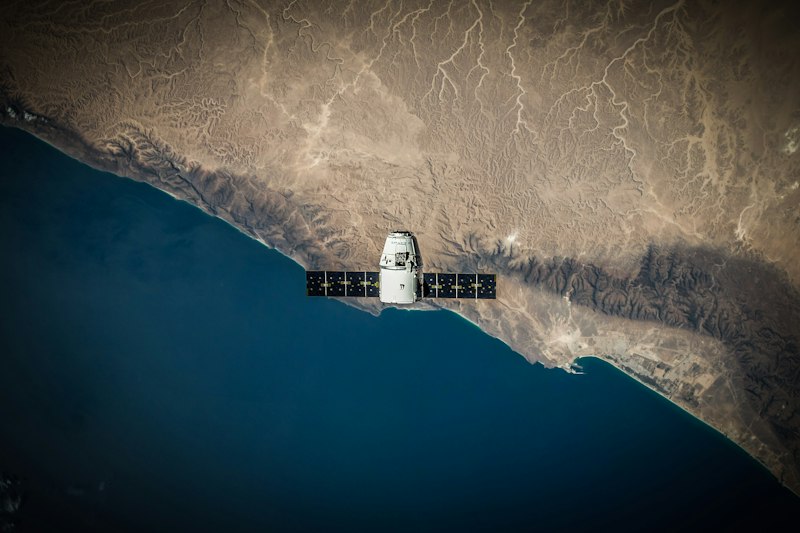
For most of the twentieth century, geography classrooms looked the same. A pulled-down wall map of the world. A globe in the corner. A photographic atlas if you were lucky. The information was abstract by necessity: nobody had a way to actually look at a particular place. You could read about the Sahara, but you could not show your class what the Sahara looked like from above this week.
Free satellite imagery changed that. The arrival of Google Earth in 2005, the Landsat archive going open in 2008, and the proliferation of high-resolution commercial imagery in the years since have done more to reshape how geography is taught than any curriculum reform of the same period. The change is not just that there are more pictures — it is that the underlying question of what geography is for has quietly shifted.
The old model: place names and statistics
Before free imagery, school geography was mostly two things — naming places and memorising statistics. You learned the capitals. You learned the longest rivers, the highest mountains, the largest deserts. You learned which country produced which crop. Geography was largely a recall subject, closer to history or civics than to a science.
This was not because teachers wanted it that way. It was because there was no other option. Without imagery, you cannot teach a student to recognise a river delta as opposed to telling them rivers form deltas. You cannot show what an oxbow lake looks like on the ground — you can only describe how one forms. The result was a subject that produced students who could name forty African countries but could not necessarily tell you what most of them looked like.
The new model: reading the planet
With satellite imagery freely available, geography has become a visual literacy subject as much as a recall subject. The questions a teacher can put in front of a class have changed dramatically. Instead of "name three causes of soil erosion", the question becomes "here is a satellite image of a hillside — identify the signs of erosion you can see and explain what is producing them". Instead of "describe the climate of the Mediterranean", it is "compare a summer image and a winter image of the same olive grove and explain the difference".
This is a more demanding form of geography. It rewards observation, pattern recognition, and the ability to connect what you see to what you know. It also produces students who can actually read a landscape — a skill that has applications well beyond the geography classroom.
What students can do now that they could not before
- See change over time: most free imagery platforms include historical layers. A student can pull up the Aral Sea in 1985 and in 2025 and see for themselves what happened — no graph, no statistic, just the same place at two moments.
- Compare side by side: the Korean peninsula at night is the standard example, but the same technique works for any pair of places with a sharp visual contrast. The Israel-Egypt border, North and South Dakota during the harvest, the Amazon edge in Brazil and in Peru.
- Investigate without permission: a generation ago, fieldwork meant getting on a bus. Now a class can investigate the geomorphology of the Norwegian fjords, the irrigation patterns of central California, or the urban growth of Lagos without leaving the room.
- Build their own datasets: with a free tool like Google Earth Engine, a motivated student can pull thirty years of cloud-free imagery for any place on the planet and analyse it. This was a senior researcher's job in 2005.
The unexpected change: geography as a game
One development we did not anticipate when free imagery first appeared: the explosion of geography-as-entertainment. Geography games — guess the location from a street view, identify the country from a satellite frame, race to name the most flags — have become a small genre of their own, and they have done something traditional geography teaching could not. They have made the subject addictive.
A teenager who would never sit through a lesson on cultural geography will happily play three rounds of a satellite-imagery game in a row and, in the process, internalise more about the difference between Polish and Romanian roadside vegetation than they ever would from a textbook. The mechanism is exactly the same one that makes language-learning apps work. You learn fastest when there is a small feedback loop — guess, see the answer, refine your intuition — and a satellite imagery game is that loop run on geography.
This has implications for how the subject can be taught. The students who are best at recognising countries from imagery are very often not the top recall students. They are the players. The skill is acquired through repetition and pattern recognition, not through memorisation, and a well-designed game produces both the repetition and the pattern recognition automatically.
What this means for curricula
Most national curricula have not fully caught up. The standard syllabus in most countries still spends a disproportionate share of time on place-name recall and statistical recitation. The shift toward visual literacy and pattern recognition is happening unevenly — some teachers have built their lessons around imagery and games, others teach much the way they did in 1995.
The argument for incorporating imagery is not just that it is more engaging, although it is. It is that geographic literacy in 2026 means something different from what it meant in 1986. The basic skill is no longer "can you list the countries of South America" — it is "can you tell me what part of South America this is, and why". The first question can be answered by a phone. The second cannot, and it never will be.
Looking ahead
Satellite imagery in classrooms is going to get better, not worse. New constellations are pushing revisit times down — many populated parts of the world now have daily, cloud-free imagery available from open sources. Sub-metre resolution is becoming the floor rather than the ceiling. AI-assisted analysis tools that were research-grade five years ago are turning into classroom toys.
What the next generation of geography students will be able to do at thirteen would have been a graduate thesis project a few decades ago. The question is whether the way we teach the subject keeps up. The tools are extraordinary. The pedagogy is the part that still has room to catch up.