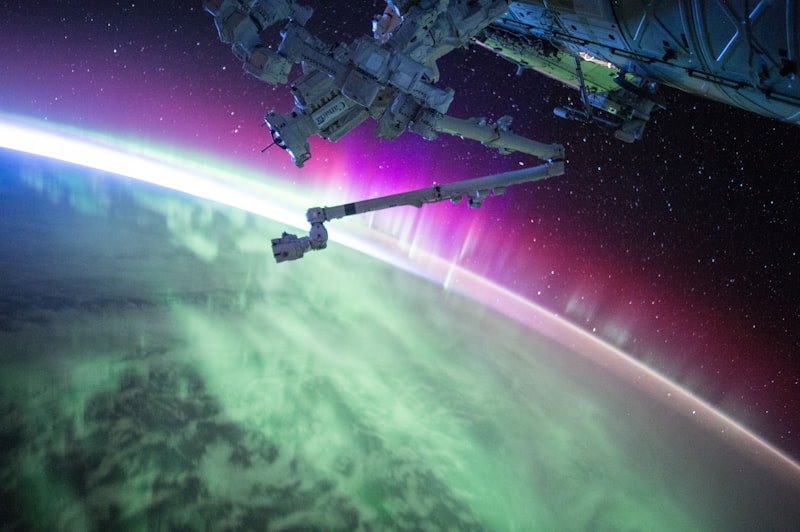
Ever since the first astronauts looked down from orbit and described what they could see, people have been fascinated by the question: what exactly is visible from space? The answer is more surprising than most people expect. The Great Wall of China — the most common answer on school tests — is almost certainly not visible to the naked eye from the International Space Station. But dozens of other things are, including some that will genuinely stop you in your tracks.
Here are ten real things visible from space, verified by astronaut accounts, satellite imagery, and scientific research. Some are natural wonders. Some are human achievements. All of them reshape how you see our planet.
1. The Sahara Desert's Sand Dune Patterns
The Sahara is the world's largest hot desert, covering roughly 9 million square kilometers — nearly the size of the United States. From orbit, it is unmistakable: a vast, pale ocean of sand and rock that dominates North Africa. But what makes it truly extraordinary at satellite altitude is the structure within it. The erg — the sand sea — contains dune patterns of breathtaking regularity and scale. Star dunes, seif dunes, and transverse ridges form repeating geometric shapes across hundreds of kilometers, driven by wind patterns that have persisted for millennia. Astronauts consistently cite the Sahara as one of the most visually striking things they see from the ISS.
2. The Amazon River and Its Tributaries
The Amazon Basin covers 7 million square kilometers and contains about 20% of all the world's fresh water. From orbit, the river system looks like a vast dark circulatory system threading through an ocean of deep green. The main channel is wide enough to be immediately obvious — over 11 kilometers across at some points — but what is more striking is the sheer density of tributaries spreading out from it in every direction. The meeting of the Amazon and the Rio Negro near Manaus, where dark tannin-rich water meets the lighter silty Amazon for dozens of kilometers without mixing, is one of the most dramatic river features on Earth.
3. The Nile Delta — A Green Triangle in the Desert
The Nile Delta is one of the most recognizable features on Earth from space, precisely because of the extreme contrast it creates. A vivid green triangle of irrigated agricultural land pushes northward into the Mediterranean Sea, surrounded on all sides by the pale tan of the Sahara and the Eastern Desert. The delta supports over 50 million people on a strip of land fed entirely by a single river crossing thousands of kilometers of desert. From orbit, it looks almost impossibly vivid — a jewel of green pinned between two seas.
4. The Tibetan Plateau — The Roof of the World
The Tibetan Plateau is the largest and highest plateau on Earth, averaging over 4,500 meters in elevation across an area of 2.5 million square kilometers. From space, it appears as an enormous pale brown expanse ringed by the white peaks of the Himalayas to the south and the Karakoram and Kunlun ranges to the west and north. The plateau is so high and so vast that it has its own weather system, acting as a heat pump that drives the Asian monsoon. Astronauts describe it as looking like a different planet — a world above the clouds.
5. The Aral Sea's Disappearance
One of the most haunting things visible from space is something that used to be there and now mostly is not. The Aral Sea, once the world's fourth-largest lake, has shrunk by over 90% since the 1960s due to Soviet-era irrigation projects diverting its feeder rivers. Satellite images taken over decades show the water retreating, leaving behind white salt flats and stranded fishing boats. The before-and-after comparison in satellite imagery is one of the starkest visual records of human environmental impact ever captured.
6. The Great Barrier Reef
The Great Barrier Reef stretches over 2,300 kilometers along Australia's northeastern coast, making it the world's largest coral reef system — and the largest structure built by living organisms. From orbit, it appears as a turquoise and pale blue band running parallel to the Queensland coast, distinct from the deeper blue of the Coral Sea. The shallow reef-filtered water creates a color contrast vivid enough to be seen clearly from the International Space Station. Astronaut Chris Hadfield photographed it multiple times during his missions, calling it one of the most beautiful natural features visible from space.
7. City Light Patterns at Night
The famous Earth-at-Night images are composites of thousands of satellite passes — yet what they reveal is real and profound. Human civilization's footprint is written in light. The dense web of European cities bleeding into each other. The hard-edged border between North and South Korea — the south blazing with light, the north almost entirely dark. India's cities glowing like galaxies. The striking darkness of the Amazon Basin and the Sahara. These light patterns reveal inequality, density, and infrastructure in a single image in a way no political map can match.
8. Deforestation Scars in the Amazon and Congo
The herringbone pattern of deforestation in the Brazilian Amazon is one of the most recognizable man-made features in satellite imagery. Roads cut into the forest, and settlement follows along each road, creating a feather-like pattern of cleared land against the dark green canopy. Similar patterns appear in the Congo Basin, Borneo, and Indonesia. These scars are growing year by year and are tracked precisely using satellite data — which means the forest's loss is documented in real time from space.
9. Greenhouse Complexes in Almeria, Spain
A strange white patch near the southern tip of Spain has puzzled people looking at satellite maps for years. It is not a salt flat or a dry lake — it is the largest concentration of greenhouses in the world, covering roughly 35,000 hectares in the province of Almeria. These plastic-covered structures produce a significant portion of Europe's fruits and vegetables year-round, and from orbit they create a reflective white expanse so bright it actually affects the local temperature. This human-made feature is genuinely easier to spot from space than many natural landmarks.
10. The Confluence of Major Rivers
Where two major rivers meet, the visual contrast is often dramatic enough to be seen clearly from orbit. The confluence of the Blue and White Nile at Khartoum shows two distinct colors of water joining and briefly running side by side before mixing. The Ohio River meets the Mississippi at Cairo, Illinois, in a sharp angle visible from satellite altitude. The Rio Negro meets the Amazon near Manaus in the Meeting of the Waters — dark tannic water and silty cream water flowing side by side for 80 kilometers without mixing, an effect driven by differences in temperature, speed, and density.
All ten of these features appear regularly in satellite imagery — and EarthGuessr puts you above them. Players who spend time exploring Earth from orbit start to recognize these signatures intuitively: the green triangle of the Nile Delta, the ghostly white salt pans of the former Aral Sea, the turquoise glow of the Great Barrier Reef. That recognition is exactly the kind of deep geographic literacy that makes the game endlessly rewarding.