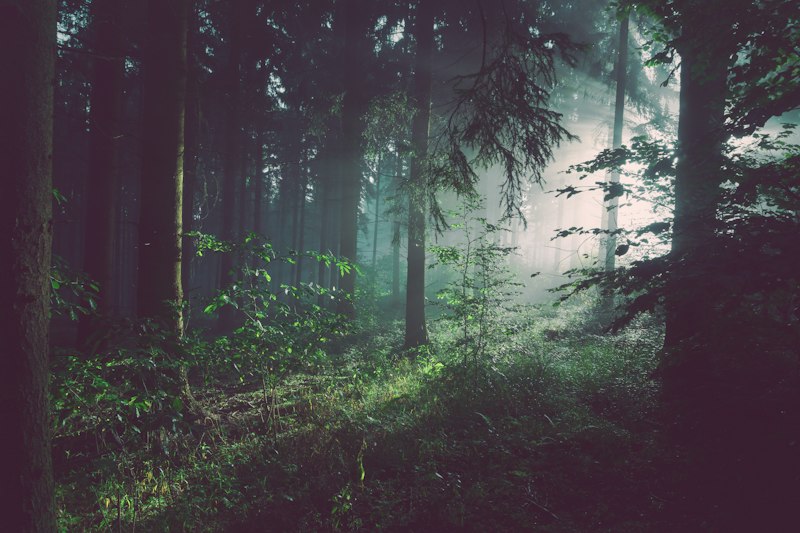
A biome is a large ecological community defined by its climate, vegetation, and animal life. Earth has roughly a dozen major biomes, and each one looks completely different from space. Once you know what to look for, satellite imagery becomes a living map of the planet's ecological zones — a color-coded guide to where rain falls, where temperatures plunge, and where life flourishes in its most concentrated forms.
Understanding biomes from satellite imagery is one of the most powerful geography skills you can develop. It lets you narrow down a location from a global view in seconds, reading the planet's surface the way a naturalist reads a landscape. Here is a guided tour of Earth's major biomes and exactly what they look like from above.
Tropical Rainforest: The Dark Green Canopy
Tropical rainforests are the most visually distinctive biome in satellite imagery. The canopy is a deep, saturated green — often so dark it looks almost black in standard true-color images — and the texture is uniformly dense, like a tightly packed carpet of broccoli. The Amazon Basin, the Congo Basin, and the island of Borneo are the three great rainforest masses, and they are impossible to confuse with any other biome. What distinguishes them from each other is their surroundings: the Amazon is encircled by the agricultural arc of Brazil's interior; the Congo is flanked by savanna and dry woodland; Borneo is an island in an archipelago with the South China Sea visible on its edges.
Rainforest rivers run dark — stained by tannins from decaying vegetation — and in larger rivers like the Negro, this produces the famous black-water appearance visible from orbit. The forest floor receives so little light that almost all the photosynthetic activity happens in the canopy, which is why the biome reads as a single unbroken surface from above.
Tropical Savanna: Gold and Khaki Grassland
The tropical savanna biome surrounds rainforest zones at higher latitudes where rainfall becomes seasonal. In the dry season, savannas appear pale gold and khaki from satellite altitude — enormous stretches of dried grass with scattered trees creating a finely stippled texture. In the wet season, the same regions transform to vivid green. This seasonal color shift is one of the most dramatic biome signatures on the planet, and it explains why images of the same location can look radically different depending on when they were taken.
Africa's savannas — the East African plains, the Serengeti, the miombo woodlands — cover roughly 5 million square kilometers. Australia's tropical north, the South American Cerrado, and parts of South Asia all share the same broad visual signature: open, light-colored grassland with trees spaced too far apart to close the canopy.
Desert: Bare Rock, Sand, and Salt
Deserts cover about 33% of Earth's land surface and are visually one of the most varied biomes in satellite imagery. The color depends entirely on the underlying geology. The Sahara shifts from pale tan sand seas to dark grey volcanic rock to brilliant white salt flats. The Atacama, the world's driest desert, shows orange-red sand and rock against the snow-capped spine of the Andes. Australia's interior is a deep rusty red from iron-oxide-rich soil. The Arabian Desert has a distinctive sandy buff tone. Arctic deserts appear white or blue-grey. What unites them all is the absence of vegetation — there is nothing to soften or color-code the raw geology beneath.
Temperate Forest: Seasonal Green and Brown
Temperate deciduous forests cover much of the eastern United States, central Europe, and East Asia. From satellite altitude in summer, they look similar to tropical rainforest — dense green canopy — but slightly lighter and with more variation in texture as different tree species mix. The real signature of temperate forest is the autumn color change: satellite images taken in October over the Appalachians, the Alps, or Japan's mountains show an extraordinary patchwork of orange, red, and gold that has no equivalent anywhere else on Earth. Temperate forests are also heavily fragmented by agriculture and settlement, so they rarely appear as the unbroken expanses you see in tropical zones.
Boreal Forest (Taiga): The Conifer Belt
The boreal forest — also called taiga — is the world's largest terrestrial biome, stretching in a continuous band across Canada, Russia, and Scandinavia. From space, it appears as an enormous dark green mass, but the texture is distinctly different from tropical rainforest: conifer canopies are spikier, more open, and a cooler, blue-tinged green. The boreal forest is interrupted by thousands of lakes and wetlands, which creates a complex mosaic of dark green forest, blue water, and pale grey bog. In winter, the snow-covered taiga turns a pale silver-grey.
Tundra: The Treeless Arctic
Arctic and alpine tundra are defined by the absence of trees and the presence of permafrost. From satellite altitude, summer tundra appears as a mosaic of muted browns, greens, and yellows — low-growing vegetation without the closed canopy of any forest. One of the most distinctive tundra signatures is the pattern of permafrost polygons: as the ground freezes and thaws in repeated cycles, it creates geometric networks of ice-wedge polygons that are visible from orbit, giving the landscape a cracked, cellular appearance like dried mud at enormous scale. This feature alone is enough to identify high-latitude terrain in satellite imagery.
Mediterranean Scrubland: Grey-Green Coastal Zones
Mediterranean climate zones occur on the western edges of continents at mid-latitudes — the actual Mediterranean coast, California, coastal Chile, the Cape of South Africa, and southwestern Australia. The vegetation is drought-adapted scrubland called chaparral, fynbos, or maquis depending on the region, and from satellite altitude it appears as a grey-green or olive tone on rocky hillsides, usually adjacent to a vivid blue sea. The combination of pale rocky terrain, grey-green vegetation, and cobalt blue water is instantly recognizable and shared across all five Mediterranean climate zones on Earth.
Using Biome Knowledge in EarthGuessr
Every EarthGuessr round is, at its heart, a biome identification challenge followed by a process of geographic narrowing. The moment you can identify the biome in a satellite image — tropical rainforest, desert, temperate grassland, boreal forest — you have eliminated most of the planet. The biome tells you the climate zone, which constrains the latitude. The specific color and texture tells you the geology. The surrounding features tell you the continent. By the time you have read all three, you are often within a few hundred kilometers of the correct answer.