We use cookies for analytics and advertising to understand traffic and improve EarthGuessr. You can accept or reject — essential cookies always stay on. Privacy & cookies

All posts
GeographyJune 12, 20265 min readEarthGuessr Team

How to Spot Bangladesh From Satellite Imagery

The world's largest river delta, braided rivers, and the vast Sundarbans mangroves make Bangladesh recognisable from above. Here is how to read it from satellite imagery.

How to Spot Bangladesh From Satellite Imagery

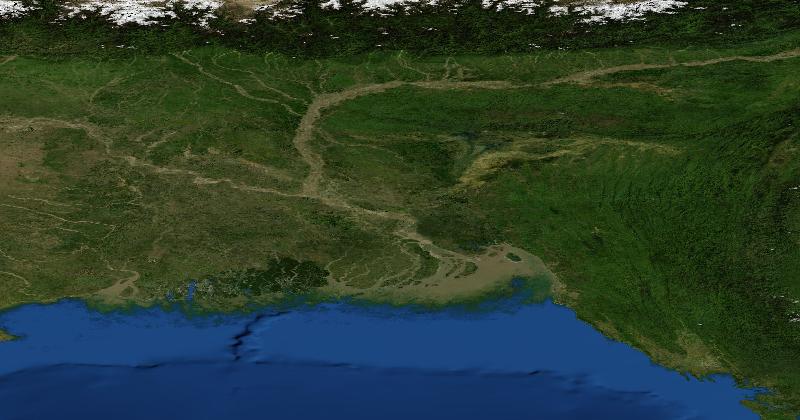
Bangladesh is, more than almost any other country, defined by water. It sits at the meeting point of three great rivers as they spill into the Bay of Bengal, forming the largest river delta on Earth. That single fact shapes nearly everything you see from above, and it makes the country surprisingly readable from satellite imagery once you know the signs.

The great braided rivers

The first thing to look for is the rivers, and they are unmistakable. The Ganges (known here as the Padma), the Brahmaputra (the Jamuna), and the Meghna are not the neat blue lines of a textbook. They are enormous, pale, braided channels, sometimes several kilometres wide, split around constantly shifting sandbars called chars. From above they look like wide, woven ropes of water and sand sprawling across a flat plain. Few places on Earth have rivers this big and this restless packed so close together.

Flat, green, and densely farmed

Almost the entire country is a low, flat plain, and almost all of it is farmed. From above, Bangladesh is an intense patchwork of green, mostly rice paddies, broken up by countless small ponds and waterways. There are no deserts and no big mountain ranges in the heart of the country, just an endless, water-logged green flatness that is one of the most densely populated rural landscapes in the world.

The Sundarbans

In the south-west, where the delta meets the sea, sits the Sundarbans, the largest mangrove forest on the planet, shared with neighbouring India. From above it is a dark green tangle of forest split by a maze of tidal creeks and channels, with no farms and no straight lines. This dense, untamed coastal forest, home to the Bengal tiger, is one of the clearest markers that you are looking at the Bangladesh-India delta coast.

A landscape that changes with the seasons

Bangladesh looks different depending on the time of year, and that itself is a clue. During the summer monsoon, huge areas flood, the rivers swell and swallow their sandbars, and standing water spreads across the fields. In the dry season the channels shrink and the pale chars reappear. Few places show such dramatic seasonal change between images, a direct consequence of life on the world's biggest delta.

The one hilly corner

The exception to all that flatness is the south-east. The Chittagong Hill Tracts, near the border with Myanmar, are the country's only substantial hill country, a region of forested ridges that stands out sharply against the surrounding plain. Nearby, the port city of Chittagong marks the main gateway to the Bay of Bengal. If you see real hills at all in this part of the world, you are probably in that south-eastern corner.

Telling it apart from its neighbours

Bangladesh borders India on almost every side, so the trick is recognising the delta core rather than just the general region. A few features point specifically here:

  • Three giant braided rivers converging toward a single bay
  • An almost entirely flat, green, pond-dotted landscape with no desert and little forest inland
  • The Sundarbans mangroves along the south-west coast
  • The Bay of Bengal to the south, with the Chittagong Hill Tracts to the south-east

Reading a delta is one of the most satisfying skills in a satellite guessing game, because so few of them look alike. Next time EarthGuessr drops you over a flat green plain split by huge, sand-choked rivers running toward the sea, think of the great delta of the Bay of Bengal, and place your pin.

More in Geography

Related reading

Ready to explore?

See the world from above and test your geography skills on a 3D globe.