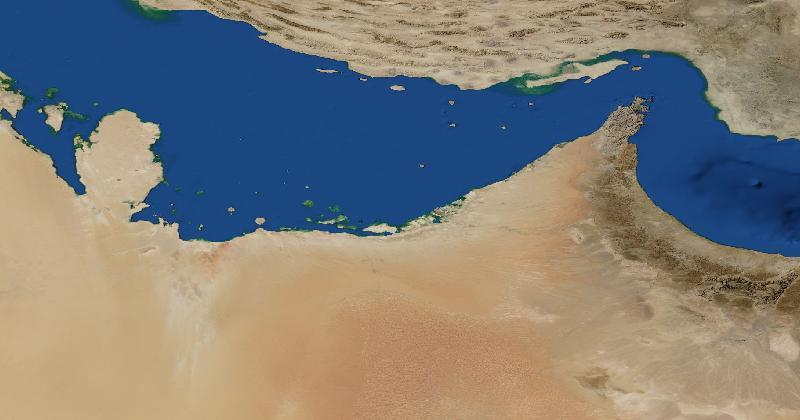
Most countries take a little detective work to identify from orbit. The United Arab Emirates is not one of them. Thanks to some of the most dramatic engineering on the planet and a stark desert setting, the UAE offers a handful of clues so distinctive that a single glance is often enough. Here is how to recognise it from satellite imagery.
The artificial islands
Nothing else on Earth looks quite like the coast of Dubai. The Palm Jumeirah, a vast artificial island shaped like a palm tree inside a protective crescent, is instantly recognisable and visible from a great height. Nearby sit the larger Palm Jebel Ali and The World, a cluster of small islands arranged to resemble a map of the globe. If you see a palm tree made of land reaching into the sea, you are looking at the UAE and you are done.
Red desert and giant dunes
Step inland and the UAE becomes desert almost immediately. The south and west fade into the edge of the Rub al Khali, the Empty Quarter, one of the largest sand deserts in the world. From above the sand often reads as a warm orange-red, organised into long parallel ridges or sweeping star dunes. That distinctive reddish desert is a strong sign you are on the Arabian Peninsula.
Green circles in the sand
Scattered across the desert interior, especially around oases like Liwa and Al Ain, you will find bright green circles, the tell-tale signature of centre-pivot irrigation, where a long sprinkler arm rotates around a central well. Set against bare red sand, these vivid green discs and the date palm plantations around the oases are a clear marker of farming in an extremely dry land.
Salt flats along the coast
Between the dunes and the sea, much of the UAE coast is fringed by sabkha, flat, crusty salt flats that show up as pale grey or white smudges in satellite imagery. These low, salty plains, sometimes laced with winding tidal creeks, are common all along the Persian Gulf shore and help distinguish this coastline from a normal sandy beach.
Cities and the mountains in the east
The two big cities have their own look from above. Dubai sprawls along the coast around the long, straight gash of Sheikh Zayed Road, with its marina and island developments, while Abu Dhabi, the capital, sits on a cluster of low islands threaded by causeways and bridges. Both glow bright green with irrigated parks against the surrounding tan. To the east, near the border with Oman, the rugged Hajar Mountains rise sharply from the desert, a band of bare, folded, brownish rock running roughly parallel to the Gulf of Oman coast. If a mostly flat, sandy country suddenly throws up a wall of dry mountains, you are probably near the UAE-Oman frontier.
Putting it together
The UAE wraps around the south-eastern corner of the Persian Gulf, so you will usually see the sea to the north and west. Combine that coastline with palm-shaped islands, red dunes, green irrigation circles, and pale salt flats, and the identification is almost foolproof:
- Sea to the north and west, desert everywhere inland
- Palm-shaped and globe-shaped artificial islands off Dubai
- Warm red-orange dunes fading south into the Empty Quarter
- Bright green irrigation circles and date palms around desert oases
- Pale coastal salt flats and rugged dry mountains in the far east
Few countries reward a sharp eye as quickly as this one. Next time EarthGuessr drops you above a red desert reaching down to a warm gulf, scan the coast for a palm made of land, and take your guess with confidence.