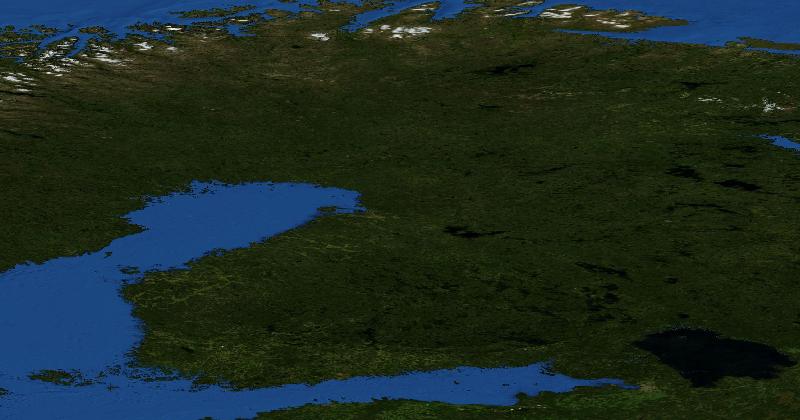
From orbit, the Nordic countries can blur together — all dark forest, cold seas, and northern light. But Finland has a signature unlike any of its neighbours, once you know what to look for. Learn its tells and you'll pick it out of a satellite image in seconds, even without a single label.
A Country of Lakes
Finland's most reliable giveaway is water — not the sea, but the inland lakes. It's often called the Land of a Thousand Lakes, which badly undersells it; the real count runs into the tens of thousands. In the southeast, the Finnish Lakeland is a vast mosaic of blue and green, where it becomes genuinely hard to tell where the land ends and the water begins. No other country in the region is this thoroughly perforated with lakes. If a satellite view looks like someone spattered water across a forest, you're probably looking at Finland.
Forest From Edge to Edge
Finland is one of the most heavily forested countries in Europe, and from above it shows as an almost unbroken dark-green canopy stretching to the horizon. Look closely and you'll often see the geometric scars of commercial forestry — straight-edged clear-cuts and replanted blocks — laid over the natural sprawl. That mix of endless forest and sharp man-made rectangles is very characteristic of the Nordic timber landscape.
The Shattered Coast and the Archipelago
Finland's southwestern coast doesn't end cleanly — it disintegrates into the Archipelago Sea near Turku, one of the largest archipelagos in the world by sheer number of islands, with tens of thousands of skerries and islets scattered offshore. To the west lies the Gulf of Bothnia, separating Finland from Sweden, and to the south the Gulf of Finland, with Estonia on the far shore. That fractured, island-strewn coastline is a strong regional tell.
Seasonal Tells
Time of year changes everything. In winter, much of the country is under snow, the lakes freeze into flat white sheets, and sea ice creeps across the Gulf of Bothnia — a near-monochrome landscape. In high summer, the far north basks in the midnight sun, while the south greens up. The very north, Finnish Lapland, trades dense forest for low, rounded, treeless fells — the bare, tundra-like uplands that mark the approach to the Arctic.
Roads, Rail, and the Empty Middle
Infrastructure is another quiet tell. Finland's road and rail networks are dense in the south, around the capital region and the southern cities, then thin out fast as you head north until single roads and railway lines thread alone through huge stretches of forest and bog. At night, the satellite view makes this obvious: a bright cluster along the southern coast, a few scattered points inland, and a vast dark interior. That pattern of a lit south and an empty north is shared with Sweden and Norway, but combined with the lakes it points firmly to Finland.
Telling It From Its Neighbours
The classic confusion is with Sweden, Norway, and Russia. Norway, to the northwest, is all dramatic relief — fjords and steep mountains along the Atlantic. Sweden has more high ground along its western spine, toward the Norwegian border, while Finland is comparatively flat and low. To the east, Russian Karelia is essentially the same lake-and-forest terrain continuing across the border, so there the political line is invisible from space — you have to lean on other clues.
Two Details Worth Knowing
Two features reward a closer look. The first is Lake Saimaa in the southeast, the largest lake in Finland and the heart of the Lakeland — a sprawling, many-armed body of water so intricate it's hard to trace its edges. The second is the Aland Islands, an autonomous, Swedish-speaking archipelago sitting in the Baltic between Finland and Sweden; spotting that cluster of islands roughly halfway across the gap is a neat way to confirm you're looking at the right corner of the map.
A Coast That Is Still Rising
Finland has a slow-motion geographic quirk worth knowing. During the last ice age, kilometres of ice pressed the land down, and ever since the ice melted, the ground has been springing back up — a process called post-glacial rebound. Along the Gulf of Bothnia the land is still rising at close to a centimetre a year in places, the fastest such uplift in the world. New islands and shoals slowly emerge, harbours gradually become too shallow, and the country is, very literally, getting bigger. It's not something you'll catch in a single image, but it's part of why the coast is so low, shallow, and island-strewn.
Bogs, Mires, and Drainage
Between the lakes and the forest lies a third kind of terrain: peatland. Finland is one of the most mire-rich countries on Earth, and from above these bogs show as mottled, rust-and-olive patches that don't quite read as forest or open water. In many areas you'll see them threaded with the long parallel lines of drainage ditches dug for forestry. That spongy, in-between texture is one more layer in Finland's unmistakable signature.
Reading a country from the air is a skill, and Finland is one of the most satisfying ones to crack precisely because it hides in plain sight among its neighbours. Want to test whether you can spot it for real? Drop into a round of EarthGuessr and see if those lakes and forests give it away.