We use cookies for analytics and advertising to understand traffic and improve EarthGuessr. You can accept or reject — essential cookies always stay on. Privacy & cookies

All posts
GeographyJune 3, 20265 min readEarthGuessr Team

How to Spot Madagascar from Satellite Imagery: Red Rivers, Reefs, and Rainforest

From space, Madagascar looks like it's bleeding into the sea. Once you understand why, you'll never mistake the world's fourth-largest island for anywhere else.

How to Spot Madagascar from Satellite Imagery: Red Rivers, Reefs, and Rainforest

Some places are hard to identify from orbit. Madagascar is not one of them. The world's fourth-largest island sits alone in the Indian Ocean with a set of visual tells so distinctive that satellite imagery of it has become genuinely famous. Learn three or four of them and you'll place it instantly.

The Rivers That Run Red

Madagascar's most striking feature from above is that its rivers appear to bleed. The island's soil is rich in iron-bearing laterite, and where forest has been cleared, heavy rains wash that red earth into the rivers and out to sea. The result is rust-coloured rivers ending in vivid red sediment plumes spreading into the blue ocean. The estuary of the Betsiboka River on the northwest coast is one of the most recognisable satellite images on Earth — a delta that looks like an open wound. Nowhere else on the planet shows this on the same scale.

An Island Cut in Half

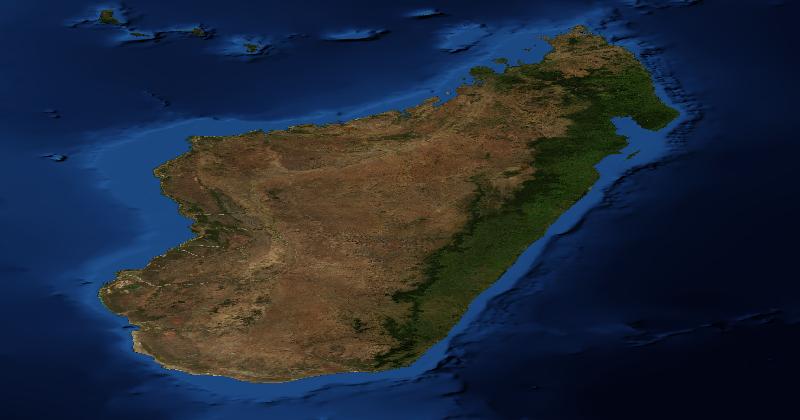
Madagascar has a sharp east-west split that's clear from space. A range of mountains and an escarpment run down the eastern side, catching the moisture-laden trade winds, so the narrow eastern strip is lush, dark-green rainforest. West of the central highlands the land falls into drier savanna and, in the far south, an arid, almost desert-like spiny landscape. That contrast between a green eastern margin and a browner, drier west is a strong, reliable tell.

Reefs and a Turquoise Fringe

Look at the coast, especially the southwest around Toliara, and you'll often see the pale turquoise glow of coral reefs and shallow lagoons fringing the shoreline. Those bright shallows against the deep ocean blue are another giveaway, and they sit right alongside the red river plumes for a colour combination that's unmistakable once you've seen it.

The Fourth-Largest Island

Size and shape help too. Madagascar is the fourth-largest island in the world, behind only Greenland, New Guinea, and Borneo. It's long and roughly north-south, like a giant footprint dropped into the Indian Ocean. Its sheer size means that at most zoom levels it reads clearly as a major island rather than a cluster of small ones.

Telling It Apart

Honestly, the hardest part of spotting Madagascar is overthinking it. It sits in splendid isolation off the southeast coast of Africa, separated from Mozambique by the wide Mozambique Channel. There's no other large island nearby to confuse it with, and once you've registered the red rivers and the east-west green-to-brown split, second-guessing is the only thing that will catch you out.

Stranger Landscapes Still

Beyond the red rivers, Madagascar hides some genuinely odd terrain. On the west coast lies the Tsingy de Bemaraha, a forest of razor-sharp limestone pinnacles carved by rain into a stone labyrinth so jagged that parts of it are nearly impossible to cross on foot. In the far south, the spiny forest is a bizarre, near-desert tangle of thorny, water-storing plants found almost nowhere else. Even at low resolution, the abrupt switches between rainforest, highland, karst, and thorn-scrub make the island read as a patchwork rather than a single landscape.

A Landscape Under Pressure

Those bleeding rivers tell a real and sobering story. Madagascar has lost a large share of its original forest to slash-and-burn clearing, known locally as tavy, and the erosion that follows is exactly what paints the rivers red. So the island's most beautiful satellite signature is also a record of environmental strain — a reminder that what we read from space is often the planet's surface responding to how people use it.

An Island That Went Its Own Way

All of this traces back to a single geographic fact: Madagascar has been an island, cut off from the African mainland, for tens of millions of years. That long isolation is why so much of its wildlife — lemurs, chameleons, and thousands of plants — exists nowhere else on Earth. It's a powerful reminder that geography isn't just scenery; the position and history of a place shape the very life that evolves on it.

The Highlands and the Rice Terraces

The cool, hilly centre of the island is its human heart. Around the capital, Antananarivo, the central highlands are carved into countless terraced rice paddies that fill the valleys floor to rim. From above, that terracing reads as fine, contour-hugging patterns quite unlike the blocky fields of large-scale agriculture — a clear sign of intensive, hand-worked farming on steep ground. Where the red soil meets flooded green paddies, the highlands take on a distinctive mottled look you won't easily mistake.

Cyclone Country

Madagascar's east coast faces the open Indian Ocean and takes a regular battering from tropical cyclones, which sweep in from the northeast during the wet season. Their influence is written into the landscape: the lush eastern rainforest owes much to that storm-driven rainfall, while settlement patterns and river mouths reflect a coast shaped by heavy, sometimes violent weather. It's a reminder that what you read from satellite imagery is rarely just rock and vegetation — it's climate, history, and human response all layered together.

Madagascar is one of the most rewarding places to learn from above precisely because its story is written so plainly across its surface. Want to see if you can recognise it — and dozens of other landscapes — for real? Jump into a round of EarthGuessr and put your satellite-reading skills to the test.

More in Geography

Related reading

Ready to explore?

See the world from above and test your geography skills on a 3D globe.