All posts
GeographyMay 19, 20266 min read read

How to Spot Ireland from Satellite Imagery: Bogs, Boreens, and the Forty Shades of Green

Ireland has one of the most distinctive aerial signatures in Europe — a green-on-green patchwork of tiny fields, peat bogs that read almost black from orbit, and winding country lanes called boreens. Here's how to identify it from a single satellite frame.

How to Spot Ireland from Satellite Imagery: Bogs, Boreens, and the Forty Shades of Green

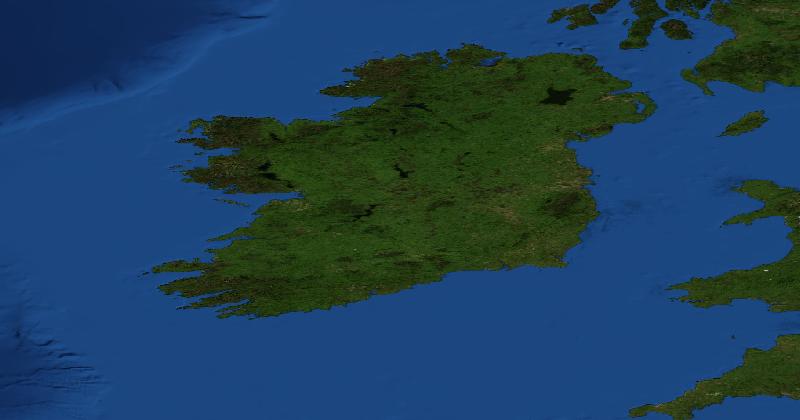
Ireland is one of the smaller countries in Europe, but it has one of the most legible aerial signatures on the continent. Pull up a satellite image of the Irish countryside and you will see something you do not see anywhere else: a continuous quilt of small green fields, separated by dark hedgerows, threaded by impossibly narrow winding lanes, and broken every few kilometres by the inky black of a peat bog. Once you know what to look for, you can place Ireland from orbit within seconds.

This guide walks through the satellite imagery clues that give Ireland away, the regional differences between the west and east coasts, and the handful of features that distinguish Ireland from neighbouring Britain — which is closer in appearance than most people realise but ultimately quite different at scale.

The Green Is Real — And It's More Specific Than You Think

Ireland's reputation for being green is not a tourist board exaggeration. The combination of a temperate maritime climate, abundant rainfall spread evenly across the year, and a long growing season produces a particular shade of vivid emerald that satellite imagery captures clearly. The dominant green in Irish farmland comes from permanent pasture — about 60 percent of Ireland's land area is grassland used for grazing cattle and sheep, far higher than any other European country except possibly Switzerland.

From orbit, this means Ireland's farmland appears more uniformly green than its neighbours. England has more cropland and shows a higher proportion of yellow-brown fields in summer. France has vast wheat plains. Even Scotland and Wales — also very green — have more brown moorland visible at higher elevations. Ireland's flat-to-rolling lowlands stay green almost year-round.

Tiny Fields, Endless Hedgerows

The single most distinctive feature of Irish satellite imagery is field size. Irish fields are small — often just one to three hectares — and each is bordered by a dark, scrubby line of hedgerow. The result, viewed from above, is a fine-grained patchwork that looks almost like a quilt. The average Irish farm is around 33 hectares, divided into 10 to 20 small parcels, which is one of the most subdivided agricultural landscapes in western Europe.

This is a legacy of Irish land history. After the famine and through the late 19th century, large estates were broken up under the Land Acts, and farms were redistributed to tenant occupiers. The resulting holdings have stayed small for over a century. Compare this to the giant rectangular fields of eastern England, the long strip fields of northern France, or the open prairies of the American Midwest. Ireland is unmistakable at this scale.

If you zoom into a random rural Irish location on Google Earth, the texture is unlike anything else in Europe. The grain of the landscape — that tight quilt of tiny green parcels — is the single most reliable clue you can train your eye on.

— Dr Eoin Mac Cárthaigh, geography lecturer, NUI Galway

Bogs Are Ireland's Other Fingerprint

Roughly one sixth of Ireland is covered by peatlands. From satellite imagery, raised bogs appear as dark brown to almost black patches, often with visible drainage channels cut in regular parallel lines — a sign of historic peat extraction. The biggest concentrations sit across the central midlands, from Offaly through Westmeath and Longford. Western blanket bogs cover much of Connemara, Mayo, and Donegal, and look subtly different: less black, more textured, with exposed bedrock and small lochans punctuating the surface.

Bogs are one of the easiest ways to distinguish Ireland from Britain in an ambiguous frame. Britain has some peatlands, but nowhere does it have the sheer density of central Irish raised bogs. If you see drained, rectangular peat workings against a green pastoral background, you are almost certainly in the Irish midlands.

Aerial view of Irish bogland with the characteristic dark peat surface
Irish peat bogs read as deep brown-black patches in satellite imagery, often with visible parallel drainage channels — a fingerprint you will not find in this density anywhere else in western Europe.

Boreens: The Smallest Roads in Europe

Look at the road network in any rural Irish satellite frame and you will see something unusual: an extraordinarily dense web of tiny, winding, single-track lanes. These are boreens — small country roads, often hedge-lined and barely wider than a car. They connect almost every farm and townland to its neighbours and produce a capillary-like pattern that is denser than rural Britain and far denser than rural France or Germany.

From orbit, the give-away is the lack of straight lines. Roads in Ireland follow field boundaries, old townland edges, and topography rather than imposed survey grids. There are almost no kilometre-long straight stretches in rural Ireland. Compare this to the Roman-era straight roads still visible across England, the rectilinear départemental roads of France, or the cadastral grid of the American Midwest — Irish boreens look almost organic by comparison.

Regional Differences: West vs East

The Irish landscape is more varied than the green-quilt cliché suggests. Knowing the regional differences sharpens your guesses considerably.

  • The east and south (Leinster, east Munster): the flattest, most fertile, and most agricultural. Larger fields, more arable cropland, denser road network, larger towns. This is where you will see the most yellow-green wheat fields in summer.
  • The midlands: raised bogs, dairy pasture, the Shannon catchment, lakes. The bogs are the strongest tell.
  • The west (Connacht, west Munster): blanket bog, exposed bedrock, very small fields divided by stone walls rather than hedges, dramatic coastal cliffs. The Aran Islands and Connemara are unmistakable — pale grey limestone karst with tiny green pockets between bare rock.
  • The northwest (Donegal, Sligo): rugged, fjord-like inlets, peat-cut hillsides, scattered crofting settlements, dark mountains running to the coast.
  • Northern Ireland: politically separate, but visually similar to the rest of the island, with one strong cue — the Sperrin and Mourne mountains, and the urban footprint of Belfast on the east coast.

Coastline: The Atlantic Edge Is Unmistakable

Ireland's west coast is one of the most geographically distinctive coastlines in Europe. The combination of long inlets, peninsular fingers reaching west into the Atlantic, and sheer cliff edges along Clare, Mayo, and Donegal is unlike anywhere else outside Norway or Scotland. The Cliffs of Moher, the Dingle and Iveragh peninsulas, Achill Island, and Donegal's serrated coastline all read clearly from orbit. The east coast, by contrast, is comparatively smooth — a long curve from Wexford up to the border, with the major exception of Dublin Bay and Carlingford Lough.

If your satellite frame includes a coastline of deeply incised peninsulas with green-topped headlands plunging into dark Atlantic water, you are looking at Ireland's western seaboard. If it is a smoother east-facing coast with a clear bay or inlet, you are on the Irish Sea side.

How to Tell Ireland from Britain

Ireland and Britain are the two most commonly confused islands in geography games, especially when the satellite frame is rural. A few rules of thumb separate them reliably.

  • Field size: Ireland's fields are noticeably smaller and more uniformly green than southern and eastern England. Northern and western Britain (Wales, Scotland, northern England) is closer in appearance — small green fields, hedgerows, hills.
  • Bogs: Heavy concentration of dark central peatland strongly suggests Ireland's midlands. Britain's peatlands are more scattered and tend to be upland blanket bog rather than central lowland raised bog.
  • Stone walls: Western Ireland uses stone walls rather than hedges (no trees to grow them from). The pattern of bright limestone walls dividing tiny green parcels is almost only seen in Connemara, the Burren, and the Aran Islands.
  • Settlement pattern: Ireland has a much weaker urban hierarchy outside Dublin — fewer mid-sized cities, more dispersed villages. Britain has many more medium cities visible in any random frame.
  • Coastline shape: If you can see the broader island outline, Britain is large and roughly triangular with Scotland's jagged top; Ireland is smaller and rounder with a heavily indented Atlantic edge.

Urban Fingerprints: Dublin, Cork, Galway, Belfast

Irish cities are small by European standards. Dublin is the only metro area with a population over a million, and its urban form is unmistakable: a tight Georgian core wrapped in 20th-century suburbs, the curving River Liffey cutting east to west, the Phoenix Park as a large green block on the north side, and the M50 motorway forming a clear half-ring around the city. Cork sits in a river valley on the south coast with a distinctive island-bound city centre. Galway is a small low-rise grid on the edge of Galway Bay. Belfast is wedged between the Antrim Hills and Belfast Lough, with the harbour cranes of Harland and Wolff occasionally visible as bright dots near the docks.

Outside these cities, urban Ireland is mostly low-rise market towns spaced 15 to 30 kilometres apart. The lack of dense mid-sized cities is itself a clue — a frame containing only one significant settlement amid hundreds of square kilometres of fields is much more likely to be Ireland than England.

Practice Spotting Ireland

Ireland is one of the most rewarding countries to learn to recognise from satellite imagery, because once the quilt-of-tiny-fields, dark-bog, and winding-boreen signature locks in, you can place it from almost any rural frame. The next time you find yourself spinning the EarthGuessr globe and landing on a green patchwork with stone walls and no straight roads, trust the pattern. You are looking at the most photographed, most green, and most distinctive small country in western Europe.

Ready to explore?

See the world from above and test your geography skills on a 3D globe.