All posts
GeographyMay 19, 20268 min read read

How to Spot Canada from Satellite Imagery: Lakes, Boreal Forest, and the Prairie Grid

Canada is the second-largest country on Earth and one of the most distinctive from orbit — endless boreal forest stippled with lakes, a prairie grid that almost mirrors the United States, and a settlement pattern unlike anywhere else. Here is how to identify it from a single frame.

How to Spot Canada from Satellite Imagery: Lakes, Boreal Forest, and the Prairie Grid

Canada is enormous. At 9.98 million square kilometres, it is the second-largest country on Earth by area, only slightly smaller than Russia and roughly the size of all of Europe with a Brazil thrown in for scale. Almost all of that area is forest, lake, tundra, or otherwise lightly inhabited — Canada's population of 40 million is clustered in a narrow strip within a few hundred kilometres of the US border, which means most satellite frames of Canada show something other than where most Canadians live.

That asymmetry is what makes Canada both easy and hard to identify in geography games. Easy, because the empty interior has a handful of unmistakable signatures. Hard, because the populated south can look a lot like the northern United States, and the prairies can look a lot like Montana or North Dakota. This guide walks through the cues that lock Canada in confidently.

The Boreal Forest and Glacial Lake Country

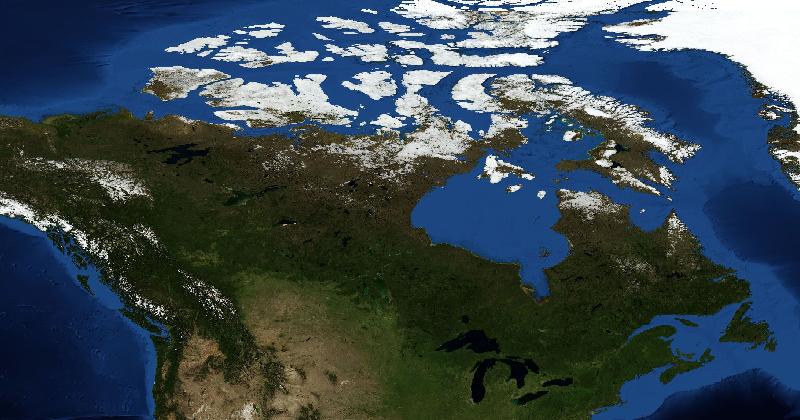
The single most distinctive aerial feature of Canada is the Canadian Shield — an enormous slab of ancient Precambrian bedrock that covers roughly half the country, from Labrador across northern Quebec and Ontario through Manitoba and into Saskatchewan and the Northwest Territories. The Shield was scraped clean by Pleistocene glaciers, which left behind a landscape of innumerable irregular lakes nestled in shallow basins between low ridges of exposed rock. From orbit, it looks like a dark green carpet of boreal forest perforated by hundreds of bright blue lakes per frame, in irregular shapes that no other large country reproduces at this scale.

If a satellite frame shows dense conifer-dominated forest with dozens of small to medium lakes in clearly glacial shapes — long thin lakes, kettle ponds, rivers that connect lake to lake in messy chains — and very little visible settlement, you are looking at Canada. Russia has similar landscapes in places, but Russian lakes tend to be in larger basins with more permafrost-related features, and the forest texture is subtly different. Sweden and Finland share the look, but the country itself is far smaller, so the absence of any obvious border or coastline within a wide frame points to Canada.

The Prairie Grid, with a Canadian Twist

Southern Saskatchewan, Alberta, and Manitoba are gridded farmland on a scale that rivals the American Great Plains. The Dominion Land Survey, adopted in 1871, divided the prairies into one-square-mile sections in the same manner as the US Public Land Survey System. The result is a near-identical-looking checkerboard from orbit — but with a few telltale differences that experienced players learn to read.

Canadian prairie sections are slightly different in their road density: roads tend to come at every two miles rather than every mile in many areas, producing a coarser grid than the American Midwest. Farms tend to be larger. Shelterbelts of trees planted around farmsteads are often more conspicuous because the open country offers no other windbreak. And the latitude is higher — a frame in Saskatchewan or Alberta in the shoulder seasons will show longer shadows, more snow remnants, and sparser greenery than equivalent latitudes in Iowa or Illinois. Combine those cues with the proximity of poplar-aspen parkland transitioning into boreal forest along the northern edge of the agricultural zone and the country becomes recognisable.

Boreal forest landscape with multiple glacial lakes
Canada's Shield country — dense conifer forest perforated by irregular glacial lakes — is one of the most recognisable terrains on Earth.

The Rockies, the West Coast Rainforest, and the Maritimes

Western Canada has a sequence of landscapes that no other country reproduces in the same order. The Canadian Rockies are sharper and more vertical than the American Rockies, with much more visible glaciation, distinctive turquoise glacial lakes, and a steep western face that drops into the interior plateau of British Columbia. West of the plateau, the Coast Mountains plunge into the Pacific, producing a fjord-cut, rainforest-covered coastline that is unmistakable once you see it: deep narrow inlets reaching far inland, islands strewn along the edge, and a continuous dark green carpet of temperate rainforest from sea level to treeline.

On the east coast, the Maritime provinces — Nova Scotia, New Brunswick, Prince Edward Island, and Newfoundland — have their own distinctive aerial signatures. PEI is small, gently undulating, and famously red-soiled, with farms in long thin strips reflecting French colonial land division. Newfoundland's coastline is one of the most rugged on Earth, with deep glacial fjords, scattered fishing villages, and an interior of bog and barren rock. The Gulf of St. Lawrence itself, when in frame, gives away the region.

Canadian Cities Have a Different Footprint

Canadian cities look superficially American — gridded streets, suburban sprawl, big highway interchanges — but the details diverge in ways that experienced players pick up:

  • Downtown skylines are often taller and denser per capita than equivalent American cities, with a concentration of high-rise residential towers (Toronto, Vancouver, Calgary, and Montreal all have unmistakable downtown footprints).
  • Suburbs include more apartment buildings and townhouse complexes scattered among single-family homes, less of the pure tract-house sprawl of the US Sunbelt.
  • Street name signs in Quebec are visible in distinctive blue, and city blocks in Montreal have a unique east-west grid with characteristic external metal staircases on triplex housing.
  • Sports facilities tend to be hockey arenas and curling rinks, not baseball diamonds — sometimes visible as distinctive long rectangular pads with curved ends.
  • Industrial zones feature grain elevators in the prairies, paper mills near boreal regions, and oil sands infrastructure (huge tailings ponds, mine pits) in northern Alberta.

Where Canada Gets Confused

Canada is most often confused with the northern United States, particularly Minnesota, North Dakota, Montana, Idaho, and Washington. The disambiguators are usually subtle: latitude effects on vegetation and shadows, road density (lower in Canada), grain elevators and rural infrastructure styling, and signage when visible. Bilingual French-English signage anywhere is a near-instant lock on Canada, since no US state outside parts of Louisiana approximates it.

The boreal forest can be confused with Russia, Sweden, Finland, or even Alaska. The clearest disambiguators are the specific lake patterns (Shield country looks different from glaciated Fennoscandia, which is rougher; Russian taiga has fewer lakes in many regions), the texture of settlements when they appear (Canadian remote settlements often have a characteristic colour palette of metal-roofed houses on cleared lots beside lakes), and the road network (Canadian remote roads are wide, paved, and well-maintained where they exist, distinctive from many Russian equivalents).

Pro-Tier Signals

Advanced players use finer details. The colour and style of farm vehicles parked beside homesteads (red and green machines visible from orbit in some imagery). The presence of distinctive long rectangular curling rinks beside community centres in small prairie towns. The size and arrangement of grain elevators along rail lines — most have been demolished and replaced by enormous inland terminals, and the rate of demolition versus retention tells you which province you are in. And in the far north, the distinctive grid of permafrost polygons in tundra areas, the rectangular pads of mining infrastructure, and the characteristic horizon of First Nations and Inuit communities with grouped housing and a central school.

Practise It

Canada rewards practice as much as any country in the game. The Shield, the prairies, the Rockies, the West Coast, and the Maritimes each have distinctive signatures that lock in fast once you have studied a handful of frames from each. Spend a session deliberately playing rounds across Canada on EarthGuessr and the country will quickly become one of your most reliable identifications — and one of the most rewarding, because the variety of landscape inside Canadian borders is unmatched in any other single country on Earth.

Series · Spot the Country

More from this series

View all in Spot the Country →

Ready to explore?

See the world from above and test your geography skills on a 3D globe.