We use cookies for analytics and advertising to understand traffic and improve EarthGuessr. You can accept or reject — essential cookies always stay on. Privacy & cookies

All posts
GeographyJune 5, 20265 min readEarthGuessr Team

How to Spot Nepal from Satellite Imagery: The Himalayan Wall, the Hills, and the Terai

Nepal is one of the easiest countries to read from above once you know its three stripes — the snow-capped Himalaya, the green middle hills, and the flat farmed Terai. Here is the field guide.

How to Spot Nepal from Satellite Imagery: The Himalayan Wall, the Hills, and the Terai

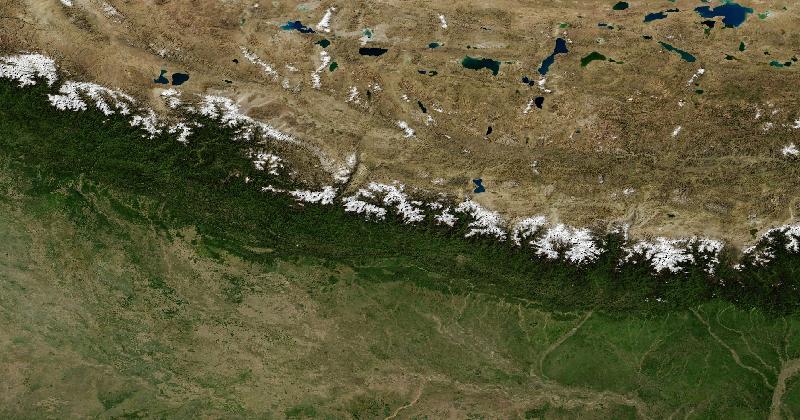
Few countries are as cleanly layered as Nepal. Landlocked between India and the Tibetan plateau of China, it is a long, roughly rectangular country that runs from southeast to northwest along the spine of the Himalaya. What makes it so satisfying to identify from satellite imagery is that it is built in three distinct horizontal bands, stacked from the hot lowlands in the south to the highest mountains on Earth in the north.

This is part of our series on spotting countries from above — the core skill behind EarthGuessr.

Position: Wedged Between Two Giants

Start by finding the Himalaya, the great mountain arc separating the Indian subcontinent from the Tibetan plateau. Nepal sits on the southern side of that arc, with India wrapping around it to the south, east, and west, and China (Tibet) along the high crest to the north. It is a long, narrow country — far wider east to west than north to south — which gives it a distinctive elongated shape draped along the mountain front.

The Northern Band: The Himalayan Wall

The north of Nepal is unmistakable: a band of brilliant white, snow-capped peaks and grey rock, including some of the highest mountains in the world. Mount Everest sits on the border with China in the east. From space this band reads as a rugged, bright ridge of permanent snow and deep shadowed valleys, with glaciers feeding rivers that run south. Beyond the crest, the land opens onto the brown, high, comparatively dry Tibetan plateau on the Chinese side — a sharp contrast that helps mark the border.

The Middle Band: The Green Hills

Below the high peaks lies the band of middle hills, the Pahad — a deeply folded, green, heavily terraced landscape of ridges and river valleys. This is where most Nepalis live, and from above it shows as crinkled green terrain stitched with the fine contour lines of hillside farming terraces. Tucked into this zone is the Kathmandu Valley, a flatter urban basin ringed by hills — a dense patch of grey settlement that stands out against the surrounding green and is the country's largest urban area.

The Southern Band: The Flat Terai

At the bottom, the land suddenly flattens into the Terai, a strip of low, fertile plain that is the northern edge of the vast Indo-Gangetic plain. The transition is abrupt: crumpled green hills give way to a flat patchwork of farm fields, towns, and straight roads. The Terai is Nepal's agricultural heartland and, along its border with India, its most densely farmed land. From space it looks completely different from the rest of the country — orderly, flat, and geometric.

The Rivers That Cut Through

Nepal's big rivers — the Koshi in the east, the Gandaki in the center, and the Karnali in the west — all run roughly south, slicing through the hills in deep gorges before spilling out onto the Terai and on into India's Ganges system. Following one of these rivers from the snow line down to the plain takes you through all three of Nepal's bands in a single sweep, and the braided, sediment-heavy channels where they hit the flat land are a useful clue.

Climate Written on the Land

Nepal's three bands double as a climate map. The southern Terai and the lower hills catch the summer monsoon and run lush and green, with subtropical jungle preserved in lowland reserves like Chitwan, home to rhinos and tigers. Climb north and the air cools and dries with altitude, until beyond the high peaks the land falls into the rain shadow of the Himalaya — the brown, arid trans-Himalayan valleys such as Mustang that look far more like the Tibetan plateau than the green hills below. Reading that wet-to-dry, green-to-brown gradient from south to north is one of the surest ways to confirm you are looking at Nepal.

Telling Nepal Apart From Its Neighbors

Two confusions are common. The first is Bhutan, the smaller Himalayan kingdom further east — also mountainous, but much smaller and more uniformly forested, without Nepal's broad southern plain. The second is simply mistaking the view for northern India or Tibet. The trick is the three-band stack: if you can see snow peaks to the north, crumpled green hills in the middle, and a flat farmed plain to the south all within one country, you are almost certainly looking at Nepal.

That layered structure is what makes Nepal a favorite for satellite-guessing. The next time EarthGuessr drops you onto terraced green hillsides beneath a wall of snow, or onto a flat farmed plain with mountains rising sharply to the north, run through the three bands — Terai, hills, Himalaya — and you will have found Nepal.

More in Geography

Related reading

Ready to explore?

See the world from above and test your geography skills on a 3D globe.