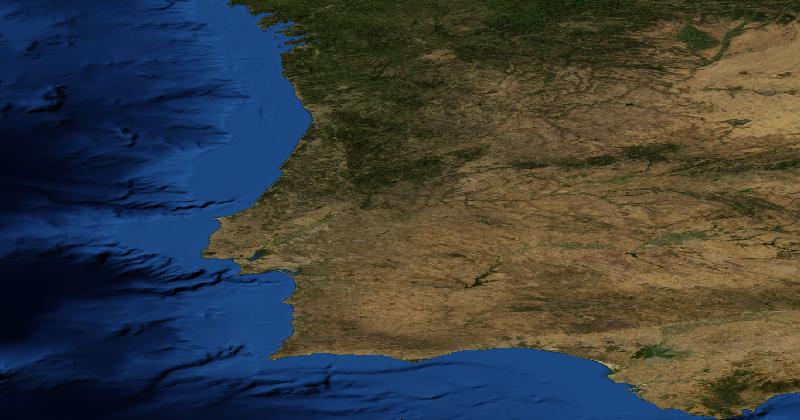
Portugal occupies the western edge of the Iberian Peninsula, a tall, narrow rectangle facing the open Atlantic. That position is its biggest tell from space: while most of Europe wraps around inland seas, Portugal stares straight out at the ocean, with a long, fairly smooth coastline running almost north to south. Learn the handful of features below and it becomes one of the more recognizable countries on the western seaboard.
This is part of our ongoing series on identifying countries from satellite imagery — the exact skill that makes a game like EarthGuessr click.
Start With the Shape and Position
Find the Iberian Peninsula, the big square block hanging off southwestern Europe, then look at its western strip. Portugal is the relatively thin country running down the Atlantic side, with Spain filling the much larger interior to the east and north. The land border with Spain is long and mostly follows hills and rivers; the western and southern edges are all coast. That tall-rectangle-on-the-ocean outline is the first thing to lock in.
The Atlantic Coast
Portugal's coastline is its signature. Running down the west, it is comparatively straight, with long sandy beaches, dune systems, and coastal lagoons rather than the deep fjords or jagged inlets you see further north in Europe. Two big estuaries break the line: the Tagus (Tejo) estuary, where the river widens into a broad bay at Lisbon, and the Sado estuary just to the south. The Tagus estuary in particular is a standout — a large, almost inland-sea-shaped body of water with a major city wrapped around it.
The Green North and the Douro
Northern Portugal is wetter, hillier, and noticeably greener than the south. The defining feature here is the Douro valley, where the river winds west toward Porto through steeply terraced hillsides — the vineyards of the port-wine country. From above, those terraces give the valley sides a finely ridged, contour-following texture that is unusual and distinctive. The Douro reaches the Atlantic at Porto, the country's second great estuary city.
The Central Mountains
Between the green north and the open south rise Portugal's interior highlands. The Serra da Estrela, the highest mountain range in mainland Portugal, forms a rugged upland in the center-north that can hold snow through winter — a pale, rough patch standing above the surrounding hills. These ranges, part of the same broad system that continues east into central Spain, help explain why Portugal's biggest rivers, including the Tagus and the Douro, arrive from the east after long journeys across Iberia before reaching the Atlantic.
The Dry South: Alentejo and the Plains
Cross into the center and south and the land flattens and dries out. The Alentejo is a region of wide, golden-brown plains, large fields, and scattered cork oak and holm oak woodland known as montado — an open, savanna-like pattern of dotted trees over pale ground. Compared with the crowded green north, the Alentejo reads as spacious and sun-baked, with far fewer towns and big reservoirs dotting the rivers, including the vast Alqueva reservoir near the Spanish border.
The Algarve and the Southern Edge
At the very bottom, the coast turns to run east to west: this is the Algarve. Look for a southern shoreline with limestone cliffs, sandy barrier islands, and the lagoon system of the Ria Formosa, a fringe of sheltered water and sandbars behind the open coast. The southwestern corner ends in the dramatic headland of Cape St. Vincent, the southwesternmost point of mainland Europe — a sharp, weathered tip jutting into the Atlantic.
Do Not Forget the Atlantic Islands
Portugal is not only the mainland. Far out in the Atlantic lie two autonomous regions: Madeira, a green, mountainous island southwest of the mainland, and the Azores, a scattered chain of volcanic islands much further west, roughly a third of the way to North America. If a satellite view drops you onto a steep, deep-green volcanic island alone in the open Atlantic, the Azores or Madeira are very much in play.
Telling Portugal From Its Neighbor
The most common confusion is with western Spain, especially Galicia just to the north. A few cues help: Portugal's coast is the straighter, ocean-facing western edge, while Galicia's is broken by deep rias (drowned river valleys); Portugal's interior shows the strong green-north, golden-south split; and the two great estuary cities, Lisbon on the Tagus and Porto on the Douro, anchor the western coast. Put those together and Portugal stops being a hard guess.
Next time EarthGuessr drops you onto a west-facing Atlantic coastline backed by terraced valleys or wide cork-oak plains, run the checklist — ocean to the west, green to the north, gold to the south — and you may have just spotted Portugal.