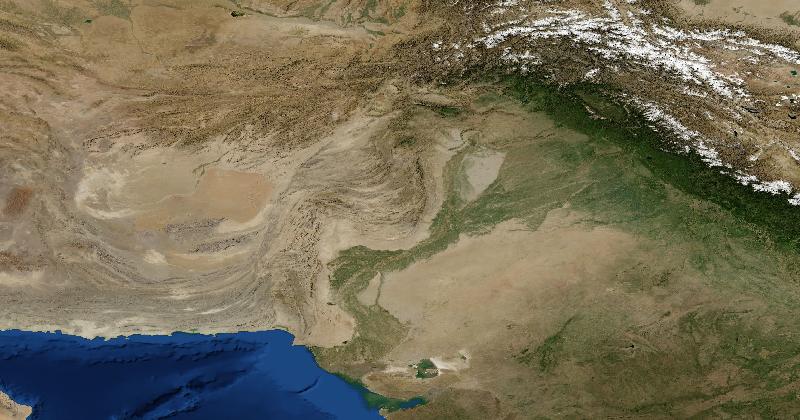
Pakistan is one of the most geographically varied countries in Asia, and one of the more challenging to identify from satellite imagery because so much of its landscape blends into the surrounding region. To the south, the Thar Desert continues across the Indian border. To the north, the Karakoram and Hindu Kush merge into the broader Himalayan system. To the west, the Balochistan plateau bleeds into Iran and Afghanistan. The Indus River, however, is the spine that ties everything together — and once you learn to read it, Pakistan becomes unmistakable from orbit.
Start with the Indus
The Indus River is the single most important feature for identifying Pakistan from satellite imagery. It runs roughly north-to-south through the entire country, fed by five major tributaries — the Jhelum, Chenab, Ravi, Beas, and Sutlej — which together give Punjab its name ("five waters"). From above, the Indus is broad, often braided into multiple channels, and surrounded by an intensely green corridor of irrigated cropland that contrasts sharply with the surrounding desert.
This corridor — the Indus Plain — is one of the most productive agricultural regions on Earth. It supports more than 200 million people and feeds the country's wheat, cotton, rice, and sugarcane production. From orbit, the contrast between the lush green of the irrigated belt and the pale tan of the surrounding desert is one of the sharpest land-use boundaries visible anywhere outside the Nile Valley.
The Roof of the World
Northern Pakistan contains some of the most dramatic mountain terrain on Earth. The Karakoram range holds K2, the second-highest peak on the planet, along with four of the world's 14 eight-thousanders. The Hindu Kush runs along the Afghan border. The Pamirs reach into the northeast at the Wakhan Corridor. The Himalayan foothills extend across Kashmir.
From satellite imagery, this region appears as brilliant white peaks, dark valleys, and the unmistakable blue-grey curl of the Hunza, Gilgit, and upper Indus valleys cutting through the mountains. The combination of bare rock, glacial ice, and narrow green valleys is characteristic of the Karakoram and the Hindu Kush specifically. If your frame contains 7,000-metre peaks adjacent to a desert plateau within 200 kilometres, you are almost certainly in northern Pakistan.
The Cholistan and Thar Deserts
Southern Pakistan slides into one of the world's largest contiguous deserts. The Cholistan in southern Punjab and the Thar (which extends across into India) cover roughly 200,000 square kilometres of pale, dune-textured terrain. From orbit, the Thar reads as a wash of warm tan-orange punctuated by occasional small towns and oasis-like irrigation circles where the canal system reaches. The dunes are linear and clearly oriented by the prevailing wind — a feature you can see clearly at any reasonable zoom level.
Distinguishing the Pakistani side from the Indian side of the Thar is harder, because the desert itself does not respect borders. The cue is the irrigation pattern. Pakistan has built one of the largest contiguous irrigation networks on Earth, fed by the Indus and its tributaries. As you move west and north out of the Thar, the green spreads quickly. India's Rajasthan stays dry for longer because its canal infrastructure is more limited and lies further from the major rivers.
Balochistan: The Empty Quarter of Pakistan
Western Pakistan is dominated by Balochistan, a vast plateau of arid mountains, salt flats, and almost no agriculture. From above, it looks like a duller, browner version of eastern Iran — which is exactly what it is, geologically and climatically. The terrain is corrugated by north-south running mountain ridges with shadow valleys between them. There are few roads, few towns, and few green patches. The major urban hub, Quetta, sits in a tight valley surrounded by dry mountains.
If your frame shows brown corrugated mountain terrain with almost no settlement and no agriculture, and there is no major mountain range visible to the north, you are likely in Balochistan or adjacent parts of Iran or Afghanistan. The Makran coast — the southern edge of Balochistan along the Arabian Sea — has a distinctive feature: a thin strip of green along the shore where small fishing villages cluster, backed immediately by bare brown hills.
Punjab: The Beating Heart
Punjab is where most of Pakistan lives and farms. From satellite imagery, it appears as a vast green patchwork stretching across the central belt, cut through by the five rivers of the Indus system. Field sizes are medium — larger than India's tiny holdings, smaller than American farms — and the pattern is dense, regular, and continuous for hundreds of kilometres.
The Pakistani Punjab is visually very similar to the Indian Punjab on the other side of the border. Disambiguating them comes down to a few cues: Pakistan's canal system is denser and shows up clearly as straight blue-grey lines across the landscape; Indian Punjab has a slightly different field-shape mix and slightly more concentrated village footprints; and the major cities anchor each side — Lahore on the Pakistani side, Amritsar and Chandigarh on the Indian side. The Wagah border crossing area itself shows a clear linear cut through agricultural land.
Cities: Karachi, Lahore, Islamabad
Pakistan's urban fingerprints are individually distinctive. Karachi, the largest city with over 20 million people, sprawls along the Arabian Sea coast in a vast irregular grid that fades into desert at its eastern and northern edges. The Karachi port is visible from orbit, with container terminals and the Manora promontory marking the southern edge. Lahore, the cultural capital, has a denser historic core, a clear green ribbon along the Ravi River, and the green of the Lahore Cantonment area. Islamabad is the most architecturally striking from above: a planned city laid out in a strict numbered grid against the Margalla Hills, designed by Greek planner Constantinos Doxiadis in the 1960s.
- Karachi: massive coastal sprawl, port visible to south, Indus delta swamps to the southeast.
- Lahore: dense historic walled city, the Ravi River curving along the north, Mughal-era fort visible at high zoom.
- Islamabad / Rawalpindi: the only major planned grid city in Pakistan, set against an abrupt mountain edge (the Margallas).
- Faisalabad and Multan: classic Punjabi city pattern — dense central core, surrounding villages along irrigation canals, intensive agriculture to every horizon.
- Peshawar: gateway to the Khyber Pass, sat in a fertile bowl surrounded by tribal-area mountains.
How to Tell Pakistan from Its Neighbours
Pakistan is most often confused with India, Iran, and Afghanistan. A few quick checks resolve most ambiguous frames:
- India vs Pakistan: India's field sizes are smaller, its villages denser, its road networks darker. Pakistan's irrigation canal grid is more obvious. The Indus visible? Pakistan. The Ganges or a tiny-field Indian patchwork? India.
- Iran vs Pakistan: Iran's central deserts (Dasht-e Lut, Dasht-e Kavir) are larger and more featureless than anything in Pakistan. If you see big agricultural belts with canal infrastructure, you are east of the Iran-Pakistan border.
- Afghanistan vs Pakistan: Afghanistan has more uniformly brown mountain terrain and fewer green irrigated valleys than Pakistan. The Hindu Kush itself sits on the border, so distinguishing is hardest there — look at urban form and road density on the Pakistani side.
- Kashmir: the disputed region has a distinctive look — green high valleys, snow-capped surrounding peaks, dense villages along the Jhelum. Visually it sits inside the Pakistan family but is politically separate.
The Quick Field Test
If you see a wide braided river running south through an intensely green irrigated plain flanked by desert, with high mountains visible somewhere to the north or northwest, you are in Pakistan. If your frame shows a planned grid city up against an abrupt mountain edge, that is Islamabad. If you can see straight canal lines pulling green cropland into otherwise tan-coloured terrain over hundreds of kilometres, you are over Punjab. With the Indus as your anchor and the Karakoram as your roof, Pakistan becomes one of the more readable countries on the globe.