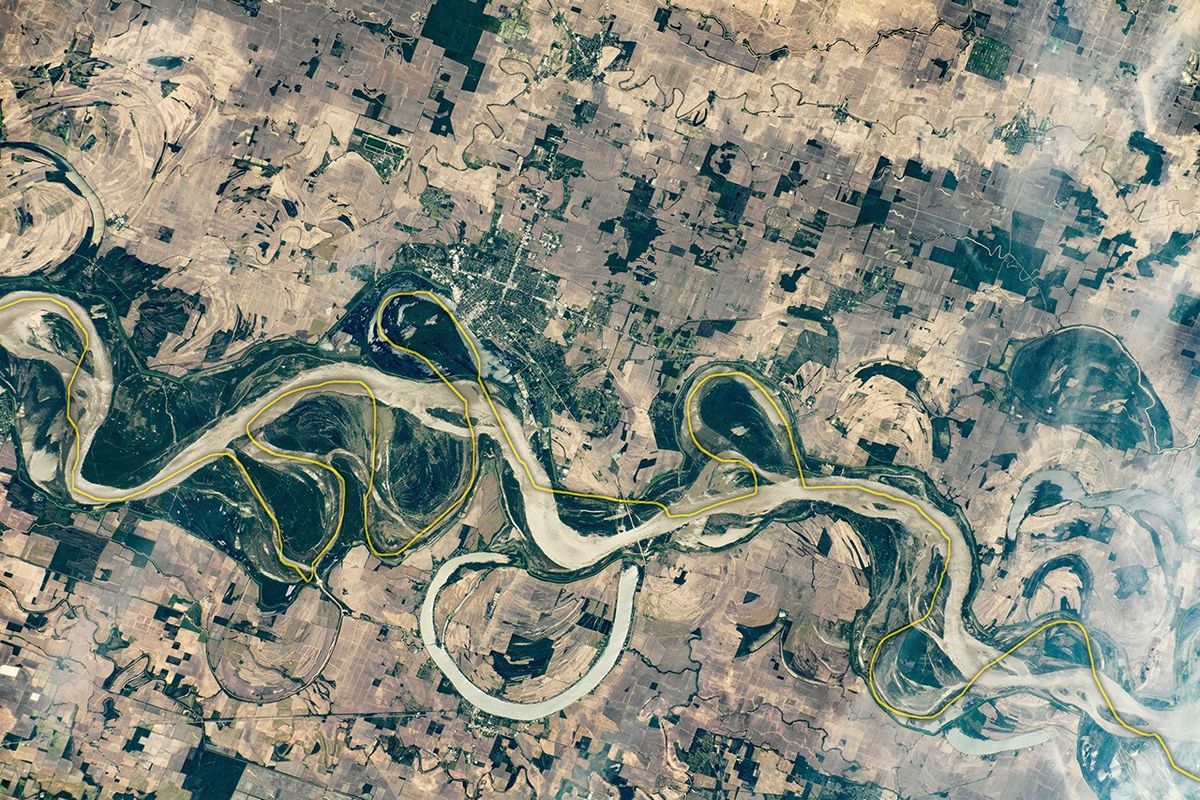
Look at any river from satellite altitude and one thing immediately stands out: rivers almost never run straight. They curve, loop, twist, and in some cases double back on themselves so dramatically that they form complete circles of water almost entirely cut off from the main channel. These sinuous curves are called meanders, and they are not random. They are the product of elegant, predictable physical processes that play out over decades, centuries, and millennia across every river on Earth.
Understanding why rivers curve — and what controls how tightly they loop — is one of the most satisfying chapters in physical geography. It also happens to be directly useful for reading satellite imagery, because meander patterns are among the most distinctive and identifiable features visible from above.
The Physics of the First Curve
Rivers begin to curve because of a simple physical instability. Even a perfectly straight channel in a perfectly uniform landscape will not stay straight for long. Random variations in the riverbed — a slightly harder patch of rock, a fallen tree, an animal burrow — cause the current to deflect slightly. Once deflected, the water hits one bank harder than the other, eroding it outward. The momentum of the flowing water then swings it back across to the other bank, eroding that one too. A slight deflection becomes a gentle curve, which becomes a pronounced bend, which becomes a full meander.
This is called positive feedback: the curve creates conditions that deepen the curve further. The physics is related to a phenomenon called helicoidal flow — a corkscrew-like rotation in the water column that transfers eroded material from the outer edge of the bend (where erosion is fastest) to the inner edge (where deposition builds up). The outer bank wears away; the inner bank builds up. The bend tightens and migrates.
The Meander Wavelength: Why All Rivers Look Similar
One of the most striking facts about river meanders is that their wavelength — the distance from one bend to the equivalent point on the next bend — scales predictably with the width of the river. In virtually every river on Earth, the meander wavelength is approximately 10 to 14 times the channel width. This relationship holds from the smallest stream to the Amazon. It is one of the most robust scaling laws in physical geography, and it means that satellite images of meandering rivers have a characteristic rhythm regardless of their size.
Meanders are not accidents. They are the river solving an optimization problem — distributing energy loss as evenly as possible along its length.
— Luna Leopold, pioneering river geomorphologist
Oxbow Lakes: When Meanders Cut Themselves Off
As meanders develop, the loops become tighter and tighter. Eventually, two parts of the same loop come very close together at the neck of a bend. During a flood, when water levels are high and the river has excess energy, it will cut straight across the neck — taking the most direct route downhill and abandoning the old loop entirely. The loop is left as a curved lake, disconnected from the main channel. These are called oxbow lakes, named for their resemblance to the wooden yoke used with oxen.
From satellite altitude, oxbow lakes are unmistakable. They appear as curved, crescent-shaped water bodies adjacent to an active river channel, often strung along former river courses like beads on a necklace. The Mississippi River floodplain contains hundreds of them. The Amazon has thousands. They are biological hotspots — the still water hosts completely different ecosystems from the active channel — and they are also sediment archives, preserving records of past river behavior in their layered deposits.
Why Some Rivers Meander More Than Others
Not all rivers meander to the same degree. The sinuosity of a river — a measure of how much it curves relative to the straight-line distance from source to mouth — depends on several factors. Slope matters enormously: rivers on very gentle gradients, like those crossing wide coastal plains, have excess energy that they cannot discharge by flowing faster, so they discharge it by lengthening their path — meandering more. Rivers descending steep mountain slopes are more likely to braid, splitting into multiple channels divided by gravel bars, rather than meander.
The cohesiveness of the bank material also plays a role. Rivers cutting through soft clay or silt meander more easily and more quickly than rivers in gravel or bedrock. Some rivers in permafrost zones, like those in Siberia and Arctic Canada, meander with extraordinary amplitude because the frozen ground provides initial constraint, but the shallow active layer in summer erodes easily.
Incised Meanders: When Rivers Are Locked in Stone
One of the most dramatic meander types is the incised meander, where a river has cut deeply into bedrock while maintaining its meandering planform. The Colorado River's famous canyon systems, the Goosenecks of the San Juan River in Utah, and the Wye Valley in Wales all show meanders carved hundreds of meters deep into solid rock. These features form when a meandering river is uplifted — by tectonic forces raising the surrounding plateau — and responds by downcutting vertically while keeping its existing curves. The result is a sinuous canyon whose shape is a fossil record of the ancient floodplain that existed before the uplift.
Reading Meanders in Satellite Imagery
In EarthGuessr and in any satellite imagery context, meander patterns carry a wealth of location information. Highly sinuous rivers in wide, flat floodplains suggest coastal lowlands or major continental basins — the Mississippi, the Amazon, the Ob in Siberia, the Irrawaddy in Myanmar. The density of oxbow lakes tells you how active the meander migration has been, which in turn suggests something about the river's age and the softness of its floodplain sediments. Incised meanders in arid terrain are almost exclusively North American or Middle Eastern, where the combination of plateau topography and canyon-cutting rivers is geologically distinctive.
The next time you spot a sinuous, looping river in a satellite image, you are looking at one of geography's most elegant processes — thousands of years of water finding its way downhill, distributing its energy, carving its banks, and slowly migrating across a floodplain. That graceful curve is not an accident. It is physics made visible from space.