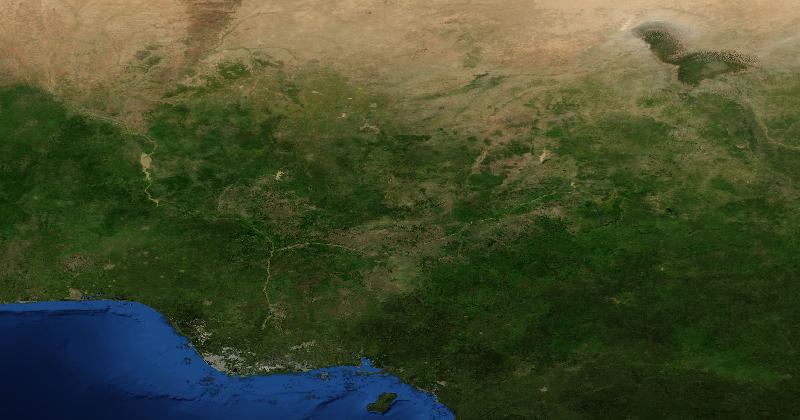
Nigeria contains around 230 million people, the largest population on the African continent and one of the largest in the world. It is also one of the more difficult African countries to identify from satellite imagery, because its landscape spans almost every West African biome — from tropical mangrove swamps in the south to the dust-edge of the Sahel in the north — and shares those biomes with neighbouring countries.
That said, Nigeria has a few visual fingerprints that no other African country quite matches: the world-class sprawl of Lagos, the unmistakable fan of the Niger Delta, and a settlement density along certain corridors that you do not see elsewhere on the continent. Here is what to look for.
The Niger Delta: One of Africa's Most Recognisable Features
The Niger Delta is the single most distinctive feature of Nigerian geography. The Niger River — the third-longest in Africa after the Nile and the Congo — fans out into a vast delta covering about 70,000 square kilometres along the Gulf of Guinea. From orbit, the delta appears as an enormous green fan of mangrove forest and swamp, threaded by hundreds of braided distributary channels, fading into the dark Atlantic at its southern edge.
Two features make the delta unmistakable. First, the fan shape is wider and more bulbous than any other African river mouth — the Nile Delta is a clean triangle, the Congo has almost no surface delta because it pours straight off a continental shelf, but the Niger Delta is round and spreading. Second, the delta is dotted with the gas flares and oil infrastructure that mark Nigeria's hydrocarbon belt. At night-time satellite imagery, the constellation of flares across the Niger Delta is one of the most distinctive man-made features on the continent.
Lagos: Africa's Megacity
Lagos is the largest city in Africa by metropolitan population, with roughly 25 million people, and is the second-fastest-growing megacity on Earth. From orbit, Lagos is one of the most readable cities on the continent. It sits on a series of low islands and lagoons along the western Gulf of Guinea, with the urban footprint hugging the coast for over 100 kilometres east-west.
The give-aways: a vast lagoon (the Lagos Lagoon) sits behind the coastal islands; the older Lagos Island sits as a dense node with several visible bridges connecting it to the mainland; Victoria Island and Lekki Peninsula extend eastward as more recently developed grids; the new Eko Atlantic land-reclamation project juts out into the ocean as a clearly artificial peninsula. The whole metropolitan area is a vast irregular mosaic of dense, low-rise neighbourhoods, with the Murtala Muhammed International Airport visible north of the city centre.
If your satellite frame shows a sprawling coastal megacity wrapped around a long lagoon, with multiple bridge crossings and a clearly reclaimed peninsula, you are looking at Lagos. No other coastal African city has this combination of features.
The North-South Climate Gradient
Nigeria sits across one of the sharpest climate gradients in West Africa. From the wet tropical coast in the south to the dust-grey edge of the Sahel in the north, you pass through five distinct vegetation zones in roughly 1,200 kilometres. From orbit, this manifests as a clean colour transition:
- Coastal mangroves and swamp (Niger Delta, Lagos lagoon, Cross River): dark green, almost black, with braided channels.
- Rainforest belt (Edo, Ondo, Cross River): a thinning band of dense green canopy, much of it now degraded by logging and oil palm plantations.
- Derived savanna (the middle belt): patchy green and tan, a mosaic of farmland and remnant trees. This is the largest single zone.
- Guinea savanna (most of central-northern Nigeria): tan and dry-green, open grassland with scattered trees and intensive smallholder agriculture.
- Sudan and Sahel (the extreme north — Sokoto, Borno): pale tan, sparse vegetation, increasingly desert as you approach Niger and Lake Chad.
If your frame shows the transition between two of these zones — say, a clear gradient from rainforest green to tan savanna — and the gradient runs roughly north-south, you are likely in central Nigeria or its immediate neighbours.
The Inland Cities: Kano, Abuja, Ibadan
Nigeria has more million-plus cities than any other African country. Several of them have distinctive aerial signatures.
- Abuja: the planned federal capital built in the 1980s. It sits on a flat plateau in the middle of the country, with a clear Doxiadis-influenced grid, the Aso Rock granite monolith visible to the east of the city, and Zuma Rock standing alone a few dozen kilometres to the northwest. The grid is far more legible than any other Nigerian city.
- Kano: the largest city in northern Nigeria, set in the dry savanna. From above, the old walled city is partly visible as a circular outline, with the airport to the southeast and Hadeija-Nguru wetlands further east.
- Ibadan: Africa's largest indigenous urban area by population, an enormous low-rise sprawl of red-roofed dwellings in the southwestern interior. The roofs themselves are a distinctive cue — the corrugated rust-red metal sheeting reads strongly in high-resolution imagery.
- Port Harcourt: the major Niger Delta city, surrounded by mangroves, oil infrastructure, and the network of creeks that drain into the Gulf of Guinea.
- Kaduna: a planned colonial-era city in the centre-north, with a clear grid layout and the Kaduna River running through it.
Lake Chad and the Far North
Nigeria's far northeast meets one of Africa's most consequential geographic features: Lake Chad. The lake has lost about 90 percent of its surface area since the 1960s due to drought, dam-building on its feeder rivers, and irrigation extraction. From satellite imagery, the surviving lake is a small patch of blue surrounded by an enormous expanse of pale, dried-out lakebed and reed flats. The Nigerian portion is the southwestern shoreline, around Lake Chad's largest remaining open water.
If your frame shows a small blue lake remnant surrounded by an obviously much larger former lakebed, with desert encroaching on the western side, you are looking at the Chad Basin — most likely the Nigerian or Cameroonian shore.
Telling Nigeria from Its Neighbours
Nigeria's most-often-confused neighbours from satellite imagery are Ghana, Cameroon, Niger, and Benin. A few quick checks:
- Niger Delta visible? Nigeria — no other West African country has a delta of this size.
- Megacity on a long lagoon visible? Almost certainly Lagos.
- Planned grid city next to a granite monolith? Abuja, central Nigeria.
- Sahelian savanna with a small Lake Chad fragment? Nigeria, Niger, Chad, or Cameroon — narrow down using settlement density (Nigeria is much denser).
- Coastal mangroves but no large megacity? Probably Cameroon or southern Ghana, not Nigeria.
- Cocoa, oil palm, and dense rural settlement but no rainforest belt? Likely Ghana or Côte d'Ivoire, not Nigeria.
The Quick Field Test
Nigeria's three big tells are easy to remember: the Niger Delta's enormous green fan, Lagos's lagoon-wrapped megacity sprawl, and Abuja's planned grid against a granite monolith. Combine those with the country's distinctive north-south climate gradient and the dense rural settlement that signals Africa's most populous nation, and you have enough to recognise Nigeria from most satellite frames. The country is varied, vast, and visually rich — once you train your eye, it stops blending into West Africa and starts standing out as the heavyweight it is.