All posts
GeographyMay 9, 20268 min read read

How to Spot Italy from Satellite Imagery: The Boot, the Po Valley, and the Hilltop Towns

Italy has one of the most recognisable shapes on Earth and one of the most varied aerial signatures in Europe — the flat industrial Po Valley, the spine of the Apennines, terraced Mediterranean coasts, and hilltop towns visible from orbit. Here is the full guide.

How to Spot Italy from Satellite Imagery: The Boot, the Po Valley, and the Hilltop Towns

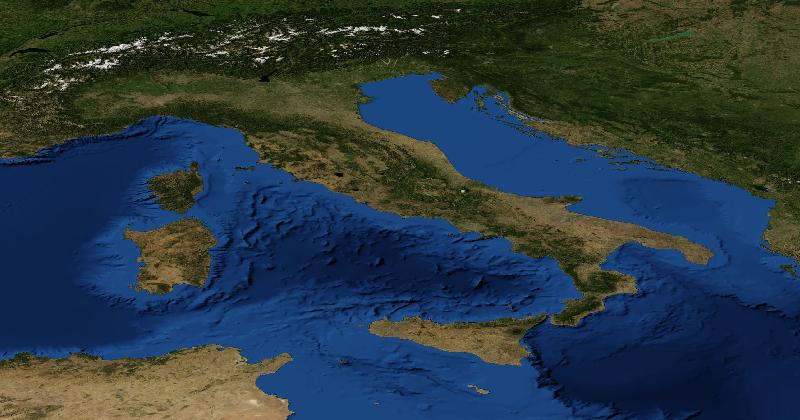
Italy has one of the most recognisable national outlines on Earth — the unmistakable boot kicking the island of Sicily into the Mediterranean. But the boot only helps when you have a wide enough satellite frame to see most of the country at once. In a typical round of a geography game, you will see a single small frame with no coastline visible at all, and the question becomes whether you can identify Italy from what is inside the frame rather than its silhouette. This guide focuses on those internal signatures.

Italy is surprisingly varied. The Po Valley in the north is one of the most industrialised and intensively farmed plains in Europe. The Alps along the northern border are some of the most glaciated mountains on the continent. The Apennines run the length of the peninsula. Tuscany and Umbria have their famous hilltop-town landscape. The south has its own arid, dramatic look. Sicily and Sardinia are island worlds of their own. Each region produces distinctive satellite signatures, and once you can recognise them Italy becomes one of the easier European countries to lock in fast.

The Po Valley: A Geometric Northern Plain

The Po Valley — the broad flat plain stretching across northern Italy from Piedmont in the west through Lombardy, Emilia-Romagna, and the Veneto to the Adriatic — is the largest plain in Italy and one of the most intensively used landscapes in Europe. From orbit, it looks like a vast green and brown patchwork of large rectangular fields, dense networks of irrigation canals, scattered industrial zones, and a tight cluster of cities (Turin, Milan, Brescia, Verona, Padua, Venice, Bologna) connected by a dense motorway network. The fields are larger than typical European farmland, often planted with rice in the western Po (Vercelli and Novara), corn, soybeans, and wheat further east, and orchards and vineyards on the rolling foothills to the north and south.

Several signatures lock the Po Valley in. The river itself — wide, sinuous, with extensive levees and oxbow lakes — runs east-west across the plain. The Adriatic coast at the eastern end has the distinctive lagoons of Venice and the Po Delta. The Alps rise sharply to the north, often visibly snow-capped. The Apennines rise gently to the south. And the proliferation of mid-sized cities arranged in a roughly linear pattern along the Via Emilia is unique in Europe.

Tuscany, Umbria, and the Hilltop-Town Landscape

Central Italy has one of the most recognisable rural landscapes in the world. Tuscany, Umbria, the Marche, and Lazio all share a pattern: rolling hills with cypresses lining ridge-top roads, olive groves and vineyards on the slopes, fields of wheat or sunflower in the valleys, dense forest crowning the higher hills, and small towns perched on hilltops, often medieval in origin and visible from orbit as clusters of red-tile roofs grouped around a tower or fortress.

The hilltop-town pattern is one of the strongest single signals of central Italy. Towns like Siena, San Gimignano, Cortona, Assisi, Orvieto, and Urbino all sit on hilltops and are clearly visible from satellite altitude as compact stone-and-tile settlements surrounded by carefully managed agricultural land. Other Mediterranean countries have hilltop towns (Spain, Greece, Croatia, Portugal), but Italy has the highest density of them in the world and the surrounding agricultural texture is distinctively Italian — small fields, alternating crops, frequent cypresses, and meticulously maintained terraces.

Italian rolling hills with cypress trees and vineyards
Italy's hilltop towns and meticulously managed agricultural landscapes produce one of the most recognisable aerial signatures in Europe.

The Apennines, the Alps, and Italian Volcanism

The Apennines run roughly 1,200 kilometres down the length of the Italian peninsula, forming a continuous spine of mountains rising to nearly 3,000 metres in the central section. From orbit, they appear as a long, narrow band of green-forested ridges with distinctive limestone karst features in places, dotted with stone villages in the high valleys, and bordered on each side by lower hills running down to the coastal plains.

Italian volcanism gives the country some of its most distinctive landforms. Vesuvius dominates the Bay of Naples, with the famous cone visible from orbit alongside the ruins of Pompeii and Herculaneum. Etna in Sicily is the largest active volcano in Europe, with its broad shield form and frequently visible eruption plumes. Stromboli and Vulcano in the Aeolian Islands are smaller but unmistakable. And the volcanic crater lakes of central Italy — Bracciano, Bolsena, Vico, Albano, Nemi — appear as nearly circular lakes in otherwise hilly countryside.

Italian Cities and the Mediterranean Coast

Italian cities have a distinctive footprint from orbit. Historic cores are dense, compact, and built around piazzas, with the famous Roman, medieval, and Renaissance street patterns clearly visible in cities like Rome, Florence, Bologna, Naples, and Venice. Venice in particular is unmistakable from satellite altitude — a fish-shaped city of islands divided by canals, sitting in a vast lagoon separated from the Adriatic by long thin sandbars. Rome's historic core is a tight cluster on the Tiber's bend, with the modern city extending in radial belts outward and the ring road (the Grande Raccordo Anulare) clearly visible.

The Italian coastline has its own signatures. The Ligurian Riviera has the Cinque Terre's terraced villages clinging to cliffs above the Mediterranean. The Amalfi Coast has similar terracing on dramatic limestone cliffs south of Naples. The Adriatic coast has long sandy beaches with closely spaced beach umbrellas visible from orbit in the summer. The Apulian coast has olive groves stretching almost to the sea, and the trulli huts of Alberobello have a distinctive small white cone-roof pattern. Sardinia's coast has a more rugged, less developed look. Sicily's coast wraps a triangular island with Etna dominating the east.

Regional Tells

  • Lombardy and the central Po Valley: dense canal networks, rice paddies near Vercelli (sometimes flooded silver in spring), and the unmistakable footprint of Milan with its radial street pattern centred on the cathedral.
  • Tuscany and Umbria: rolling hills, cypress avenues, vineyards, olive groves, and hilltop towns.
  • Lazio: the Roman countryside (Agro Romano) around Rome, with the Tyrrhenian coast to the west and the Apennines to the east.
  • Campania: Vesuvius, the Bay of Naples, the Amalfi Coast, dense small-scale agriculture on volcanic soils.
  • Apulia: olive groves stretching to the horizon, white-painted hilltop towns, the trulli of Alberobello, and the flat heel of the boot.
  • Sicily: triangular island with Etna in the east, ancient Greek and Arab agricultural patterns, dramatic coasts.
  • Sardinia: more rugged interior, distinctive pastoral landscape with sheep paths, less densely populated coast except for the Costa Smeralda.

Where Italy Gets Confused

Italy can be confused with several Mediterranean neighbours. The Po Valley resembles parts of southern France or northern Spain at large scale — disambiguators are the specific city patterns, the Italian road style (autostradas have distinctive green signage and toll plazas), and the snow-capped Alps almost always visible to the north. Tuscany resembles parts of Provence or eastern Spain — but the density of hilltop towns and the specific cypress-and-vine landscape is uniquely Italian. The southern Italian coast can be confused with Greek or Croatian coast — disambiguators are usually the specific village architecture and the field patterns just inland from the coast.

Pro-Tier Signals

Advanced players use finer details. The red-tile roofs of Italian buildings are warmer in tone than Spanish equivalents and more orange than German or Austrian tiles. The specific shape and arrangement of Italian piazza patterns are visible from orbit in historic centres. The autostrada toll plaza barriers and characteristic green signage are visible at close zoom. The pattern of Italian agricultural irrigation, the specific terracing styles in different regions, and the iconic shape of Italian regional villas (Tuscan farmhouses, Venetian villas, Sicilian masserie) all give regional cues. And the position of the Apennines as a backdrop in many rural frames, plus glimpses of the Alps further north, is often enough to confirm Italy versus its neighbours.

Practise It

Italy is one of the most rewarding European countries to learn for geography games because its regional signatures are so distinct and the country shows up frequently. EarthGuessr drops you into Po Valley industrial zones as readily as Tuscan hilltop landscapes and southern olive country, and a focused session across Italian rounds will quickly internalise the regional differences. Within a few sessions, Italy becomes one of the fastest first-second identifications in European play.

Series · Spot the Country

More from this series

View all in Spot the Country →

Ready to explore?

See the world from above and test your geography skills on a 3D globe.