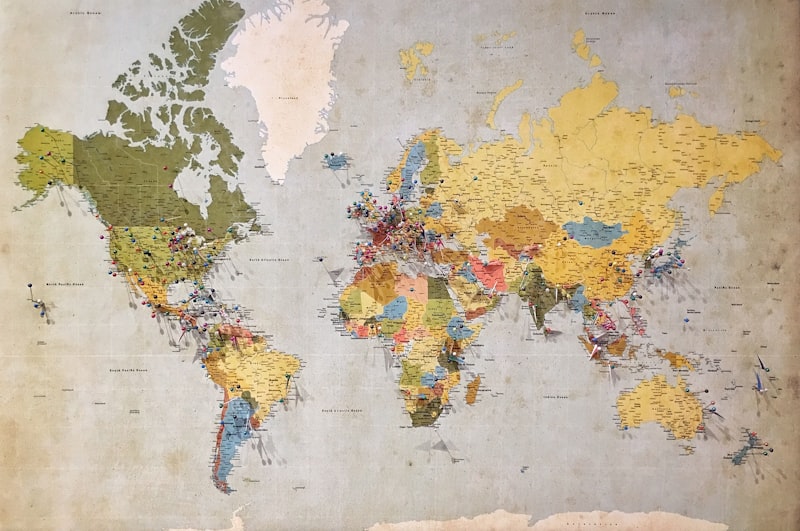
Europe, depending on how you count, has 44 to 50 countries spread across roughly 10 million square kilometres. The United States, with similar total area, has 50 states but is a single country. China, which is comparable in size to the continental United States, is also one country. India is one country. Even Russia, which alone is larger than the rest of Europe combined, is one country. So why is Europe so fragmented?
The answer is a combination of geography, climate, language, and history that has pulled Europe in the direction of fragmentation for almost three thousand years, and that even the centralising forces of the past century — the Roman Empire's successors, the Holy Roman Empire, Napoleon, the Soviet bloc, and the European Union — have never fully overcome. Here is the explainer.
Reason 1: Europe's Geography Encourages Division
Europe's physical geography is unusually fragmented for a landmass its size. The Iberian Peninsula is cut off from France by the Pyrenees. Italy is divided from central Europe by the Alps. The Balkans are subdivided by mountain ranges and river valleys into pockets that have hosted distinct cultures for thousands of years. Britain and Ireland are islands. Scandinavia is divided from continental Europe by the Baltic and North Seas. The Carpathians cut across Central Europe. The continent has more peninsulas, mountain ranges, and natural barriers per unit area than almost anywhere else on Earth.
Compare this to China, which is dominated by two great river systems (the Yellow and the Yangtze) flowing across vast plains that have been politically and culturally unified for over 2,000 years. Or to the central United States, where you can drive over 1,500 miles east-to-west across continuous prairie without crossing a meaningful natural barrier. Geography matters: when terrain divides people, languages and cultures evolve differently, and political boundaries follow.
Reason 2: The Roman Empire Broke and Was Never Fully Replaced
At its peak, the Roman Empire unified most of what is now Western Europe and the Mediterranean rim under one political authority, one administrative system, and (in the western half) one language. When the Western Roman Empire collapsed in the 5th century, the unification fell apart. The successor kingdoms — the Visigoths in Iberia, the Franks in Gaul, the Lombards in Italy, the Anglo-Saxons in Britain — were all smaller. The Eastern Roman (Byzantine) Empire continued for another thousand years, but its territory shrank steadily.
Several later empires tried to re-unify Europe: Charlemagne in the 9th century, the Holy Roman Empire from the 10th through the 19th centuries, Napoleon in the early 19th, the Soviet bloc in the 20th, the European Union from the 1950s onward. None succeeded fully. The European Union has come closest to unifying Western Europe under a single political and economic system, but even that is a voluntary association of 27 sovereign states rather than a unified country.
Reason 3: Language and Cultural Identity Got Embedded Early
Europe is home to roughly 200 native languages spread across multiple language families — Romance, Germanic, Slavic, Celtic, Finno-Ugric, Albanian, Greek, Basque (a language isolate with no known relatives), and others. Most of these languages stabilised between 500 and 1500 CE, when populations were still relatively immobile and the local geography was reinforcing differences. Once a population speaks a different language, has different customs, and uses different legal traditions, the path of least resistance is for them to stay politically distinct from neighbours.
Compare this to China, where Mandarin became the language of administration over much of the territory more than a thousand years ago, and where a unified writing system has allowed mutual intelligibility across many spoken dialects. Or to the United States, which is large but where the dominant settler population brought a single language (English) and a single legal tradition (English common law) across the entire continent in just over 200 years.
Reason 4: The Treaty of Westphalia Locked In the Sovereign State System
In 1648, the Peace of Westphalia ended the Thirty Years' War and established the principle that sovereign states have authority over their own territory and that no external power has the right to intervene. This principle — sometimes called "Westphalian sovereignty" — is the foundation of the modern international state system, and it was developed specifically to manage Europe's fragmentation. By making fragmentation a legal principle rather than a problem to be solved, the Westphalian system actually preserved and extended it.
For the next 350 years, European borders shifted (sometimes dramatically), but the principle that each sovereign state had legitimate authority over its territory remained. Empires rose and fell, but no single state ever absorbed all the others. The European Union's institutional design — a voluntary union of sovereign states pooling specific competences — is itself a 21st-century version of the Westphalian compromise.
Reason 5: 20th-Century Decolonisation and the Break-Up of Multinational States
The number of countries in Europe actually grew dramatically in the 20th century, as multinational empires broke apart. The fall of the Austro-Hungarian Empire after World War I produced Austria, Hungary, Czechoslovakia, Yugoslavia, and other states. The fall of the Ottoman Empire reshaped the eastern Mediterranean. The fall of the Soviet Union in 1991 produced 15 independent states, several of which are in Europe (Russia, Ukraine, Belarus, Moldova, Lithuania, Latvia, Estonia). The break-up of Yugoslavia in the 1990s produced seven new states (Slovenia, Croatia, Bosnia and Herzegovina, Serbia, Montenegro, North Macedonia, Kosovo). Czechoslovakia split into the Czech Republic and Slovakia in 1993.
Modern Europe has more countries than it did in 1900 by a wide margin. The trend over the past century has been toward fragmentation, not consolidation.
How Many Countries Are There Really?
The exact count depends on definitions. The most commonly cited number is 44 European sovereign states, but you can get to 50 or higher by including the following edge cases:
- Transcontinental states that are partially in Europe and partially in Asia (Russia, Turkey, Kazakhstan, Azerbaijan, Georgia).
- States with limited international recognition (Kosovo, recognised by most Western countries but not by Russia, China, Spain, and several others).
- Microstates (Vatican City, Monaco, San Marino, Liechtenstein, Andorra, Malta).
- Self-governing territories that are not fully sovereign (Greenland, Faroe Islands, Gibraltar, Isle of Man, the Channel Islands).
- Disputed territories (Transnistria, Abkhazia, South Ossetia, Northern Cyprus, all recognised only by a handful of states or none at all).
The standard count of 44 includes the obvious sovereign states from Iceland to Cyprus and from Portugal to Ukraine. The Council of Europe has 46 member states. The European Union has 27. The United Nations recognises around 50 European states depending on the criteria used.
What This Tells Us About Geography and History
Europe's fragmentation is not an accident. It is the product of a specific combination of physical geography that divides populations, a historical centre that never fully reunified after the fall of Rome, languages and cultures that became locked in before centralising forces could homogenise them, and a sovereign state system that has actively preserved fragmentation as a principle. The result is one of the most politically diverse and complex continents on Earth — and a geography puzzle that takes years to master.
Spin the EarthGuessr globe to Europe and you will land in a different country every few hundred kilometres, each with its own language, alphabet, road signs, architectural style, and agricultural pattern visible from orbit. That density is one of the things that makes European geography games so rewarding — and one of the things that makes the continent so endlessly interesting. Forty-four countries in 10 million square kilometres is not a quirk of mapping. It is the geographic and historical fingerprint of Europe.