All posts
GeographyApril 13, 20268 min read read

How to Spot Thailand from Satellite Imagery: Rice Plains, Karst Bays, and the Long Southern Coast

Thailand has some of the most varied landscapes in Southeast Asia — the vast central rice plain, the limestone karsts of Krabi and Phang Nga, the mountainous north, and the long beach-fringed peninsula stretching south to Malaysia. Here is how to identify it from orbit.

How to Spot Thailand from Satellite Imagery: Rice Plains, Karst Bays, and the Long Southern Coast

Thailand covers 513,000 square kilometres in the heart of mainland Southeast Asia, with a long arm reaching south down the Malay Peninsula to the Malaysian border. The country has one of the most varied landscapes in the region: a vast central rice plain around the Chao Phraya river, mountainous terrain in the north, a dry plateau in the northeast, dramatic karst limestone landscapes along the southwestern coasts, and dense rainforest in some interior areas. The capital, Bangkok, is one of the largest cities in Southeast Asia.

For geography games, Thailand is a high-value country to learn because of its size, the strength of its regional aerial signatures, and the fact that it appears often in any global rotation. This guide walks through the cues that lock Thailand in and tell you where in the country you have landed.

The Central Plain: One of the Largest Rice Producers on Earth

The Chao Phraya river plain in central Thailand is one of the most productive rice-growing regions in the world, supplying Thailand's position as one of the largest rice exporters on the planet. From orbit, the central plain is unmistakable: a vast flat green and silver landscape of rice paddies stretching from the Gulf of Thailand north to the foothills of the northern mountains, divided by an intricate network of canals (khlongs) and the meandering Chao Phraya itself. The pattern of small rectangular paddies, the bright silver of flooded fields in the growing season, and the dense network of villages along the canals is one of the strongest Thai signals available.

Bangkok dominates the southern central plain. The city has one of the most distinctive aerial signatures in Asia: a sprawling low-to-mid-rise urban area divided by the Chao Phraya River winding through, with the historic core of Rattanakosin Island on a bend of the river (containing the Grand Palace and Wat Phra Kaew), the dense business district of Sukhumvit and Silom extending east, the residential districts of Thonburi west of the river, and the new city extending north to Don Mueang and east toward Suvarnabhumi International Airport. The airport itself is unmistakable — a vast geometric complex on the eastern outskirts.

The Karst Coast and the Andaman Sea

Southwestern Thailand along the Andaman Sea has one of the most distinctive coastlines in the world. The limestone karsts of Krabi, Phang Nga Bay, and the islands of Phi Phi rise as sheer cliffs from turquoise water, with characteristic vertical walls, jungle-covered summits, and hidden lagoons. Phang Nga Bay alone has hundreds of small karst islands visible from orbit, each appearing as a sharp green-topped pillar in pale turquoise water. Phuket Island to the southwest is one of the largest islands in Thailand with a distinctive long thin shape and several smaller surrounding islands.

Further south, the long thin Malay Peninsula portion of Thailand has the Andaman coast on the west (with Phi Phi, Krabi, Phuket, and further south the islands of Tarutao and the Ko Lipe area near the Malaysian border) and the Gulf of Thailand coast on the east (with Hua Hin, the islands of Ko Samui, Ko Phangan, and Ko Tao, and beyond). The combination of karst limestone, turquoise water, and long sandy beaches produces some of the most photogenic satellite frames available in Asia.

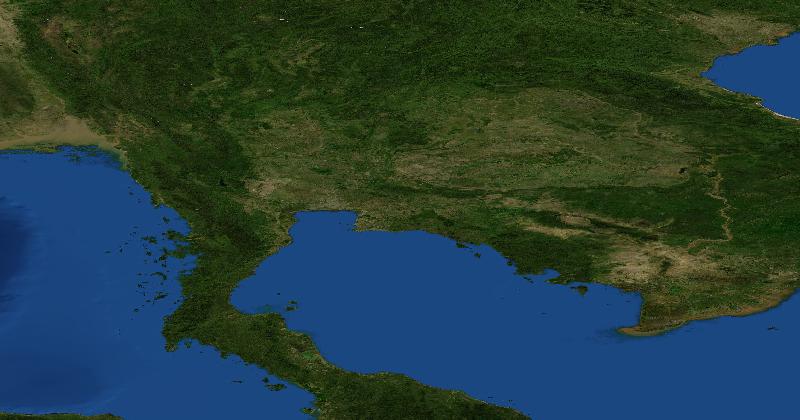
Thai tropical landscape with limestone karsts and ocean
Thailand's combination of vast rice plains, limestone karst coasts, and mountainous interior produces some of the most varied aerial signatures in Southeast Asia.

The Mountainous North

Northern Thailand is dominated by a series of mountain ranges extending south from the Burmese Shan States. The highest peak in Thailand, Doi Inthanon at 2,565 metres, is in this region. From orbit, the north appears as a landscape of dense green forested mountains, with characteristic terraced agriculture on the lower slopes, small valleys with rice paddies, and the cities of Chiang Mai and Chiang Rai visible as moderately dense urban areas in larger valleys.

Hill tribe villages (Karen, Hmong, Akha, and others) are scattered through the higher mountains, with characteristic small-scale terraced agriculture and traditional housing styles. The Golden Triangle area where Thailand meets Myanmar and Laos at the Mekong River is visible from orbit by the river itself — a wide brown ribbon cutting through forested mountains — and the small towns of Sop Ruak and Chiang Saen on the Thai side. The Mae Hong Son loop area in the far northwest has some of the most dramatic mountain terrain in the country.

The Northeast Plateau (Isaan)

Northeastern Thailand — the Isaan region — is a vast dry plateau covering roughly a third of the country. From orbit, Isaan looks distinctly different from the rest of Thailand: drier, with more visible bare soil, scattered small reservoirs (the dams of the Lam Pao, Lam Pao Yai, and Sirinthon projects are visible as large lakes), and characteristic Isaan villages with their distinctive layout around a central temple. The Mekong River forms the northeastern border with Laos, visible from orbit as a wide brown river with the Lao cities of Vientiane and Pakse on the opposite bank.

Isaan's agriculture is more variable than the central plain — sticky rice, cassava, sugarcane, and rubber are common, and the landscape generally has more rectangular fields and less of the intricate canal-and-paddy pattern of the central plain. Cities like Khon Kaen, Udon Thani, Nakhon Ratchasima (Korat), and Ubon Ratchathani serve as regional centres.

Regional Tells

  • Central Plain (Chao Phraya Basin): vast rice paddies, the Chao Phraya River and its tributaries, dense canal networks, and Bangkok at the southern end.
  • Bangkok and the immediate surroundings: dense urban area with the Chao Phraya winding through, Suvarnabhumi Airport east of the city, Don Mueang Airport north of the city.
  • North (Chiang Mai, Chiang Rai, Mae Hong Son): mountainous, forested, with terraced agriculture, small valley cities, and the Golden Triangle Mekong border with Myanmar and Laos.
  • Northeast/Isaan: dry plateau, smaller fields, Mekong River border with Laos, reservoirs, and the regional centres of Khon Kaen, Udon Thani, and Nakhon Ratchasima.
  • East (Pattaya, Rayong, Chanthaburi, Trat): coastal Gulf of Thailand region with Pattaya and the islands of Ko Samet and Ko Chang, and the eastern fruit-growing regions.
  • Southwest (Andaman Sea: Phuket, Krabi, Phang Nga): karst landscapes, turquoise water, tourist islands, and dense rainforest inland.
  • South (Malay Peninsula portion: Surat Thani, Nakhon Si Thammarat, Songkhla, Yala): rubber and palm oil plantations, long beaches on both coasts, the islands of Ko Samui and Ko Phangan, and the Muslim-majority deep south near the Malaysian border.

Where Thailand Gets Confused

Thailand can be confused with neighbouring Southeast Asian countries — Cambodia, Laos, Myanmar, Vietnam, Malaysia, and even Indonesia. The disambiguators are usually specific: the density of the central rice plain canal network (uniquely Thai at this scale), the distinctive Thai Buddhist temple architecture with steep gold-and-red roofed wats visible from orbit, the specific small-town and village patterns of central and northeastern Thailand, the unique karst coasts of the Andaman, and the road network density (generally higher than Laos or Cambodia, comparable to Malaysia). The Mekong border with Laos is visible by the river itself and the marked contrast in infrastructure density between the two sides.

Pro-Tier Signals

Advanced players use finer details. The specific colour and shape of Thai Buddhist wats (temples), with characteristic stepped roofs in red, gold, and orange tile, visible at moderate zoom in most rural and urban scenes. The pattern of Thai rice paddy mosaics, which differ subtly from Vietnamese or Cambodian equivalents — Thai paddies tend to be slightly larger and more regularly geometric. The shape of Thai canal networks (khlongs), particularly in central and southern provinces. The characteristic Thai sugarcane processing plants with their distinctive smoke plumes and large cane stockpiles. The pattern of rubber plantations in southern Thailand — long parallel rows of trees visible from orbit. And the specific shape of Thai beach resort developments, particularly the bungalow-style layouts of islands like Ko Samui.

Practise It

Thailand is one of the more rewarding Southeast Asian countries to learn for geography games because of the variety of landscape and the frequency of appearances. The central plain, the karst coast, the mountainous north, the dry Isaan plateau, and the southern peninsula each have signatures distinct enough to lock in fast. Spend a focused session on EarthGuessr playing Thai rounds and the country will quickly become one of the more reliable identifications across the region.

Series · Spot the Country

More from this series

View all in Spot the Country →

Ready to explore?

See the world from above and test your geography skills on a 3D globe.