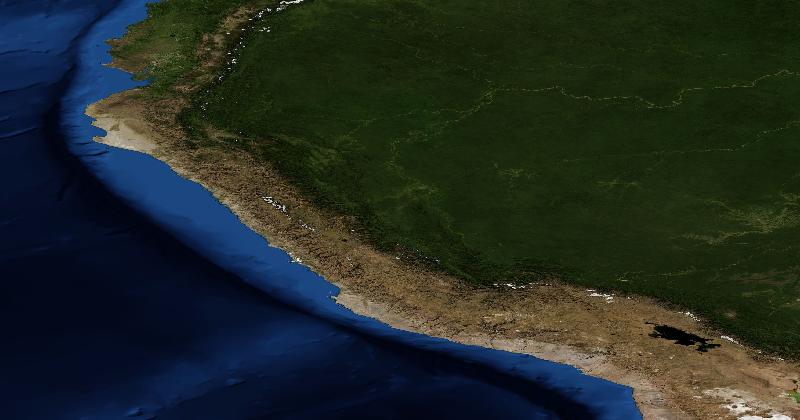
Peru covers 1.29 million square kilometres on the western coast of South America — the third-largest country on the continent after Brazil and Argentina. The country has one of the most extreme cross-sectional geographies on Earth: a narrow coastal desert strip in the west, the high Andes running down the centre, and the vast lowland Amazon in the east. Within a few hundred kilometres, you can travel from a coastline that hasn't seen significant rain in decades to glaciated peaks over 6,000 metres to dense tropical rainforest where annual rainfall exceeds 3,000 millimetres. Few countries on Earth pack so much landscape variety into a single national footprint.
For geography games, Peru is a high-value country to learn because each of the three major regions has a strongly distinctive aerial signature. This guide walks through the cues that lock Peru in fast and tell you which region you have landed in.
The Coastal Desert: One of the Driest Inhabited Strips on Earth
Peru's coastal strip, the costa, runs for roughly 2,400 kilometres from the Ecuadorian border in the north to the Chilean border in the south. The strip is between 50 and 100 kilometres wide and is one of the driest places on Earth — Lima receives less than 10 millimetres of rain per year, and parts of the southern coast can go years without any measurable precipitation. From orbit, the Peruvian coast appears as a strip of pale tan and brown desert between the bright blue Pacific Ocean and the rapidly rising green and brown Andean foothills to the east.
The desert is broken by roughly 50 short rivers flowing west from the Andes to the Pacific, each producing a green oasis valley in the otherwise barren terrain. From orbit, these river valleys are unmistakable — narrow green ribbons of intensive irrigated agriculture (rice, sugarcane, asparagus, cotton, fruit) cutting through pale brown desert, with cities and towns clustered along each valley. The pattern of these green river valleys at regular intervals along an otherwise empty coast is essentially unique to Peru and adjacent northern Chile.
The Andean Highlands: One of the Highest Inhabited Regions on Earth
The Peruvian Andes (the sierra) run down the centre of the country, divided into three main ranges (the Cordillera Occidental in the west, Cordillera Central in the centre, and Cordillera Oriental in the east) with high plateaus (altiplano) and deep valleys between them. The Andes reach their highest in southern Peru at Huascarán (6,768 metres), the tallest peak in the country. From orbit, the Peruvian highlands appear as a vast textured zone of dramatic mountains, glacial valleys, high lakes, and characteristic terraced agriculture clinging to the slopes.
Lake Titicaca on the Bolivian border is the highest large lake on Earth (3,812 metres) and one of the largest in South America, visible from orbit as a vast blue expanse surrounded by high altiplano with characteristic floating reed islands of the Uros people visible at close zoom. The Sacred Valley near Cusco contains some of the most photogenic Andean landscape — terraced fields stepping up steep valley walls, characteristic Andean villages with red-tile roofs, and ancient Inca terraces still in use today. Machu Picchu sits on a ridge above this region and is visible from satellite altitude as a distinctive cluster of stone ruins on a green mountain saddle.
The Amazon: Peru's Eastern Lowlands
Roughly 60 percent of Peru is covered by the Amazon rainforest, in the eastern half of the country known as the selva. From orbit, the Peruvian Amazon appears similar to the Brazilian Amazon but with distinctive features: the Andes rising sharply along the western edge (the abrupt transition from forested mountain to flat rainforest is one of the most striking geographical boundaries on Earth), the lowland Amazon rivers winding through with characteristic dramatic meanders (the Ucayali, Marañón, and Amazon itself), and the city of Iquitos visible as the largest city in the world accessible only by river or air.
The Peruvian Amazon is divided into two main subregions. The high jungle (selva alta) on the eastern Andean slopes has terraced agriculture, coffee plantations, and characteristic small towns at the foot of the mountains — Tarapoto, Tingo María, La Merced, and others. The low jungle (selva baja) is the vast lowland rainforest extending from the Andean foothills east to the borders with Brazil, Colombia, and Bolivia. Iquitos, the largest city in the selva, sits at the confluence of the Ucayali and Marañón rivers where they form the Amazon proper, and is visible from orbit as a small urban patch surrounded by hundreds of kilometres of unbroken green forest.
Peruvian Cities
Lima dominates Peru's urban geography. The metropolitan area holds roughly a third of the country's population (around 11 million people) and stretches along the coast in a long thin strip wedged between the Pacific and the Andean foothills. From orbit, Lima has a distinctive footprint: the dense colonial core in the centre with the historic Plaza de Armas, the wealthy southern districts of Miraflores, Barranco, and San Isidro along the coast, the airport and port at Callao on a peninsula extending into the Pacific, and the vast informal settlements (pueblos jóvenes) climbing the hillsides at the city's edges.
Other Peruvian cities have their own signatures. Cusco at 3,400 metres is the historic Inca capital, with the central Plaza de Armas surrounded by colonial buildings and the surrounding mountains visible from orbit. Arequipa in the south sits at the foot of the El Misti volcano with a distinctive central plaza and the famous white-stone colonial buildings. Trujillo on the north coast has a planned grid pattern surrounded by sugar plantations. Iquitos has its distinctive isolated jungle-city footprint. Piura, Chiclayo, Cajamarca, Huancayo, and Puerto Maldonado serve as regional centres.
Regional Tells
- Northern coast (Tumbes, Piura, Lambayeque, La Libertad): drier coastal desert with rice and sugarcane in river valleys, the Sechura Desert, and the historic Moche and Chimu archaeological sites.
- Central coast (Ancash, Lima, Ica): Lima dominates, with the desert valleys of the Rímac, Pachacámac, Cañete, and Chincha, and the Ica wine and pisco valleys further south.
- Southern coast (Arequipa, Moquegua, Tacna): the driest coastal areas, the Nazca lines and the Nazca pampa, the Atacama-like desert near the Chilean border, and the irrigated valleys of the Majes and Tambo.
- Northern Andes (Cajamarca, Amazonas): lower and gentler than the south, with traditional farming and the famous Marañón canyon.
- Central Andes (Junín, Ayacucho, Huancavelica): the high altiplano, traditional Quechua-speaking villages, and the dramatic Cordillera Blanca and Cordillera Huayhuash with their glaciated peaks.
- Southern Andes (Cusco, Puno, Arequipa highlands): the Sacred Valley, Lake Titicaca, the historic Inca cities, and the Cordillera Vilcanota.
- High jungle (selva alta in Cajamarca east, Amazonas east, San Martín, Junín east, Ucayali west): cloud forest, coffee plantations, and the transition zone from Andes to Amazon.
- Low jungle (selva baja in Loreto, Ucayali, Madre de Dios): vast Amazon rainforest, the major rivers, scattered settlements, and Iquitos as the regional centre.
Where Peru Gets Confused
Peru can be confused with neighbouring Andean countries — Ecuador, Bolivia, and Chile — as well as Brazilian Amazon regions and parts of Mexico in the highland north. The disambiguators are usually specific: the unique three-region cross-section (coastal desert, high Andes, Amazon) is essentially shared only with Bolivia (which lacks coast) and Ecuador (which has a more compressed geography). The specific style of Peruvian highland terraces and villages (with red tile roofs and characteristic Quechua agricultural patterns), the unique coastal desert valleys, the size of the Peruvian Amazon, and Lima's coastal footprint all help disambiguate. Bolivia has similar altiplano and Amazon but no coast; Chile shares similar coastal desert but lacks the Amazon.
Pro-Tier Signals
Advanced players use finer details. The Nazca Lines on the southern coast are visible from orbit as faint geometric and figurative patterns etched into the desert pampa. The pattern of Peruvian coastal sugarcane plantations and asparagus fields, with characteristic centre-pivot irrigation circles in some newer developments. The shape of Inca-era agricultural terraces (andenes) which are still visible from orbit across much of the highlands, even in places where they are no longer actively farmed. The pattern of Andean glacial lakes (cochas) at high elevation, often with characteristic turquoise colour from glacial flour. The distinctive shape of mining operations in the Peruvian highlands — the Yanacocha gold mine near Cajamarca is one of the largest open-pit gold mines in the world, visible as an enormous yellow scar in green mountain terrain. And the specific pattern of Amazon oxbow lakes and meander scars in the lowlands.
Practise It
Peru is one of the most rewarding South American countries to learn for geography games because of the extreme variety of landscape within its borders. The coastal desert, the high Andes, and the Amazon each have distinctive signatures, and the country covers a large enough area to appear frequently in any global rotation. Spend a focused session on EarthGuessr playing Peruvian rounds and the country will quickly become one of the more reliable identifications across South America — and the three-region cross-section will let you not just call "Peru" but identify the specific region within seconds.