All posts
GeographyApril 28, 20267 min read read

How to Spot Australia from Orbit: Red Centre, Coastal Grids, and the Outback

Australia is enormous, mostly empty, and visually unlike anywhere else on Earth. Here is how to identify it from a satellite frame — and how to tell Sydney from Perth in seconds.

How to Spot Australia from Orbit: Red Centre, Coastal Grids, and the Outback

Australia is the sixth-largest country on Earth, the only one to span an entire continent, and one of the easiest large countries to identify from satellite imagery once you know the signals. The combination of an enormous empty interior, distinctive red soils, a coastline dominated by a handful of population clusters, and a unique flora that produces a recognisable greyish-green canopy makes Australia stand out from a single frame in most cases.

This guide covers the dominant signatures of Australian satellite imagery — the Outback, the wheat belt, the coastal cities, and the subtropical north — and how to disambiguate the country from its closest visual cousins.

The Outback: A Red Emptiness That Speaks for Itself

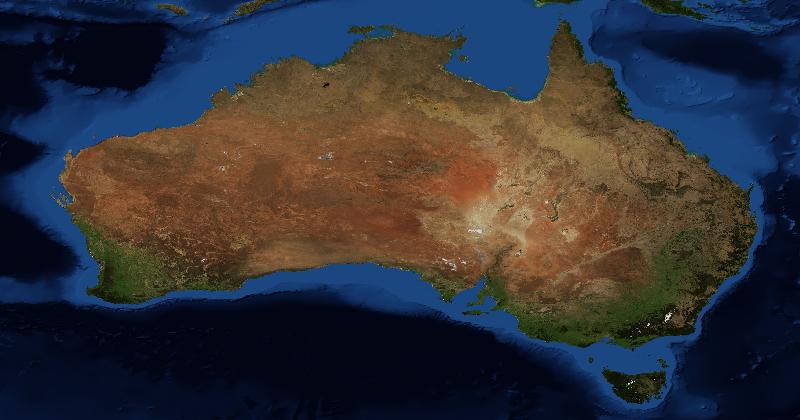
Roughly 70 percent of Australia is arid or semi-arid, and most of that is the central red desert known collectively as the Outback. From orbit, the Outback appears as a vast expanse of red-orange terrain, broken occasionally by mountain ranges (the MacDonnells, the Flinders, the Hamersley), salt lakes (Lake Eyre being the largest), and very thin road networks that can run hundreds of kilometres without a settlement.

The specific colour of the soil is the strongest single signal. Australian Outback red is more saturated and consistent than the redder soils of Brazil's terra roxa, the iron-rich soils of the Sahel, or the rusty desert tones of the American Southwest. When you see a vast flat-to-rolling red landscape with almost no visible human infrastructure, no centre-pivot circles, very long unpaved roads, and salt-encrusted dry lake beds, you are almost certainly in central or western Australia.

Salt Lakes and Drainage Patterns

Australia's centre is dominated by endorheic basins — drainage areas where rivers run inward rather than to the sea. Most of the time these basins are dry, but the lake beds remain as distinctive bright white or pale pink patches in satellite imagery, often surrounded by intricate networks of ephemeral channels. Lake Eyre, Lake Torrens, Lake Frome, and dozens of smaller salt lakes form a distinctive pattern that almost no other continent reproduces at the same scale.

If a frame shows pale white-pink patches surrounded by reddish desert and a network of intricate dry channels with no large cities anywhere visible, you are looking at the Australian interior.

Satellite view of a continental landmass with distinctive arid interior
Australia's combination of vast empty interior, distinctive red soils, and coastal urban clusters is one of the most recognisable national signatures on Earth.

The Wheat Belt: Australia's Agricultural Crescent

Surrounding the desert is a belt of grain agriculture — wheat, barley, and canola — that forms an arc from southern Queensland down through New South Wales, Victoria, the eastern half of South Australia, and across the western Australian wheat belt. From orbit these areas look like very large, geometric paddocks in pale yellow-brown during the dry season and bright green in winter. The fields are bigger than European or Asian ones but smaller than the giant Plains of North America, and the road network is sparse.

If you see large rectangular paddocks in pale agricultural land with a regional centre town visible — typically a single railway line, a grain silo cluster, and a few hundred houses — and the surrounding land transitions outward into red desert, you are likely in the Australian wheat belt.

Coastal Cities: Different from American Sprawl

Almost all Australians live in a handful of coastal cities — Sydney, Melbourne, Brisbane, Perth, Adelaide, and a sprinkling of smaller centres. From orbit these cities have a distinctive look. They sprawl extensively in low-density suburbs, similar to American cities, but the suburban streets curve more, the lot sizes are slightly different, and the urban edge usually ends abruptly against the natural landscape rather than fading into farmland.

Each major city has identifiable features: Sydney's harbour is one of the most recognisable from orbit, with its complex inlet system and distinctive bridge. Melbourne's grid pattern is unusually rigid for a southern-hemisphere city. Brisbane sits on the meandering Brisbane River with characteristic dark-green parkland. Perth is isolated against a wide coastal plain, with the city pressed against the Indian Ocean and the desert beginning surprisingly close inland. Adelaide is laid out as a one-mile city centre surrounded by a green parkland ring.

Tropical Northern Australia

The far north of Australia — Top End of the Northern Territory, the Cape York Peninsula, and the Kimberley region in northwest Western Australia — is tropical, with monsoonal vegetation, large braided rivers, sandstone escarpments, and very low population density. It looks visually different from both the Outback and the coastal cities: greener, with more wetlands in the wet season, and dramatic plateaus dissected by gorges.

Kakadu, the Kimberley, and Arnhem Land all have distinctive aerial signatures that more closely resemble parts of Africa or northern Brazil than the rest of Australia. The key disambiguator is usually the lack of dense human settlement combined with the specific landform style — orange-red plateaus dissected by deep gorges is an Australia-specific pattern.

Where Australia Gets Confused

Australia is sometimes confused with the United States (gridded suburbs, large agricultural scale, English-language signage), South Africa (similar veld and savanna landscapes), and parts of Argentina (Pampas grasslands). The clearest disambiguators are:

  • Soil colour: Australian red is more uniform and more orange than American Southwest red or Brazilian terra roxa.
  • Settlement density: Australia has far emptier interior than any of its visual cousins, with hundred-kilometre stretches between towns.
  • Vegetation palette: eucalyptus produces a greyish-green canopy that is distinct from oak, pine, or tropical forest cousins.
  • Coastline: Australia's relatively smooth coastline with concentrated cities is different from the more dispersed coastal urbanisation of the United States or South America.
  • Driving on the left: when visible, road markings and intersection design follow British conventions, which distinguishes Australia from North America.

Pro-Tier Signals

Advanced players look for finer details: the specific style of Australian rural fencing, the way isolated cattle stations are laid out (a homestead plus a few sheds plus a windmill plus a road that runs for tens of kilometres before reaching anywhere else), and the unique greyish hue of mature eucalyptus forest. Bauxite mines in the north, iron mines in the Pilbara, and gold mines in Western Australia all produce distinctive open-pit signatures visible from orbit.

Practise on Outback Rounds

Outback rounds are some of the most distinctive in any satellite-imagery game and a great way to lock in Australia identification. Once you have learned to recognise the red soils, salt lakes, and sparse infrastructure of the interior, the coastal cities and wheat belt become easy to triangulate. Play a few EarthGuessr sessions paying deliberate attention to Australian frames, and the country will become one of your fastest first-guess locks.

Series · Spot the Country

More from this series

View all in Spot the Country →

Ready to explore?

See the world from above and test your geography skills on a 3D globe.