All posts
GeographyMay 4, 20268 min read read

How to Spot Russia in a Single Satellite Frame

Russia is the largest country on Earth by a wide margin, spanning 11 time zones and almost every biome north of the tropics. Here is how to recognize it from orbit — and which clues separate it from its neighbours.

How to Spot Russia in a Single Satellite Frame

Russia is the largest country in the world by a margin so large it bends intuition. At 17.1 million square kilometres, it is nearly twice the size of the next largest country and accounts for roughly an eighth of all the land surface on Earth. Played on a satellite-imagery game, this means Russia comes up often. It also means that knowing how to recognize its many regional landscapes is one of the most rewarding skills in the genre.

The challenge with identifying Russia is that the country is so vast it does not have a single landscape. The Black Sea coast looks Mediterranean. Karelia looks like Finland. The taiga of Siberia looks like Canada. The far east looks like northern Japan in places. This guide walks through the signals that consistently point to Russia, and how to triangulate which region of Russia you are looking at.

The Big Picture: Taiga, Tundra, and Steppe

Most of Russia falls into one of three broad biomes. Tundra dominates the far north — a treeless, lichen-covered landscape that appears as a mottled brown-grey-green surface from orbit, often pockmarked with thousands of small lakes from permafrost melt. Taiga, the boreal coniferous forest, covers the centre of the country and stretches from Karelia in the west to the Pacific — a dense, dark green canopy interrupted by rivers and clearings. Steppe — the temperate grasslands — covers the south, especially in European Russia and southwestern Siberia.

If you see a vast undifferentiated dark-green forest with very few visible roads, large rivers winding across the frame, and almost no settlements — and the latitude (judged by sun angle and shadow length) seems high — you are very likely looking at the Russian taiga. If you see a flat, pale agricultural landscape with large rectangular fields, that probably puts you in the Black Earth belt of southern Russia or western Siberia.

Permafrost Polygons and Thermokarst Lakes

One of Russia's most distinctive aerial signatures appears in the northern tundra and permafrost zones, particularly in Yakutia and the Yamal Peninsula. Permafrost ground forms polygonal patterns visible from orbit — usually pentagonal or hexagonal cells outlined by ice wedges. As the climate has warmed, melting permafrost has produced thermokarst lakes, often nearly circular, scattered across the landscape in enormous numbers.

If you see a landscape with hundreds of small to medium-sized circular or polygonal lakes in a flat region with no visible mountains, you are very likely in the Russian Arctic or near-Arctic. Canada produces a similar pattern in the Northwest Territories, but the lake shapes and densities are different and the surrounding vegetation cues — particularly the lack of trees — usually point clearly to Russia.

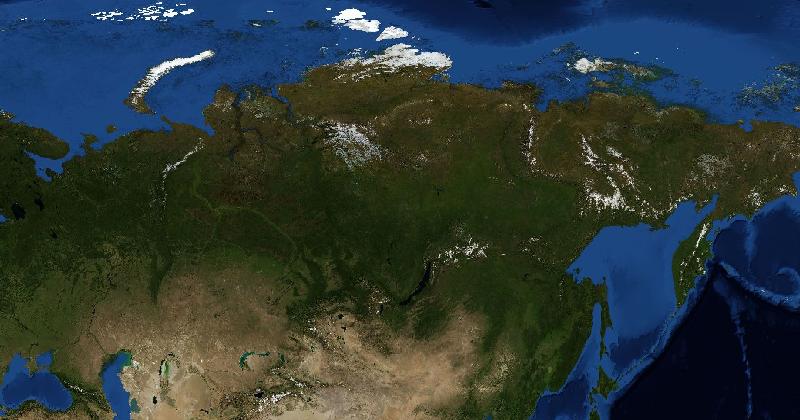
Satellite view of a large forested landscape with rivers
The Russian taiga is one of the largest continuous ecosystems on Earth and has a specific aerial signature that becomes recognisable with practice.

Cities Built for the Cold

Russian cities have a distinctive urban form. Soviet-era planning produced huge blocks of identical apartment buildings — the famous khrushchevki and brezhnevki — arranged in geometric clusters, often surrounded by green space or fields. From orbit, a typical Russian provincial city looks like a tight cluster of long rectangular roof shapes, with very straight roads, large central squares, and a clear boundary where the urban area ends and the forest or farmland begins.

Industrial zones are often visually separated from residential areas and feature large factories, rail yards, and pipeline infrastructure. The contrast between the dense, geometric Soviet-built core and the surrounding landscape is one of the strongest urban-identification signals available. American, European, and Asian cities mostly do not produce the same combination of long uniform apartment blocks and rigid central planning.

Rivers That Run North

Russia's geography is dominated by three enormous Siberian river systems — the Ob, the Yenisei, and the Lena — that drain almost the entire continent northward into the Arctic Ocean. These rivers are so large that they are visible from orbit even when zoomed quite far out, and they have very specific characteristics: wide channels with extensive flood plains, long meanders, and ice cover for much of the year. The Lena delta in particular is one of the most distinctive landforms on Earth.

If you see a massive river meandering through flat taiga or tundra terrain, with extensive sandbar islands in the channel and very few bridges or settlements visible, you are likely looking at one of the great Siberian rivers.

Regional Tells

  • European Russia (west of the Urals) has more agricultural land, denser road networks, and the highest concentration of cities — Moscow, Saint Petersburg, Kazan, Nizhny Novgorod.
  • The Caucasus region (Krasnodar, Stavropol, the North Caucasus republics) has mountains, more diverse agriculture, and a Mediterranean tinge.
  • The Urals appear as a relatively low north-south mountain range with extensive forest, mining operations, and industrial cities like Yekaterinburg and Chelyabinsk.
  • Western Siberia is largely flat, swampy, and forested — the world's largest single contiguous wetland is here.
  • Eastern Siberia and the Far East feature more dramatic mountains, larger rivers, and a sharper transition between coastal and inland climate.
  • Kamchatka, in the far east, is one of the world's most volcanically active regions and looks visibly different — towering stratovolcanoes rising above a landscape dotted with hot springs and lakes.

Confusion Cousins

Russia is most often confused with Canada (similar taiga forest, similar latitudes), Scandinavia (similar coniferous forests in Karelia and the northwest), Kazakhstan (which shares the steppe biome along the southern border), and Mongolia (further south steppes). The clearest tells that distinguish Russia from these are usually the Soviet-era settlement patterns, the specific shape of the road network (long straight roads with very widely spaced settlements), and the cyrillic script visible when zoomed in close enough to read signs — though most satellite-game frames are too zoomed out for text to be readable.

How to Lock In Russia Faster

Practical pattern for fast Russian identification: huge scale of empty space in the frame + dark coniferous forest + very few roads + Soviet-style settlement when visible + likely high latitude based on sun angle. If three or more of those are present, lock in Russia and use the regional cues to triangulate where exactly. Even seasoned players sometimes call "Russia" as their first guess and then refine within the country — and they are usually right.

Play Russia Rounds Deliberately

The fastest way to internalize the regional differences is to study Russian rounds in EarthGuessr specifically. When a Russian frame appears, take an extra few seconds to identify which region you are looking at before guessing. Over a few weeks of deliberate practice, your accuracy inside Russia will sharpen dramatically — and your country-level identification rate will climb noticeably because Russia is such a frequent answer.

Series · Spot the Country

More from this series

View all in Spot the Country →

Ready to explore?

See the world from above and test your geography skills on a 3D globe.