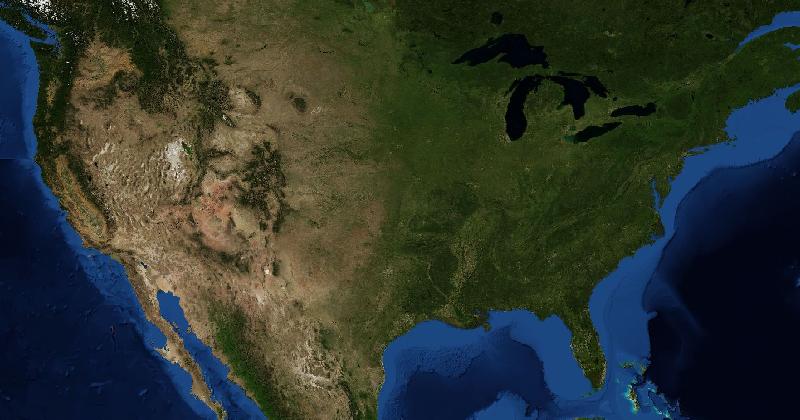
If you have ever played a satellite-imagery guessing game, you already know the moment. The image loads, you scan the patterns for half a second, and a quiet voice in the back of your head says: this is the United States. Sometimes it is unmistakable — a perfectly square mile of corn next to a perfectly square mile of soybeans, a town arranged on a grid that ignores the local terrain entirely. Sometimes it is subtler — the colour of the soil, the spacing of the houses, the angle of the roads. But the USA almost always announces itself, if you know what to look for.
This guide breaks down the visual signatures that make the United States the easiest large country to identify from above. The patterns described here are the same ones top players use to lock in a guess within the first second of seeing a frame, and they translate directly into faster, more accurate rounds on EarthGuessr.
The Number One Giveaway: the Public Land Survey Grid
The single most distinctive feature of the American landscape — visible from space across two-thirds of the country — is the Public Land Survey System. Created in 1785 by the Land Ordinance, this system carved most of the United States west of the Appalachians into perfect one-square-mile sections, six-mile-by-six-mile townships, and 36-section blocks. The grid is so dominant that on a satellite image of Iowa, Kansas, Nebraska, the Dakotas, or rural Texas, you can often count individual square miles by counting the road intersections.
No other large country has this. Brazilian, Russian, Chinese, and Indian rural land does not look like this. European farmland is fragmented into irregular medieval-era plots. African and Asian agricultural patterns follow river systems, terrain contours, and tribal boundaries. The relentless north-south, east-west grid of American farmland — the famous checkerboard — is one of the strongest single signals in satellite imagery guessing.
Centre-Pivot Irrigation Circles
Look closely at agricultural areas in the western and central United States — especially Nebraska, Kansas, Colorado, the Texas panhandle, Idaho, and eastern Washington — and you will see circles. Perfect, dark green or brown circles inscribed inside square fields, often dozens or hundreds of them in a single frame. These are centre-pivot irrigation systems, and they are an almost uniquely American signal at scale. Other countries use them, but no other country has the density of pivot agriculture that the US Great Plains and Mountain West does.
When you see a satellite image dominated by green circles inside square sections, you are almost certainly looking at the American interior. The pattern is so distinctive that it is often visible at altitudes where almost nothing else can be identified.
City Grids That Ignore the Land
American cities are gridded. Not just downtown — entire metropolitan areas. The grid often runs north-south and east-west regardless of terrain, with streets cutting across hills and creeks rather than following them. Compare the satellite view of Phoenix or Salt Lake City — sprawling rectangular grids extending tens of kilometres in every direction — to the curving streets of European, Latin American, or Asian cities. The contrast is immediate.
Suburbs are even more diagnostic. American suburban subdivisions have a signature look: cul-de-sac loops, wide curving streets that suddenly end, oversized lots, and houses set back from the road with front lawns. The combination of geometric main roads and curving suburban tendrils is something other countries do not produce in the same way. Australian suburbs are the closest analogue, but the road widths and lot sizes tend to be different enough that experienced players can distinguish them.
Highway Interchanges That Look Like Sculpture
American highway interchanges are large, complex, and often built as multi-level stacks. The Interstate Highway System produced an enormous network of cloverleafs, stack interchanges, and diamond interchanges with very specific geometric signatures. From orbit, a Texas-style five-level stack interchange is unmistakable, and even modest suburban interchanges have a scale and curvature that does not appear in many other countries.
On a satellite image, if you see a giant interchange with wide cloverleafs surrounded by parking lots, retail strips, and frontage roads — that is almost certainly the United States. Canada is the closest visual cousin, but Canadian interchanges tend to be smaller and the surrounding development less sprawling.
Climate and Vegetation Tells
The United States spans almost every biome on Earth — subtropical Florida, the Mojave Desert, the Pacific rainforest, the high Rockies, the Great Plains, the Appalachian hardwoods, the Alaskan tundra. Once you have established the country, the regional cues kick in.
- Bright orange-red soils in agricultural fields point to Georgia, Alabama, or the Carolinas — the famous red clay of the Southeast.
- Pale, dusty fields with sparse vegetation and centre-pivot circles point to the high plains: western Kansas, eastern Colorado, the Texas panhandle.
- Snow-capped peaks immediately south of a flat irrigated valley point to the Rockies, the Sierra Nevada, or the Cascades.
- Dense, dark green deciduous forest with rolling hills and small farms suggests the Appalachian belt or the Upper Midwest.
- Saw-grass wetlands, pine flatwoods, and bright turquoise coastal water indicate Florida or the Gulf Coast.
Where It Gets Confusing
The two countries most often confused with the USA from satellite imagery are Canada and Australia. Canada shares the gridded prairie pattern in Saskatchewan and Alberta, but Canadian sections are slightly differently sized, the road network is sparser, and the latitude usually produces longer shadows and shorter growing seasons visible in the imagery. Canadian forests in the boreal zone have a distinctive scattered-lake pattern from glacial action that the contiguous USA mostly lacks.
Australia produces some of the same suburban-sprawl and agricultural-grid signals, but the soil is usually redder, the vegetation drier, and the urban density lower. The Outback's vast emptiness — hundreds of kilometres without a road — is something the United States does not produce at the same scale.
The Pro-Tier Signals
Experienced players read finer details. The colour of road paint (white edge lines, yellow centre lines in the US). The width of road shoulders. The specific spacing of utility poles. The size and roof colour of warehouses in industrial zones. The presence of large rectangular lakes that turn out to be reservoirs created by the US Army Corps of Engineers. All of these become quick country-confirmation cues once you have played enough rounds.
But for most players, the big three — the square-mile grid, the centre-pivot circles, and the gridded sprawling cities — are enough to lock in the United States with high confidence inside two or three seconds of seeing a frame. The American landscape, viewed from orbit, is one of the most legibly engineered surfaces on Earth.
Try It on EarthGuessr
The fastest way to internalize these signals is to play. EarthGuessr drops you into satellite imagery from across the world, and after a few rounds you will start to feel the difference between a Nebraska field and a Ukrainian one without consciously thinking about it. Country identification is a pattern-recognition skill, and like all such skills, it improves dramatically with practice. The USA is the easiest country to learn first — and the patterns you pick up here become the baseline against which you start to read everywhere else.