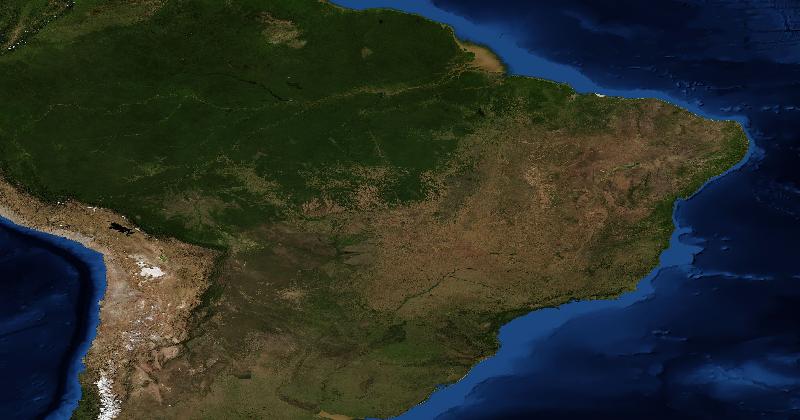
Brazil is enormous — 8.5 million square kilometres, larger than the contiguous United States, and home to landscapes so distinctive that a single satellite frame is often enough to know where you are. The Amazon Basin alone covers an area roughly the size of Australia. The Cerrado, Brazil's vast tropical savanna, is one of the largest single biomes on the continent. And the agricultural frontier expanding through Mato Grosso has a visual signature unlike anywhere else on Earth.
If you play geography games regularly, learning to spot Brazil is one of the highest-leverage skills you can develop. Brazil shows up in a lot of rounds because it is large, and most of those rounds can be solved within seconds if you know the country's three or four characteristic landscape types. This guide walks through each of them.
The Amazon: A Green Texture Like Nowhere Else
The Amazon rainforest, viewed from orbit, has a specific texture: a fractal, broccoli-like canopy in dark to medium green, broken up by sinuous rivers that curve through the trees in extravagant meanders. The rivers are usually wide and the colour varies — the Amazon mainstem looks muddy brown, the Rio Negro looks black, and the meeting of the waters near Manaus is one of the most photographed satellite views on the planet.
Other rainforests exist — the Congo Basin in Africa, the Indonesian and Bornean rainforests, parts of Papua New Guinea — but the Amazon's combination of scale, river patterns, and the specific shade of the canopy is recognisable with practice. If you see an enormous, undifferentiated green expanse with massive curving rivers and almost no roads or settlements visible, you are looking at the Amazon. If the rivers run through a more compact canopy with mountainous terrain rising in the background, you may be looking at the Congo or Indonesia instead.
The Cerrado and the Frontier of Deforestation
South of the Amazon, the Cerrado is Brazil's tropical savanna — a vast plateau covered in grasslands, scattered trees, and rolling agricultural landscape. From above, it looks pale yellow-brown in the dry season and bright green in the wet season, with large rectangular farms cleared from native vegetation. The Cerrado has become the centre of Brazilian soybean and cattle production, and from orbit you can see the frontier of conversion clearly: dark Amazon forest abruptly meeting pale rectangular fields along nearly straight lines.
These deforestation frontiers — particularly in Mato Grosso, Rondônia, and Pará — are one of the most visually striking patterns on Earth. The famous fishbone pattern of secondary roads branching off from main highways into newly cleared land is something you will see in Brazil far more than anywhere else on the planet. If a frame shows large pale rectangles cut directly out of dense green forest with a clear linear boundary, you are very likely in the southern Amazon or northern Cerrado.
Red Soils and Coffee Country
The southeast of Brazil — particularly the states of São Paulo, Minas Gerais, and Paraná — has famously rich red soils, the famous terra roxa that supports the country's coffee and sugarcane production. From orbit, these regions appear as a patchwork of red-brown earth, dark green forest fragments, and the distinctive striped pattern of sugarcane fields. The hills are gentler than in the Andes, the agriculture more intensive than in the Cerrado, and the urban density much higher.
If you see rolling hills with red soil, intensive farmland, scattered towns, and a much denser road network than the deeper interior, you are likely in southeastern Brazil. This is also the most populous part of the country, so urban areas are common: São Paulo's megacity sprawl, Rio de Janeiro's distinctive granite peaks rising from the coastal forest, Belo Horizonte's hilly footprint, and dozens of medium cities packed into the region.
The Coastline: Bays, Lagoons, and Jungle Meeting the Sea
Brazil's Atlantic coastline runs roughly 7,400 kilometres from the Amazon delta in the north to the Uruguayan border in the south. The northern coast is dominated by sandbars, mangroves, and slow muddy rivers reaching the sea. The northeast features long white beaches, dunes, and the famous Lençóis Maranhenses with its rain-filled white sand basins. The southeast features steep coastal mountains plunging directly into the ocean — Rio's famous Sugarloaf and Corcovado are visible from orbit. The south transitions to wide beaches, lagoons, and the start of the Pampas plain.
Coastline texture is one of the fastest country-identification signals in geography games, and Brazil's coast — particularly the central and southern stretches — is hard to mistake once you have studied a few examples.
Urban Patterns That Give Brazil Away
Brazilian cities have a specific footprint that distinguishes them from cities elsewhere in the Americas:
- Favelas — dense, organic-looking informal settlements clinging to hillsides — are one of the strongest urban signals. They appear as a tight cluster of small roofs in irregular patterns, often on terrain too steep for planned development.
- Beachfront condo towers in cities like Rio, Recife, and Fortaleza form distinctive long rows of high-rises parallel to the coast.
- Brazilian planned cities — particularly Brasília — have unique geometric signatures from orbit. Brasília's airplane-shaped plan is one of the most recognisable urban layouts on Earth.
- Smaller Brazilian towns often centre on a praça (central square) with a church, surrounded by lower-rise housing that follows the original Portuguese colonial pattern.
Where Brazil Gets Confused
Brazil is most often confused with other South American countries — particularly Argentina in the south (the Pampas extend into both), Paraguay (which shares the Cerrado biome), and Bolivia (the Amazon basin extends into both). The Brazilian Amazon also gets confused with the Peruvian or Colombian Amazon. The key tells are usually scale (Brazil is much larger, so a frame with no visible terrain change for a long way is more likely Brazil), the specific red soil colour in agricultural areas (more pronounced in Brazil than neighbours), and the density of the deforestation-frontier pattern.
Pro-Tier Signals
Advanced players use finer details: the colour of dirt roads (pale yellow in the Cerrado, deep red in the southeast, brown in the Amazon), the specific style of farm building (large clusters of warehouses for soybean storage in Mato Grosso), and the layout of cattle ranches (very large rectangular pastures separated by long straight fences). Even the colour of fresh-cleared land tells you what stage of the deforestation cycle you are looking at — bright orange-red for very recent clearing, fading to pale tan and then green over a few years as pasture establishes.
Practise It
Brazil is one of the highest-frequency answers in satellite-imagery games simply because of its size. Learning to recognise the Amazon, the Cerrado, the deforestation frontier, the southeastern coffee belt, and the coast is one of the fastest scoring upgrades you can give yourself. Play a few rounds on EarthGuessr, focus consciously on the Brazilian frames when they come up, and you will start to see the country's patterns even at a glance. Within a few weeks of regular play, most users find they can confidently call Brazil within the first second of seeing a typical frame.