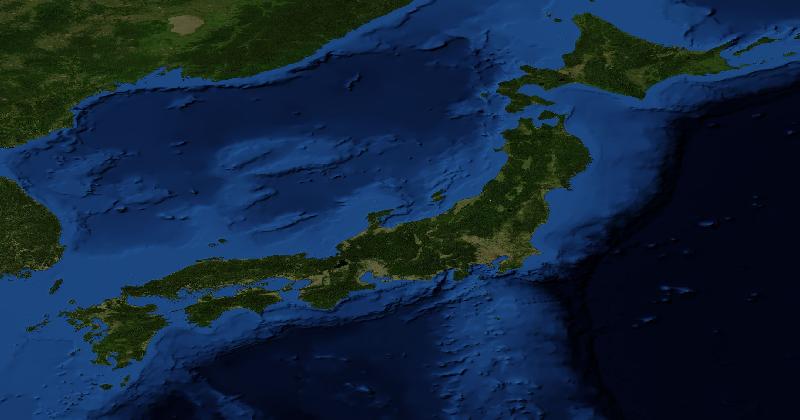
Japan is small relative to other major countries on the geography-game circuit — roughly 378,000 square kilometres, about the size of California or Germany — but it shows up disproportionately often because its landscapes are so visually distinctive. A satellite frame of Japan, once you have learned what to look for, is almost impossible to confuse with anywhere else on Earth. The combination of mountainous interior, narrow coastal plains, extreme population density, and the country's specific style of small-scale agriculture produces a fingerprint that is genuinely unique.
This guide breaks down how to spot Japan from orbit — and once the country is identified, how to localise quickly between Hokkaido in the north and Kyushu in the south.
The First Giveaway: Density Pressed Against the Coast
Roughly 75 percent of Japan's land area is mountainous, which means almost all of the country's 125 million people live on narrow strips of flat land along the coast or in pockets between mountain ranges. The result, viewed from above, is one of the most distinctive settlement patterns on Earth: incredibly dense urban and agricultural land squeezed into thin lowland corridors, with steep forested mountains rising abruptly behind.
Compare a satellite view of Osaka or Nagoya to a comparable American city. The Japanese city has the same population packed into a much smaller footprint, with the urban edge ending sharply against a forested mountain rather than fading gradually into suburbs. This pattern — extreme density adjacent to immediate forest — is something almost no other country produces at scale. Only South Korea and parts of Taiwan come close.
Rice Paddies in Tile Patterns
Japanese agriculture has a specific aerial signature. Rice paddies are small, geometric, and tightly packed — usually arranged in long parallel strips or grid patterns inside the available flat valley floors. In the growing season they appear as bright green rectangles flooded with shallow water; in winter they are pale brown or stubble-coloured. The size of individual fields is much smaller than in the United States, Canada, or Brazil, reflecting the centuries-old fragmentation of Japanese farmland.
If you see a flat valley with hundreds of small rectangular fields, narrow roads weaving between them, and forested mountains rising immediately on either side, you are very likely in Japan. The closest visual cousins are South Korean and Taiwanese paddy country, but the field shapes, settlement patterns, and surrounding terrain usually distinguish them on a closer look.
The Coastline Tells
Japan's coastline is one of the most visually identifiable on Earth. The country is an arc of volcanic islands, which produces a coastline studded with bays, peninsulas, drowned river valleys (rias), small offshore islands, and breakwaters. Major ports — Tokyo, Yokohama, Osaka, Kobe, Nagoya — have extensive reclaimed-land industrial zones extending into the sea in geometric blocks, easily visible from orbit. Smaller fishing harbours sit in nearly every coastal indentation along the country's 30,000 kilometres of shoreline.
If a satellite frame shows a steep mountainous coast with a complex bay, a small fishing port at the head of the bay, terraced fields on the lower slopes, and forested upper slopes — that is a high-probability Japan frame. The same pattern with simpler bays and slightly different vegetation might be Korea or northern Taiwan, but the small details of village layout and field geometry usually point to Japan.
Regional Identification Inside Japan
- Hokkaido (the northern island) has a much more spread-out agricultural landscape with larger rectangular fields, fewer rice paddies, and a colder-looking forest. It looks visually closer to Canadian or Russian farmland than the rest of Japan.
- Honshu (the main island) shows the classic Japan pattern: dense valleys, paddies, narrow coastal plains, and steep forested mountains. The Kanto plain around Tokyo is one of the largest flat areas in the country.
- Shikoku (the smallest of the four main islands) is heavily mountainous with small settlements along the coast and in interior valleys.
- Kyushu (the southern main island) is more volcanic in appearance, with the active calderas of Aso and Sakurajima visible from orbit. The climate-driven vegetation is greener and the agriculture more diverse.
- Okinawa and the Ryukyu Islands have a subtropical look, with coral reefs visible offshore and a very different vegetation palette from mainland Japan.
Volcanoes and Lakes
Japan sits on the Pacific Ring of Fire, and from orbit this means volcanoes are visible across the archipelago. Mount Fuji is the most famous — a near-perfectly conical stratovolcano visible from satellite imagery of central Honshu. Crater lakes like Lake Toya in Hokkaido, Lake Towada in northern Honshu, and Lake Ikeda in Kyushu form distinctive nearly circular water bodies that help pinpoint regions. The presence of a volcanic peak or crater lake in a frame is a strong Japan signal, especially when combined with the surrounding density and coastal patterns.
Where Japan Gets Confused
Japan is most often confused with South Korea, Taiwan, and occasionally coastal China. South Korea shares the dense-settlement-and-mountain pattern, but Korean cities tend to have a slightly different layout (more linear high-rise apartment blocks called apateu), and the agricultural plains are larger. Taiwan has similar mountain-and-coast geography, but the tropical vegetation is more pronounced and the western plain is wider. Coastal China, particularly Fujian, has paddy country that can look superficially similar but usually has a larger scale and more contemporary industrial sprawl.
The clearest disambiguators are usually the specific shape of the paddy fields, the style of small-village layouts, the presence of distinctive Japanese coastal infrastructure (specific breakwater patterns, fishing harbours), and the often-visible Shinkansen rail lines crossing the country in remarkably straight long-distance corridors.
Pro-Tier Cues
Advanced players look for finer details: blue tile roofs in rural housing (a distinctly Japanese signature), the specific design of Japanese highway rest-area complexes, baseball diamonds in school yards (much more common in Japan than in Korea or China), and the network of small dammed reservoirs in farmland that are characteristic of Japanese irrigation. None of these are necessary for country-level identification, but they sharpen accuracy once you have practised reading more obvious patterns.
Practise in a Few Sessions
Japan rounds appear regularly in any satellite-imagery game, and learning the country's signatures pays back quickly. A few focused EarthGuessr sessions where you pay deliberate attention to Japanese frames — taking note of the coastline, paddy patterns, and mountain-versus-plain contrast — will move your Japan identification from "East Asia maybe" to "Japan, near Nagoya" within a handful of evenings of play.