All posts
GeographyApril 27, 20268 min read read

How to Spot India from Satellite Imagery: The Patchwork That Gives It Away

India has one of the most visually distinctive agricultural and urban signatures of any country on Earth. Here is how to identify it from satellite imagery — and how to distinguish its regions in a single frame.

How to Spot India from Satellite Imagery: The Patchwork That Gives It Away

India is the most populous country in the world — more than 1.45 billion people living on roughly 3.3 million square kilometres, which makes it both extremely large and extraordinarily dense. From orbit, this population pressure produces some of the most visually distinctive landscapes on Earth. Indian farmland is a fine-grained patchwork of small fields. Indian towns are tightly packed clusters of low-rise housing along intricate road networks. The Ganges plain alone supports a density of agriculture and settlement that no other large region on the planet matches.

If you play satellite-imagery games regularly, learning to identify India is one of the highest-yield investments you can make. India shows up often, and once you have learned the signals it is one of the harder-to-confuse countries on the board. This guide walks through the visual fingerprints of India and how to refine identification down to the regional level.

The First Signal: A Fine-Grained Patchwork

The defining aerial signature of India — particularly the northern plains, the major agricultural states, and most of the populated regions — is a patchwork of tiny fields. Average Indian farm sizes are much smaller than in the United States, Brazil, or even most of Europe. From orbit, this produces a texture that looks almost like quilt-work: hundreds of small rectangular or irregular plots in slightly different colours, packed into every available flat surface and broken up by villages, dirt roads, and irrigation channels.

Compare this to the giant rectangular sections of American agriculture or the long strips of European medieval farmland. India's pattern is unique in both its granularity and its density. The closest visual cousin is Bangladesh or eastern Pakistan, which share the South Asian field-size pattern but have other regional differences. Most other countries do not produce this texture at scale.

Settlement Density: Villages Everywhere

Rural India is not really rural in the way North American or Australian countryside is. Villages are scattered every few kilometres across the agricultural plains, with even the most remote rural districts hosting hundreds of small settlements visible from orbit. A satellite frame of rural Uttar Pradesh or Bihar might show dozens of villages packed into a single agricultural landscape, connected by a fine network of unpaved roads and irrigation channels.

Compare a frame from the American Great Plains — where you might see a single isolated farmhouse in a 36-square-mile section — to a comparable frame of the Indo-Gangetic plain, where dozens of villages of 500 to 5,000 people each sit within the same area. This difference in settlement density is one of the strongest country-identification signals available.

Aerial view of a dense agricultural and settled landscape
Indian agricultural landscapes have a fine-grained patchwork pattern that distinguishes them from almost any other large country.

Regional Identification: Five Indias

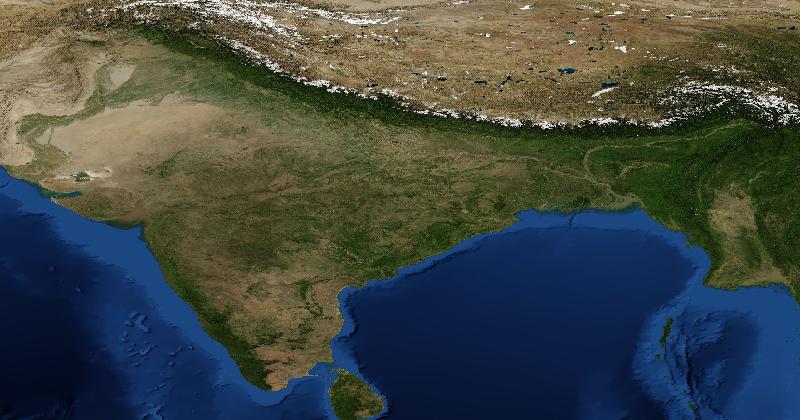
India is essentially five visually distinct regions, and once you have established the country, identifying the region is much easier:

  • The Indo-Gangetic plain (northern India: Punjab, Haryana, Uttar Pradesh, Bihar, West Bengal) is flat, intensely farmed, and very densely settled. This is where most of the patchwork is most extreme.
  • The Deccan plateau (central and southern India: Maharashtra, Karnataka, Andhra Pradesh, Telangana) has rolling terrain, more dry agriculture, smaller villages, and a different soil palette (often dark cotton soil or red lateritic soil).
  • The Western Ghats run down the western coast, a steep forested mountain range visible from orbit. The wet windward side is intensely green; the rain-shadow eastern side is browner.
  • The northeast (Assam, Meghalaya, the seven sister states) is hilly, forested, and tea-growing, with a very different aerial signature from the rest of India.
  • Rajasthan and the Thar Desert in the northwest are arid, with sandier soils, fewer fields, and lower settlement density.

Indian Cities: Dense and Layered

Indian cities have a specific footprint. The historic core is usually very dense, with narrow winding streets that follow centuries-old patterns. Surrounding that is a mix of mid-rise apartment blocks, planned colonies (especially in Delhi), and informal settlements packed into available land. Roads are often clogged, parks scarce, and the urban-rural boundary is sharp.

From orbit, the densest neighbourhoods of cities like Mumbai, Delhi, Kolkata, and Chennai are recognisable for their roof texture: tightly packed buildings with very small gaps, often with blue tarp roofs, water tanks on top of many buildings, and a much higher density than would be found in cities of similar size elsewhere. The contrast between formal and informal housing is starker than in most countries — distinctive grid-planned colonies sit directly adjacent to organic informal settlements.

Rivers, Deltas, and Coastlines

India's two great river systems — the Ganges and the Indus (and its tributaries) — produce massive distinctive features from orbit. The Ganges plain is one of the most fertile and intensively farmed regions on Earth, and the river itself meanders across northern India with a very characteristic pattern of oxbow lakes and abandoned channels. The Sundarbans, the world's largest mangrove forest at the Ganges-Brahmaputra delta, looks like an intricate green-and-black tracery from orbit.

India's coastlines are also distinctive: the Konkan coast in the west has steep mountains running right to the sea; the Malabar coast (Kerala) is famous for its backwaters and palm-fringed coastline; the Coromandel coast in the east is generally straighter, with broader plains and big delta regions where rivers like the Godavari and Krishna reach the Bay of Bengal.

Where India Gets Confused

India is most often confused with Pakistan (the western Punjab has very similar agricultural patterns), Bangladesh (the eastern Ganges plain extends across the border), and Nepal (mountains and small-scale agriculture). The clearest disambiguators are usually scale (India is far larger so a frame with no terrain change for hundreds of kilometres is more likely India), the specific layout of villages, and the road network density (India's road network is denser than Pakistan's, comparable to Bangladesh, but better paved on average).

Pro-Tier Signals

Advanced players look for finer details: the specific style of Indian village layout (a central temple, a small cluster of brick-and-tile houses, surrounding fields), the colour of brick kilns (visible as distinctive red-roofed clusters near major cities), the specific shape of Indian railway-station footprints, and the giant solar farms appearing in western India that have a recognisable layout. The presence of Devanagari script on signs (when visible) is a direct India confirmation, though most satellite frames are too far out for text recognition.

Spend a Week Studying India Rounds

Because India is so large and so often the right answer, a week of deliberate attention to Indian frames in EarthGuessr will pay back across the rest of your play. Pay attention to the field patterns, the village density, and the regional climate cues. Within a few sessions, India will go from "South Asia, probably" to "northern India near the Ganges, mid-Uttar Pradesh, summer season" — a level of precision that pulls round scores up significantly.

Series · Spot the Country

More from this series

View all in Spot the Country →

Ready to explore?

See the world from above and test your geography skills on a 3D globe.