All posts
GeographyApril 22, 20267 min read read

How to Spot Germany from Satellite Imagery: Forests, Fields, and the Autobahn

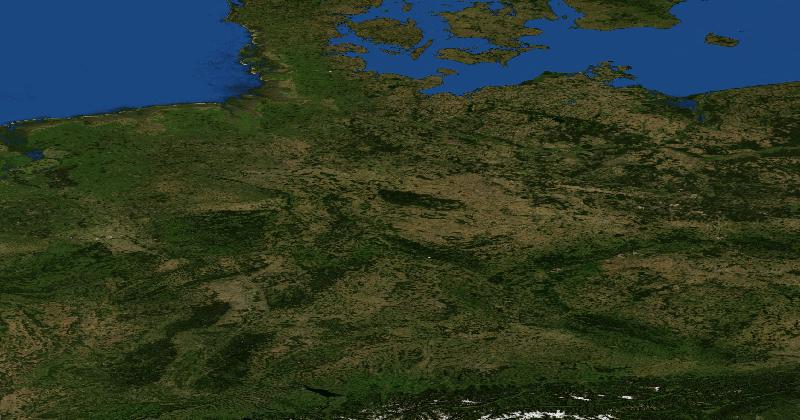
Germany has one of the most legible aerial signatures in Europe — orderly farmland, dense forests cut by straight roads, and red-roofed villages arranged in tight clusters. Here is how to identify it from a single frame.

How to Spot Germany from Satellite Imagery: Forests, Fields, and the Autobahn

Germany is a satellite-imagery game favourite because the country has a remarkably consistent aerial signature across most of its territory. The combination of intensively managed farmland, dense managed forests, tight red-roofed villages, and a road network that includes some of the straightest, widest highways on the planet makes Germany one of the easier European countries to identify with confidence — once you have learned the cues. This guide walks through them.

Germany is also a frequent round answer because it is centrally located in Europe, densely populated by European standards, and contains a wide variety of landscapes that all share a recognisable national fingerprint. From the North Sea flats to the Alps, the same set of cultural and infrastructural signals appears.

The Forest-Field Mosaic

Germany's most distinctive aerial pattern is a tight mosaic of farmland and managed forest. Roughly a third of the country is forested, and the forests are not random — they appear as crisp, geometric blocks of dark green with very straight edges where they meet agricultural land. This is the product of centuries of state forestry: planted, managed, and harvested on rotation, German forests look engineered from orbit because they essentially are.

Agricultural fields between the forest blocks are smaller than American or Russian fields but larger than the patchwork plots typical of Mediterranean Europe or India. They are usually rectangular, follow gentle terrain, and rotate between bright green (winter wheat, rapeseed), pale yellow (mature grains), and brown (fallow). The pattern reads as ordered, productive, and unmistakably north-central European.

Red Roofs in Tight Villages

German villages have a specific footprint: tightly clustered houses with red or terracotta tile roofs, a central church with a tall spire, often a small ring road, and surrounding farmland that begins abruptly at the village edge. This is true across most of the country, from Bavaria in the south to Lower Saxony in the north. The contrast with French villages (more dispersed, often with grey slate roofs) and Eastern European villages (longer linear strip layouts) becomes obvious with practice.

From orbit, a cluster of bright red rooftops with a single tall white church visible in the middle and surrounding rectangular fields is a high-probability Germany frame — particularly in Bavaria, Baden-Württemberg, or the Rhineland.

Aerial view of European countryside with villages and farmland
German villages have a distinctive red-roof cluster footprint surrounded by orderly fields and managed forest blocks.

The Autobahn

The German Autobahn network is one of the most identifiable infrastructure systems on Earth. Wide multi-lane highways with very straight long-distance sections, sweeping interchanges, and characteristic blue and white signage when zoomed in close. Where rest areas (Raststätten) appear, they have a consistent layout — large gas station and restaurant complexes, big truck parking sections, and characteristic landscaped buffers.

A long, very straight, wide divided highway through a forest-field landscape with sweeping cloverleaf interchanges every few kilometres is almost always either Germany, Austria, or Switzerland. The German version is by far the most common and the surrounding cultural signals (red roofs, tight villages) usually confirm the country quickly.

Regional Tells Inside Germany

  • Bavaria: rolling hills with denser forest, larger farms, often Alpine peaks visible in the south. The countryside has a recognisable pre-Alpine feel — bigger pastures, more wood-frame architecture, scattered lakes.
  • Northern Germany (Schleswig-Holstein, Lower Saxony): much flatter, with wider open fields, fewer trees, and windmill clusters near the North Sea coast. Coastal mudflats (Wattenmeer) are visible at low tide.
  • Rhineland and Hesse: vineyards on steep terraced river slopes (the Rhine and Mosel valleys), denser road networks, more industrial infrastructure visible.
  • Eastern Germany (Brandenburg, Mecklenburg-Vorpommern): larger fields (legacy of Soviet-era collective farming), more scattered settlements, more lakes from glacial action.
  • The Black Forest and Bavarian Forest: dense continuous coniferous forest with steep terrain, deep valleys, and small mountain villages.

Where Germany Gets Confused

Germany is most often confused with Austria, the Czech Republic, Poland, and the Netherlands. Austria shares the red-roof, tight-village, forest-field pattern but is more consistently mountainous. The Czech Republic has similar cultural signals but smaller scale and slightly different field shapes. Poland has a more elongated village layout (strip villages along single roads) and less geometric forest management. The Netherlands has a distinctive polder landscape that is unmistakable once seen — large rectangular fields below sea level, drained by perfectly straight canals.

Pro-Tier Signals

Experienced players read finer details: the specific colour of German road signs (blue for Autobahn, yellow for other highways), the layout of large wind farms (Germany is one of the world leaders in installed wind capacity), the prevalence of solar panels on village rooftops (visible as dark rectangles on red roofs from medium altitude), and the characteristic shape of German railway stations and rural train lines. Even tiny details — the colour of the gravel on rural roads, the design of bus stops — can confirm Germany once you have logged enough rounds.

Practise It

Germany comes up often in European-focused rounds and is one of the most rewarding countries to learn because the patterns are consistent and the regional cues are sharp. Once the red roofs, Autobahn, and forest-field mosaic become automatic, your European accuracy as a whole improves — because the same set of cues let you rule Germany in or out faster, which speeds up identification of neighbouring countries too.

Series · Spot the Country

More from this series

View all in Spot the Country →

Ready to explore?

See the world from above and test your geography skills on a 3D globe.