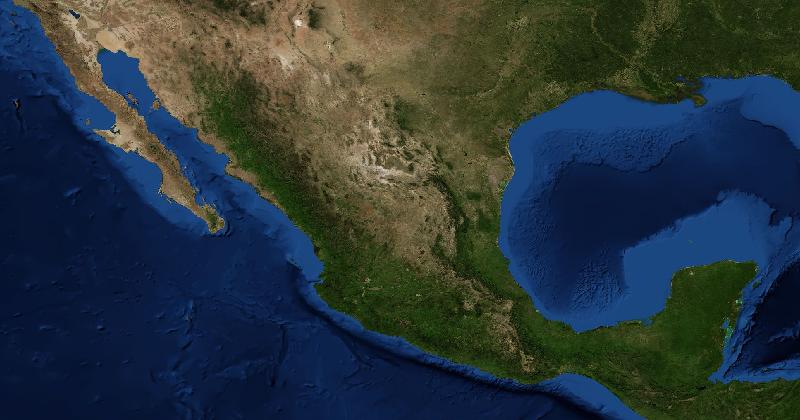
Mexico is one of the most geographically diverse countries on Earth — a single country that contains the world's third-largest desert biome on its northern border, a high central plateau ringed by volcanoes, dense tropical rainforest in the south, and a karst limestone peninsula in the east that looks like nothing else in the Americas. Learning to identify Mexico from satellite imagery means learning to recognise this variety as a single national fingerprint.
Mexico shows up regularly in satellite-imagery games, and a frame from Mexico is unlikely to be confused with anything else once you have studied a handful of regional examples. Here is how the country reveals itself from orbit.
The Volcanic Spine: the Trans-Mexican Volcanic Belt
Running east-west across central Mexico is a belt of active and dormant volcanoes that defines the country's geography. Popocatépetl, Iztaccíhuatl, Pico de Orizaba, and dozens of other major stratovolcanoes form a chain visible from orbit, with characteristic conical peaks rising above the central plateau. The plateau itself sits at roughly 2,000 metres elevation, which means much of Mexico's most populated land is high, dry, and visibly different from the lowland coasts.
When a satellite frame shows a high plain with one or more perfectly conical volcanic peaks visible, surrounded by rectangular agricultural land and tightly packed colonial cities, you are very likely in central Mexico. The combination of high elevation, volcanic peaks, and the specific settlement pattern is hard to mistake for anywhere else.
Northern Deserts and Sierras
Northern Mexico is dominated by the Sonoran and Chihuahuan deserts and the two parallel mountain ranges (Sierra Madre Occidental and Sierra Madre Oriental) that flank them. From orbit, this region looks broadly similar to the American Southwest — orange-red soils, sparse vegetation, basin-and-range terrain — but with several distinguishing features. Mexican rural roads are sparser and rougher. Agricultural areas in the north are concentrated along irrigation systems (especially the Río Yaqui and Río Mayo valleys in Sonora). Settlements are smaller and more dispersed than in the US Southwest.
The clearest disambiguator from the US side of the border is usually the road network density and the urban footprint — Mexican border-region towns have a tighter colonial-grid centre with surrounding informal expansion that does not look like American sprawl.
The Yucatán: Flat, Green, and Pockmarked
The Yucatán Peninsula is one of the most distinctive landscapes on Earth. From orbit, it appears as a vast flat green plain dotted with thousands of cenotes — sinkholes where the limestone bedrock has collapsed into underground water. The coastline is fringed with bright turquoise water and white sand beaches; the interior is dense tropical forest broken up by small clearings and Maya archaeological sites. There are very few hills, no volcanoes, and no major rivers — the surface drainage is almost entirely underground.
If a frame shows flat green terrain, an absence of visible rivers, and small circular water features scattered across the landscape — especially if a turquoise coastline is visible — you are almost certainly in the Yucatán. Nothing else on the continent reproduces this pattern.
Southern Mexico: Tropical and Rugged
Southern Mexico (Chiapas, Oaxaca, Guerrero) is mountainous, tropical, and visually different from the central plateau and the Yucatán. Steep ridges, dense rainforest in protected areas, deforested patches around small mountain villages, and dramatic terrain make this region one of the most photogenic in the country. From orbit, dense green tropical forest mixed with smaller cleared agricultural patches in steep terrain is the dominant pattern, broken by occasional bright bands of cloud or coastal lagoons.
Urban Patterns: Colonial Grids and Informal Expansion
Mexican cities have a recognisable urban form. The historic centre is laid out on a colonial Spanish grid — a central plaza (zócalo) with a cathedral, surrounded by lower-rise buildings in tightly packed blocks. Around this core is a ring of mid-rise housing, often with informal settlements (colonias populares) expanding outward up nearby hillsides. The contrast between the orderly colonial centre and the organic informal expansion is one of the strongest urban signals.
- Mexico City: an enormous urban basin surrounded by mountains, with visible smog patterns when atmospheric conditions allow, and clear remnants of the original lake system (Xochimilco's canals are visible from orbit).
- Guadalajara: a sprawling but more grid-rigid metro area in a high agricultural valley.
- Monterrey: pressed against the Sierra Madre Oriental, with a distinctive narrow valley footprint.
- Cancún and the Riviera Maya: linear coastal development along a barrier island, with hotels and resorts visible as long rows facing the turquoise sea.
Where Mexico Gets Confused
Mexico is sometimes confused with the southern United States (especially the desert Southwest), Guatemala, Cuba (Yucatán has some visual similarities with Cuban karst), and Honduras. The clearest disambiguators are the volcanic peaks (much more prominent in central Mexico than in any neighbour), the specific style of Spanish colonial urban grid (different from Central American versions in subtle ways), and the road network density (denser than Central America, less dense than the US side).
Practise the Regions
Because Mexico contains so many distinct landscapes, learning the country well means learning each region separately. Spend a session studying central Mexico volcanic frames, another on northern desert frames, another on the Yucatán, and another on southern tropical mountains. Within a few sessions, Mexican rounds become some of the most reliably scored answers in the game.