All posts
GeographyMarch 22, 20268 min read read

How to Spot Sweden from Satellite Imagery: Forests, Lakes, and the Stockholm Archipelago

Sweden is the largest country in Scandinavia — endless boreal forests stippled with hundreds of thousands of lakes, the Stockholm archipelago of 30,000 islands, and the high mountains of Lapland. Here is how to identify it from orbit, and how to tell it apart from Finland.

How to Spot Sweden from Satellite Imagery: Forests, Lakes, and the Stockholm Archipelago

Sweden is the largest country in Scandinavia at 450,000 square kilometres — bigger than California, smaller than Texas. The country stretches roughly 1,570 kilometres from the Baltic Sea coast of Skåne in the south to the Arctic plateau of Norrbotten in the north, with elevations ranging from sea level along the long coastlines to over 2,000 metres in the Scandinavian mountains along the Norwegian border. Roughly 70 percent of the country is forest, around 9 percent is freshwater, and the remainder is mostly agriculture in the south, tundra and mountains in the north.

For geography games, Sweden is one of the more common northern European countries to appear, and the distinctive combination of forests, lakes, and coastline locks it in quickly once you know the cues. This guide walks through the regional aerial signatures.

Forests and the Lake Country

The dominant aerial signature of Sweden is the boreal forest — dense conifer woodlands covering most of the country, with characteristic patterns of commercial forestry that show up clearly from satellite altitude. From orbit, Swedish forests appear as a dark green carpet with characteristic patches of recent clear-cuts (visible as bright pale-tan rectangles), young regrowth (lighter green geometric blocks), and mature stands (darker green). The grid of forestry roads visible at close zoom is one of the strongest signals of organised Nordic forest management.

Sweden also has roughly 100,000 lakes, ranging from small kettle ponds to the great lakes Vänern, Vättern, Mälaren, and Hjälmaren in the south. From orbit, the lake country looks similar to Finland's, with thousands of irregular glacial lakes set in dense forest, but with subtly different patterns: Swedish lakes tend to be slightly more clustered in specific regions (the Lake Mälaren basin around Stockholm, the Vänern-Vättern lake region in the south-centre, and the Northern lake region in Lapland), while Finland's lakes are more uniformly scattered. The pattern of countless small lakes set in continuous boreal forest, with very sparse settlement between them, is one of the strongest Swedish signals.

The Stockholm Archipelago and the Baltic Coast

Sweden's Baltic coast is one of the most distinctive coastlines in Europe because of the extraordinary number of small islands lining it. The Stockholm Archipelago alone contains roughly 30,000 islands, islets, and skerries scattered across the Baltic east of the capital. From orbit, the archipelago appears as a vast scatter of small green and grey dots in the blue Baltic, with characteristic patterns of small wooden summer cottages on the larger islands, ferry routes visible as wake patterns in the water, and the distinctive shape of the larger inhabited islands.

Smaller archipelagos exist all along the Swedish Baltic and Bothnian coasts — the Saint Anna Archipelago south of Stockholm, the Gothenburg Archipelago on the west coast, the Höga Kusten (High Coast) in the north with its dramatically uplifted shoreline, and the Luleå and Piteå archipelagos in the far north. The combination of dense skerry archipelagos and the relatively flat smooth bedrock terrain produced by glacial scouring is essentially unique to the Swedish, Finnish, and to a lesser extent Estonian Baltic coast.

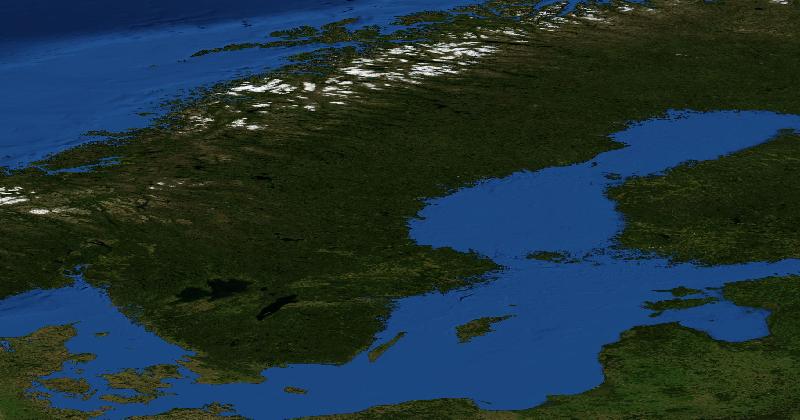
Swedish forest and lake landscape
Sweden's boreal forests, thousands of glacial lakes, and skerry-strewn coast produce a distinctively Nordic aerial signature.

Southern Sweden: Agriculture and Beech Forests

Southern Sweden — Skåne and the surrounding provinces — is the most agriculturally productive part of the country and looks distinctly different from the rest. From orbit, southern Sweden appears as a flat to gently rolling agricultural landscape with characteristic large rectangular fields (wheat, sugar beet, rapeseed, barley), scattered mid-sized farms, and forest patches on the less productive land. The pattern is more similar to Denmark or northern Germany than to the rest of Sweden. Beech and oak forests cover the southernmost areas, with characteristic broadleaf canopy texture different from the conifer-dominated forests further north.

The provinces of Småland, Östergötland, and Västergötland in central southern Sweden form a transition zone — more forest cover than Skåne, more lakes, smaller fields, and characteristic small red-painted farmhouses set in clearings. The famous Glasriket (Glass Kingdom) of Småland has historic glassworks visible at close zoom in some forest clearings. The transition from agricultural southern Sweden to forested central Sweden happens gradually around the Vänern-Vättern axis.

The Scandinavian Mountains and Lapland

Northwestern Sweden is dominated by the Scandinavian Mountains (Skanderna) along the Norwegian border. From orbit, the mountains appear as a complex zone of high terrain with characteristic glaciated valleys, snow-capped peaks, small alpine lakes, and bare rock above the treeline. Kebnekaise, the highest peak in Sweden at 2,097 metres, is in the far north. The Sarek and Padjelanta national parks contain some of the most remote terrain in northern Europe, with glaciers, sharp peaks, and almost no permanent settlement.

North of the Arctic Circle, Sweden transitions to true Arctic terrain. Swedish Lapland (Norrbotten) has characteristic flat tundra terrain in the east, the Scandinavian Mountains in the west, the major iron-mining towns of Kiruna and Gällivare (with the enormous iron mines visible from orbit as huge open pits and surrounding tailings ponds), and the Torne River forming the border with Finland in the east. The historic Sami pastoral lands cover much of the north, with characteristic small Sami siida settlements and reindeer herding paths sometimes visible at close zoom.

Swedish Cities

Stockholm is the largest city in Sweden, with a metropolitan population of around 2.4 million. From orbit, Stockholm has one of the most distinctive city footprints in Europe — built across 14 islands at the meeting point of Lake Mälaren and the Baltic, with the historic Gamla Stan (Old Town) on a small island in the centre, the inner-city districts spread across the surrounding islands and mainland, and the western waterfront extending into Lake Mälaren while the eastern waterfront extends into the Baltic archipelago. The Stockholm metro and ferry routes are visible at close zoom.

Gothenburg, Sweden's second-largest city, sits on the west coast at the mouth of the Göta älv river, with characteristic Dutch-influenced canal districts in the historic centre and the major port at the river mouth. Malmö in the far south sits across the Öresund from Copenhagen, with the famous Öresund Bridge visible from orbit as a long curved structure crossing the strait. Uppsala has its distinctive cathedral visible. Umeå and Luleå are the major northern cities. Visby on the island of Gotland has its UNESCO-listed medieval walled core. Each city has a characteristic small-to-mid-sized urban footprint.

Regional Tells

  • Skåne and the south: agricultural plain with large fields, beech forests, the Öresund Bridge to Denmark, and Malmö.
  • Småland and Halland: rolling forest-and-lake country with characteristic small red farmhouses, the Glass Kingdom, and the west coast archipelago.
  • Västergötland and Östergötland: agricultural plains around Lakes Vänern and Vättern, the Göta Canal, and the historic cities of Skövde, Linköping, and Norrköping.
  • Svealand and Stockholm: Lake Mälaren and Stockholm, the rolling agricultural-forest landscape between Stockholm and the great lakes, and the historic provinces of Uppland, Södermanland, and Västmanland.
  • Dalarna: dense forests, small lakes, the Siljan crater lake, the historic mining and folk-culture region.
  • Norrland coast: long Baltic and Bothnian coasts with skerries, characteristic small port towns (Sundsvall, Umeå, Luleå), and the Höga Kusten with its dramatic uplifted shorelines.
  • Norrland interior: vast forests, large rivers (Indalsälven, Ångermanälven, Umeälven, Skellefteälven, Luleälven) with characteristic hydroelectric infrastructure, and the iron-mining belts.
  • Lapland: tundra and mountains, the Sami cultural region, the Kebnekaise massif, the Kiruna and Gällivare iron mines, and the Torne River border with Finland.

Where Sweden Gets Confused

Sweden is most often confused with Finland (which shares similar forests, lakes, and Baltic coast), Norway (which shares the Scandinavian Mountains and high latitude), and parts of Canada or Russia. The disambiguators are usually specific: the unique pattern of Swedish skerry archipelagos with characteristic red summer cottages, the particular density and distribution of Swedish lakes (slightly more clustered than Finland's), the specific shape of Swedish forestry clear-cuts and forest management patterns, the distinctive shape of the major southern lakes (Vänern is one of the largest lakes in Europe), and the road network density (higher than Finland in most areas). Norway has more dramatic fjords and steeper terrain. Finnish landscapes have more uniform lake distribution and slightly different settlement patterns.

Pro-Tier Signals

Advanced players use finer details. The specific shape of Swedish red-painted wooden farmhouses (faluröd colour) with characteristic white-painted trim, visible at close zoom in any rural area. The pattern of Swedish forestry — characteristic mosaics of clear-cut, regenerating, and mature stands arranged in geometric forestry compartments, with access roads connecting them. The shape of Swedish hydroelectric infrastructure — Sweden has some of the most extensive river-dam systems in the world, with characteristic stepped reservoir cascades on most major Norrland rivers. The signature of the Kiruna iron mine — the largest underground iron ore mine in the world, with characteristic huge waste-rock piles, processing infrastructure, and the slowly moving town of Kiruna being relocated to escape subsidence. The pattern of Swedish summer-cottage country (stuga) on lake shores and in skerry archipelagos. And the distinctive shape of Swedish ferry routes visible as wake patterns connecting the mainland to Gotland, Öland, and the smaller archipelago islands.

Practise It

Sweden is one of the most rewarding Nordic countries to learn for geography games. The forests, the lakes, the archipelagos, and the regional variety from the Skåne plains to Lapland's tundra each have distinctive signatures. Spend a focused session on EarthGuessr playing Swedish rounds and the country will quickly become one of the more reliable identifications across northern Europe — and within a few sessions, you will be calling not just "Sweden" but "northern Sweden, probably near Luleå" or "south-central Sweden, near Lake Vättern" within a couple of seconds of seeing a frame.

Series · Spot the Country

More from this series

View all in Spot the Country →

Ready to explore?

See the world from above and test your geography skills on a 3D globe.