All posts
GeographyMarch 24, 20268 min read read

How to Spot Switzerland from Satellite Imagery: The Alps, the Mittelland, and the Jura

Switzerland is one of the most distinctive countries in Europe from orbit — the dramatic central Alps with their glaciers and high peaks, the densely engineered Mittelland in the middle, and the Jura folds along the French border. Here is the full guide.

How to Spot Switzerland from Satellite Imagery: The Alps, the Mittelland, and the Jura

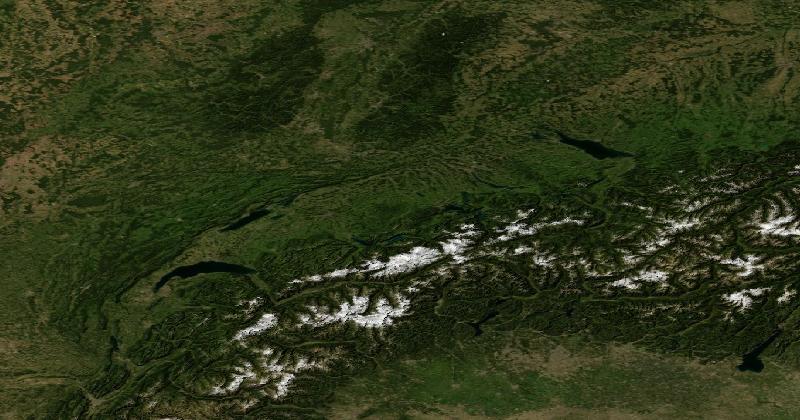
Switzerland covers just 41,000 square kilometres in the heart of Europe — about the size of the Netherlands or one and a half Belgium — but contains some of the most dramatic and densely engineered landscapes on the continent. The country is roughly divided into three physiographic regions: the Alps covering the south and centre, the Mittelland (Swiss Plateau) running diagonally from Geneva in the southwest to Lake Constance in the northeast, and the Jura along the French border in the northwest. Each region has a distinctive aerial signature.

For geography games, Switzerland is one of the easier European countries to identify once you know the cues. The Alps, the lakes, and the specific Swiss agricultural patterns combine into a national fingerprint that locks in fast from any reasonably zoomed satellite frame. This guide walks through the cues.

The Alps: One of the Most Glaciated Mountain Systems in Europe

The Swiss Alps cover roughly 60 percent of the country and contain some of the most iconic mountains in Europe. The Matterhorn, the Eiger, the Mönch, the Jungfrau, the Mont Blanc massif (on the French border), and the Dom (the highest peak entirely within Switzerland at 4,545 metres) are among the dozens of peaks above 4,000 metres. The country contains roughly 1,800 glaciers and three of the four largest glaciers in the Alps — Aletsch, Gorner, and Fiescher.

From orbit, the Swiss Alps appear as a complex zone of high glaciated mountains running west-southwest to east-northeast, with characteristic deep U-shaped valleys, hanging valleys above main valleys, alpine lakes, and the bright white of ice fields and glaciers at high elevation. The Aletsch Glacier alone is roughly 23 kilometres long and visible from satellite altitude as a long curved white snake winding through the Bernese Alps. Above about 2,000 metres, the terrain is mostly bare rock, scree, and snow, with characteristic small alpine huts and the occasional mountain railway visible at high zoom. Below the treeline, dense conifer forests cover most slopes, with characteristic alpine meadows in the summer pasture zones.

The Mittelland: Switzerland's Inhabited Heart

The Mittelland (Swiss Plateau) runs diagonally across the country between the Alps to the south and the Jura to the northwest. It is the inhabited heart of Switzerland — most of the population, all of the major cities, and most of the agriculture are concentrated in this relatively narrow zone. From orbit, the Mittelland appears as a gently rolling landscape with a fine-grained patchwork of small fields, dairy pastures, forests, and dense networks of villages and small cities. The major lakes — Geneva, Neuchâtel, Bienne, Murten, Thun, Brienz, Lucerne, Zug, Zürich, Constance — are arranged along the southern edge of the Mittelland where it meets the Alps.

Swiss agriculture in the Mittelland has a distinctive aerial signature. Field sizes are small, even by European standards — often just a few hectares. Dairy pasture dominates, with characteristic small herds of cows visible at close zoom in fields throughout the summer. Cereal fields, vegetable plots, and orchards fill the remaining agricultural land. Settlements are dense — Switzerland has one of the highest village densities in Europe — and farms tend to be small family operations rather than the larger commercial farms common in France, Germany, or Italy.

Swiss Alps landscape
Switzerland's combination of glaciated Alps, lake-strewn Mittelland, and Jura folds produces one of the most distinctive aerial signatures in Europe.

Swiss Cities and Lakes

Swiss cities are mostly small to mid-sized but densely engineered. Zürich is the largest, with a metropolitan population of around 1.4 million. From orbit, Zürich sits at the northern end of Lake Zürich with the Limmat River flowing out of the lake and through the city centre, the historic old town clustered on the river, and the city extending up the lower slopes of the Üetliberg and across the Glatt valley toward the airport. Geneva sits at the southwestern end of Lake Geneva, with the Rhône flowing out toward France, the international institutions district (UN, WTO, WHO) visible north of the historic centre, and the city compressed between the lake and the Salève mountain to the south.

Bern, the capital, sits on a tight bend of the Aare River with the medieval old town occupying the meander loop — one of the most recognisable historic city footprints in Europe. Basel sits on the Rhine at the tri-border with France and Germany, with the historic Münster district on a small bluff above the river. Lausanne climbs the steep slopes above Lake Geneva. Lugano sits on Lake Lugano with characteristic Italian-influenced architecture. The Swiss lakes themselves are some of the most distinctive single features visible from satellite altitude — Lake Geneva's crescent shape, Lake Constance's three-lobed form, Lake Lucerne's complex shape, and the long thin Lake Maggiore extending south into Italy are all recognisable individual features.

The Jura Folds and Northern Switzerland

The Jura Mountains along the French border form a parallel series of folded limestone ridges running northeast to southwest. From orbit, the Jura appear as a textured zone of parallel ridges separated by long narrow valleys, with characteristic small farming villages in the valleys and dense forests on the slopes. The pattern is similar in style to the Zagros folds of Iran but much smaller and more wooded. The Swiss Jura cover parts of the cantons of Neuchâtel, Jura, Basel-Country, Solothurn, Vaud, and Bern.

Northern Switzerland between the Jura and the Mittelland is generally rolling country with characteristic vineyards (in some areas), dense villages, and the historic Rhine River forming much of the border with Germany. Schaffhausen sits on the Rhine just downstream of the Rhine Falls — Europe's largest waterfall by volume, visible from orbit as a distinctive white-water feature in the river. The Jurapark Aargau and the Schaffhauser Randen are visible as forested ridges north of the main Mittelland.

Regional Tells

  • Lake Geneva and the Romandy: Geneva at the southwestern tip, Lausanne and Vevey along the lake, the Lavaux vineyards stepping up the hillsides north of the lake, and the Jura behind.
  • Mittelland (Bernese): Bern in its river-meander setting, the Emmental dairy country, and the Bernese Oberland Alps to the south.
  • Central Switzerland: Lucerne with its distinctive lake, Zug and its small lake, the Rigi and Pilatus mountains, and the cantons of Schwyz, Uri, and Nidwalden in the historic Swiss heartland.
  • Zürich and the northeast: Zürich at the lakehead, the Glarner Alps to the south, Lake Constance to the east, and the Rhine River forming the German border.
  • Bernese Alps: the Jungfrau, Eiger, and Mönch, the Aletsch Glacier, and the Lauterbrunnen and Grindelwald valleys.
  • Valais (Wallis): the Rhône valley between the Bernese Alps and the Pennine Alps, the Matterhorn at Zermatt, the Saastal valley, and the wine-growing slopes above Sion.
  • Graubünden (Grisons): the largest and most mountainous canton, with the Engadine valley, St. Moritz, the Rhaetian Railway lines visible from orbit, and the Italian-speaking Ticino-adjacent valleys.
  • Ticino: Italian-speaking southern Switzerland, Lake Lugano and Lake Maggiore, the dramatic alpine terrain between Locarno and the Gotthard pass.

Where Switzerland Gets Confused

Switzerland can be confused with Austria (which has similar Alpine terrain), parts of Bavaria (similar landscapes south of Munich), northern Italy (similar terrain in the Italian Alps and Lake District), eastern France (Savoy and the French Jura), or even parts of southern Germany. The disambiguators are usually specific: the unique density of Swiss villages and dairy farms, the specific style of Swiss chalet architecture, the dense Swiss railway network with characteristic viaducts and tunnels visible from orbit, the precise patterns of Swiss agriculture, and the distinctive shape of Swiss lakes. Austrian Alps tend to have larger fields and slightly different village patterns. Italian Alps have characteristic Italian village styles. French Savoy has French road and town infrastructure.

Pro-Tier Signals

Advanced players use finer details. The specific shape of Swiss chalet farmhouses — large rectangular wooden buildings with low-pitched overhanging roofs and characteristic galleries — visible at close zoom in any rural area. The pattern of Swiss vineyards on terraced hillsides, particularly the Lavaux on Lake Geneva (a UNESCO World Heritage site), the Valais Rhône valley vineyards, and the smaller vineyards of Ticino and Graubünden. The shape of Swiss alpine pastures (alpages or alps) at high elevation, often with characteristic small wooden cabins (chalets d'alpage). The signature of Swiss hydroelectric infrastructure — dams, penstocks, and powerhouses tucked into mountains, with characteristic high-altitude reservoir lakes (Grande Dixence, Mauvoisin, Emosson, Sihl). The pattern of Swiss mountain railways — distinctive narrow-gauge tracks winding up to alpine destinations, often visible as thin lines across slopes. And the specific Swiss federal motorway design — the Swiss highway system has characteristic wide medians, frequent tunnels, and distinctive blue overhead signage.

Practise It

Switzerland is one of the easier European countries to learn for geography games once you have studied the three main physiographic regions. The Alps, the Mittelland with its lakes, and the Jura each have distinctive aerial signatures, and the country's small size means most frames will contain enough cues to lock in the country fast. Spend a focused session on EarthGuessr playing Swiss rounds and you will quickly be calling not just "Switzerland" but "Valais near Sion" or "Engadine near St. Moritz" within a couple of seconds.

Series · Spot the Country

More from this series

View all in Spot the Country →

Ready to explore?

See the world from above and test your geography skills on a 3D globe.