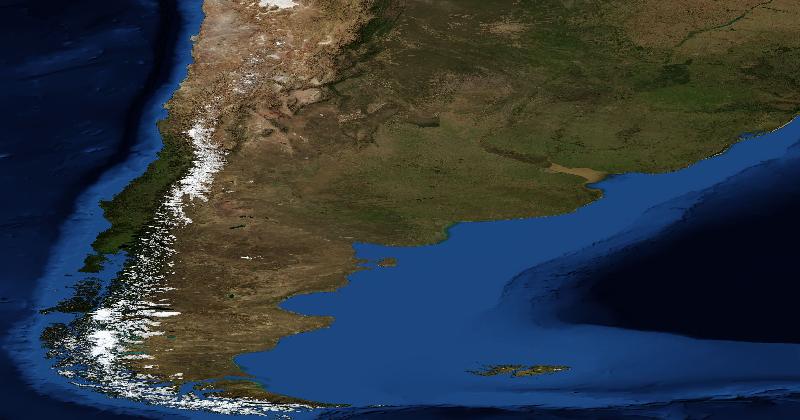
Argentina stretches roughly 3,700 kilometres from the subtropical north along the border with Bolivia and Paraguay down to Tierra del Fuego at the southern tip of South America. That north-south orientation passes through almost every climate zone on Earth except the tropics proper — from cane fields and yerba mate plantations in Misiones to vineyards and orchards in Mendoza to wheat and cattle on the Pampas to wind-blasted sheep ranches in Patagonia to glaciers and beech forests in Tierra del Fuego. The country covers nearly 2.8 million square kilometres and shows up often in satellite-imagery games.
What makes Argentina interesting to identify is that its main signatures are subtle. There is no single iconic landform like Egypt's Nile or Japan's island chains — just a series of distinctive but recognisable regional looks that, taken together, lock the country in. This guide walks through each one.
The Pampas: An Endless Grass-and-Field Plain
The Pampas — the vast grassland plain that surrounds Buenos Aires and extends inland for hundreds of kilometres — is one of the largest temperate grassland regions on Earth, comparable in scale to the North American Great Plains. From orbit, it looks deceptively similar to the American Midwest: a patchwork of rectangular agricultural fields, with cattle pastures, soybean, wheat, and corn cycling through the seasons. But the fields are not arranged on the strict one-mile grid of the US, and the road network is less dense and less regular.
Distinctive markers help disambiguate. Argentine farms typically have a cluster of buildings — a main house, outbuildings, and a stand of trees called a monte — set in the middle of the cleared land. Eucalyptus and casuarina windbreaks are common, planted in long lines along property edges. Estancias (large cattle ranches) cover huge areas with cattle yards, water tanks, and characteristic small saddling pens visible from orbit. And the Pampas-style polo fields and racetracks scattered through the region are often distinctively long rectangles or ovals near small towns. The pattern is unmistakable to anyone who has studied it.
The Andes and the Andean Foothills
Western Argentina is bounded by the Andes — the longest continental mountain range on Earth, running for over 7,000 kilometres along South America's western edge. The Argentine side of the Andes has a distinctive look from orbit: arid eastern slopes with deep canyons (quebradas), distinctive coloured rock layers (the Quebrada de Humahuaca's striped sandstones are visible from orbit), and a strip of irrigated oasis cultivation hugging the foot of the mountains where rivers emerge.
Mendoza's vineyards on the high plain east of Aconcagua are one of the most recognisable patches of Argentine landscape — vivid green geometric rectangles set in pale brown semi-desert, with the snow-capped wall of the Andes rising sharply to the west. Salta and Jujuy in the far north have their own irrigation-driven agricultural strips along Andean rivers. Tucumán's sugarcane fields cluster around the Sierra de Aconquija. The pattern of green oases against brown terrain at the foot of a high mountain wall is a strong Argentina signal.
Patagonia: One of the Emptiest Inhabited Landscapes on Earth
Argentine Patagonia covers roughly a million square kilometres and contains fewer than two million people. It is the empty quarter of Argentina — a vast, wind-scoured plateau of dry steppe rising from the Atlantic in a series of low terraces, dropping back down to glacial lakes and mountains along the Chilean border. From orbit, Patagonia looks brown and gray, with sparse vegetation, very few roads, and distinctive low ridges aligned roughly east-west. The terrain has been carved by ancient glaciation and current wind erosion into long parallel features that no other South American region quite reproduces.
Along the Chilean border in southern Patagonia, the landscape changes dramatically: high snow-capped peaks, glacial lakes in vivid turquoise, dense southern beech forests, and the massive Southern Patagonian Ice Field. Perito Moreno Glacier and the peaks of the Fitz Roy range are among the most recognisable single features in South America. North of the ice field, the Lake District around Bariloche has its own dense cluster of glacial lakes and forested mountains. The contrast between wind-blasted steppe to the east and lush mountains to the west, separated by the abrupt Andean front, is itself a Patagonia signal.
Buenos Aires and Other Argentine Cities
Buenos Aires is one of the largest metropolitan areas in the southern hemisphere, with a population of around 15 million in the metropolitan area. From orbit, the city has a distinctive footprint: a tight gridded core hugging the Río de la Plata estuary, with the famous wide Avenida 9 de Julio cutting through, the obelisk of the Plaza de la República as a landmark, and the green band of the Bosques de Palermo. The grid extends outward into mid-density inner suburbs, then breaks down into more organic outer suburbs and the working-class belt of the conurbano. The Río de la Plata itself — a vast pale brown estuary roughly 220 kilometres wide where it meets the Atlantic — is one of the largest river-mouths on Earth and gives away the city's location instantly.
Other Argentine cities have their own footprints. Córdoba is a mid-sized colonial grid in the centre of the country with strong industrial and university districts. Rosario sits on the Paraná River with distinctive grain port infrastructure. Mendoza is a low-rise oasis city surrounded by irrigated vineyards. Salta has colonial architecture nestled in a green valley. And Ushuaia at the southern tip of Tierra del Fuego is a small port city beneath snow-capped peaks, recognisable from a frame because there is simply nothing else nearby.
Regional Tells
- Mesopotamia (Misiones, Corrientes, Entre Ríos): subtropical, with red soils, wetlands, the Iguazú Falls, and yerba mate and tea plantations near the Brazilian border.
- Pampas (Buenos Aires province, La Pampa): cattle ranches and soybean fields stretching to the horizon, scattered small towns on a sparse rail-based pattern.
- Cuyo (Mendoza, San Juan): vineyards and orchards in irrigated oases against the Andean front, with distinctive blue-green colour against brown desert.
- Northwest (Salta, Jujuy, Tucumán): colourful Andean canyons, irrigation strips along rivers, sugarcane in Tucumán, salt flats at high altitude.
- Patagonia: brown steppe to the east, snow-capped peaks and lakes to the west, distinctive sheep ranches with characteristic shearing-shed clusters.
- Tierra del Fuego: forested in the south, peaty in the north, with the unmistakable Beagle Channel coastline.
Where Argentina Gets Confused
Argentina's Pampas are most often confused with the American Midwest, the Brazilian campos in Rio Grande do Sul, or Uruguay (which is essentially an extension of the Pampas culture). The disambiguators are usually field arrangement (less strict grid than the US), road network density (lower than the US Midwest), and farm style. The Andean foothills can be confused with Chile (which is just across the border) or with parts of the western US — the giveaway is usually the specific oasis-and-desert pattern and the Andean orientation. Patagonia is sometimes confused with Mongolian or Kazakh steppe, but the Andean peaks visible to the west and the South Atlantic coastline visible to the east lock it in.
Pro-Tier Signals
Advanced players use details: the specific colour and arrangement of estancia building clusters, the distinctive shape of windbreaks (long single lines of eucalyptus rather than the multi-row windbreaks of the US or Canada), the high-altitude white salt flats of the Andean north (Salar de Arizaro, Salinas Grandes), and the distinctive curve of the Río Paraná as it flows past Rosario. Argentine bollard-style railway signal cabins, mate-cup plantation rows in Misiones, and the specific pale-yellow colour of harvested wheat fields all become micro-signals once you have studied a few hundred frames.
Practise It
Argentina is a high-value country to learn because it covers so much of South America's land area and contains so many distinct regional looks. Spend a session on EarthGuessr deliberately playing rounds across Argentina and you will quickly internalise the differences between Pampas, Andean oasis country, Patagonia, and the subtropical north. Within a few weeks of regular play, Argentina becomes one of the more reliably-called South American countries — and the variety of its landscapes makes it one of the more interesting to study.