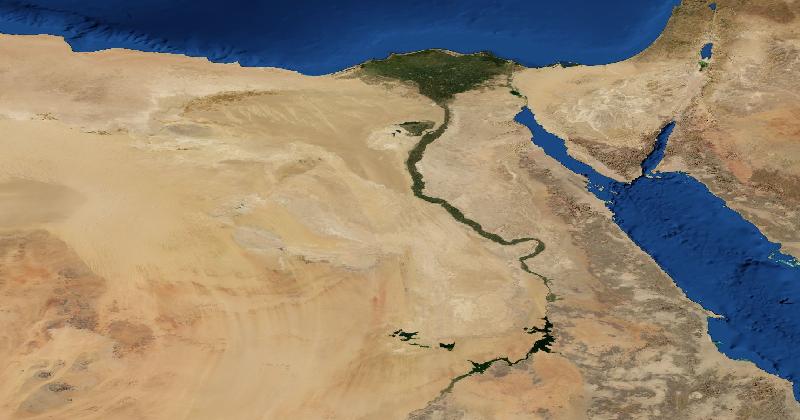
Egypt is one of the easiest countries on Earth to identify from satellite imagery. The reason is simple: roughly 95 percent of the country's population lives on the 5 percent of land within a few kilometres of the Nile. The river draws a thin, vivid green ribbon through a vast brown desert, and the boundary between cultivated land and uninhabitable Sahara is one of the sharpest visible from orbit anywhere on Earth. If a satellite frame shows a narrow strip of dense green agriculture against bare desert, with a river running through the middle, you are almost certainly in Egypt.
But Egypt is more than just the Nile. The Delta, the Sinai Peninsula, the Red Sea coast, the Western Desert oases, and the new desert cities all have their own signatures. This guide breaks down each of them so you can not just identify Egypt but pinpoint where in Egypt you have landed.
The Nile Valley: The Sharpest Land-Use Boundary on Earth
The Nile runs north for roughly 1,100 kilometres through Egyptian territory before fanning out into the Delta near Cairo. The cultivated strip on either side of the river varies from a few hundred metres in width in upper Egypt to several kilometres in the lower valley. The boundary is famously sharp because Egypt has almost no rainfall outside the Mediterranean coast — once you step off the irrigated zone you are immediately in true desert with no transitional grassland or shrubland.
From orbit, this looks like a thin emerald ribbon cutting through enormous expanses of pale tan and brown. The green strip is densely packed with small rectangular fields of clover, sugarcane, cotton, wheat, fruit orchards, and vegetables, plus villages every few kilometres. The texture is intensely human-shaped and very small-grained because Egyptian farms have averaged under one hectare for generations. The contrast with the unbroken brown desert on either side is so stark that the Nile Valley is recognisable in low-resolution satellite imagery from astronaut altitude.
The Nile Delta: One of the Greenest Spots in North Africa
North of Cairo, the Nile fans out into a triangular delta covering roughly 25,000 square kilometres before reaching the Mediterranean. The Delta is the agricultural heart of Egypt and one of the most densely populated rural regions on Earth, with population densities approaching 2,000 people per square kilometre across much of its area. From orbit, the Delta looks like a vivid green triangle pointing south, with the Mediterranean coast forming the base.
The Delta's interior is a fine-grained patchwork of small fields, irrigation channels, and tightly packed villages. The two main branches of the river — the Rosetta and Damietta — split at Cairo and reach the sea hundreds of kilometres apart. Several large brackish lagoons (Maryut, Burullus, Manzala) sit along the Mediterranean coast, separated from the sea by narrow sand bars. The combination of intensely green agriculture, the triangular shape, the two river branches, and the distinctive lagoons is unmistakable from orbit.
Cairo and Egyptian Urban Patterns
Cairo is one of the largest cities in Africa, with a metropolitan population approaching 22 million. From orbit, the city has a distinctive footprint: a dense pre-modern core on both banks of the Nile, with the river curving past gleaming high-rise developments on Gezira Island and the embassy district of Garden City; the older Islamic Cairo to the east with its distinctive mosque domes and minarets; the satellite cities of 6th of October and New Cairo emerging on the desert plateaus to the west and east; and the new administrative capital under construction further east into the desert.
Other Egyptian cities have their own signatures. Alexandria stretches along the Mediterranean coast in a thin line shaped by the lake to its south. Aswan sits at the head of the Nile cataracts with the granite cliffs of the Aswan Dam visible to the south. Luxor is a smaller town surrounded by the most famous archaeological landscape in the world — Karnak and Luxor temples on the east bank, the Theban necropolis on the west. New desert cities like the 6th of October, El Sheikh Zayed, and the New Administrative Capital have characteristic rectangular plans set in the desert with sharp boundaries against undeveloped land.
The Western Desert and Its Oases
West of the Nile, the Western Desert covers roughly two-thirds of Egypt's land area. It is part of the Sahara and contains some of the most spectacular desert landscapes on Earth: the Great Sand Sea with its hundreds of kilometres of linear dunes, the White Desert near Farafra with its chalk pinnacles eroded into surreal shapes, the Black Desert with its volcanic capping, and the depression of the Qattara — a vast salt-encrusted basin that drops nearly 150 metres below sea level. Scattered across this desert are the famous Western Oases — Siwa, Bahariya, Farafra, Dakhla, and Kharga — each appearing as a green patch in an otherwise unbroken brown expanse.
The oases are some of the most photogenic single features in any satellite frame. A bright green patch with palms, fields, and a small town, surrounded by hundreds of kilometres of bare desert in every direction — that combination is essentially unique to the Saharan oases of Egypt, Libya, and Algeria, and Egyptian oases tend to be larger and more clearly bounded than Libyan or Algerian counterparts.
The Sinai Peninsula and the Red Sea Coast
The Sinai Peninsula is a triangular mass of mountainous desert pointing southward into the Red Sea, separated from mainland Egypt by the Suez Canal — itself one of the most recognisable single features on Earth from orbit, a perfectly straight blue line cutting through the brown desert from Port Said on the Mediterranean to Suez on the Gulf of Suez. South Sinai is mountainous, with the granite peaks around Mount Sinai and St. Catherine's Monastery, while North Sinai is sandier and flatter.
The Red Sea coast on both sides of the gulf has its own distinctive look: coral reefs visible from orbit as turquoise patches against the deep blue sea, resort developments at Sharm el-Sheikh, Hurghada, Marsa Alam, and El Gouna with their characteristic geometric layouts, and stretches of empty desert coastline elsewhere. The fringing reefs of the Red Sea are some of the most photogenic features visible from satellite imagery anywhere on Earth.
Regional Tells
- Upper Egypt (south of Cairo): the Nile cuts through a narrower valley flanked by limestone or sandstone cliffs, with the Theban hills west of Luxor visible.
- Middle Egypt: the valley widens with more cultivated land, and the Faiyum Oasis southwest of Cairo is unmistakable as a large green depression with Lake Qarun on its north edge.
- Lower Egypt (the Delta): vivid green triangle with two river branches, Mediterranean lagoons, and Alexandria visible on the coast.
- Sinai: mountainous south, sandy north, and the unmistakable Gulf of Aqaba and Gulf of Suez branching off the Red Sea.
- Red Sea coast: turquoise fringing reefs, resort developments, and bare brown mountains rising sharply from a narrow coastal plain.
- Western Desert: vast brown expanse with green oases at Siwa, Bahariya, Farafra, Dakhla, and Kharga, plus the salt flats of the Qattara Depression.
Where Egypt Gets Confused
Egypt is one of the less-confused countries in satellite-imagery games because its core signal — the Nile-versus-desert boundary — is so unique. The Western Desert can be confused with Libya, Algeria, or Sudan, but the presence of large green oases, the position of the Mediterranean coast, or a glimpse of the Nile usually disambiguates. The Sinai can be confused with parts of Saudi Arabia or Jordan across the Gulf of Aqaba, but the Egyptian-side resort patterns and the Suez Canal usually appear in or near the frame. The Red Sea reefs are similar on both the African and Arabian sides — disambiguators are usually the coastal road pattern and resort architecture.
Pro-Tier Signals
Advanced players use finer details. The colour of Egyptian rural villages (mud-brick buff in many areas, pastel pink and yellow paint becoming common in others). The shape of Egyptian agricultural plots (very small, rectangular, often with characteristic palms along the edges). The distinctive yellow tarmac of Egyptian motorways. The pattern of central-pivot irrigation circles in the new desert reclamation zones (Toshka in the far south, the New Valley project, and the desert margins of the Delta). The shape and size of Lake Nasser — the world's third-largest reservoir — behind the Aswan High Dam. And the absolute clarity of the Suez Canal, the Suez approach lanes with their characteristic queueing ships visible as parallel dots in the Gulf of Suez or the Mediterranean.
Practise It
Egypt is one of the easiest countries to learn for geography games. The Nile-versus-desert signal is so strong that a single rural frame is often enough to lock in the country within a second. Spend a session focusing on Egyptian frames on EarthGuessr and the regional tells — Upper Egypt versus Delta versus oases versus Sinai versus Red Sea coast — will become automatic. Few countries reward attentive players as quickly as Egypt does.