All posts
GeographyMay 15, 20268 min read read

How to Spot France from Satellite Imagery: Hexagon Geometry, Vineyards, and the Bocage

France has one of the most distinctive aerial signatures in Europe — vast geometric agricultural plains in the north, dense vineyard patchworks in the wine regions, ancient bocage country in the west, and a coastline that touches three different seas. Here is how to identify it from a satellite frame.

How to Spot France from Satellite Imagery: Hexagon Geometry, Vineyards, and the Bocage

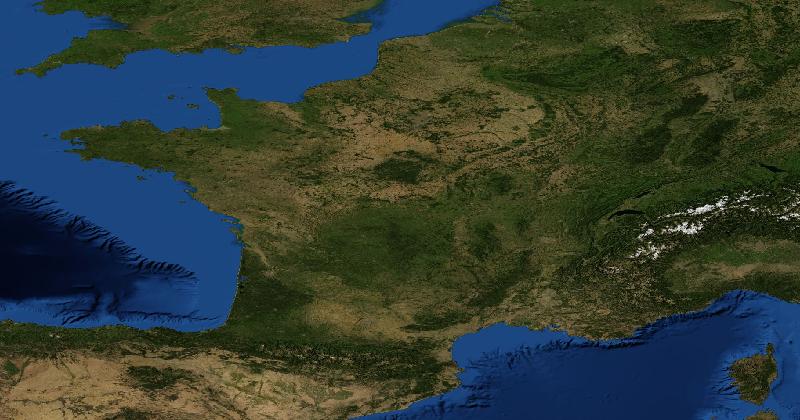
France is the largest country in the European Union by area at 551,000 square kilometres — bigger than Spain, bigger than Germany, bigger than the UK by more than a factor of two. The country is famously shaped like a hexagon, with three sides facing the sea (the English Channel, the Atlantic, and the Mediterranean) and three facing land borders (with Belgium and Luxembourg, with Germany, Switzerland, and Italy along the Alps and the Jura, and with Spain along the Pyrenees). That hexagonal balance produces a striking variety of landscapes within a country compact enough to drive across in a day.

For geography-game purposes, France is one of the most rewarding European countries to learn. Each of its main regions has a distinctive aerial signature, and once you can tell the wheat plains of Beauce from the vineyards of the Languedoc from the bocage of Normandy, France becomes one of the easier European countries to lock in within a couple of seconds.

The Open-Field Agriculture of the Paris Basin

Northern France is dominated by open-field agriculture on a scale no other European country quite matches. The Paris Basin, the Beauce, the Brie, the Champagne plains, the Picardy plateau — all are vast rolling lowlands with very large rectangular fields of wheat, barley, sugar beet, and rapeseed. The fields are bigger than UK fields by an order of magnitude, more geometric than German fields, and arranged in patterns of unmistakable scale. From orbit, you see a quilt of large rectangles in shades that vary from pale tan (after harvest) to bright yellow (rapeseed in flower) to deep green (summer cereals) to dark brown (freshly turned soil), with very few trees breaking up the patchwork.

Villages in this part of France have a characteristic compact footprint — tightly grouped stone houses with terracotta roofs around a central church spire, surrounded immediately by open fields. There is almost no suburban sprawl in the Paris Basin outside the immediate environs of Paris and the major regional cities. If you see large open fields, compact stone villages with central spires, and a very dense network of small straight roads connecting them, you are most likely in northern France.

Vineyards: A Country-Identifying Signal in Themselves

France has the second-largest vineyard area in the world after Spain, and French vineyards have an aerial signature that is hard to mistake. Vineyards from orbit look like very fine-grained parallel-line patterns, with rows spaced 1.5 to 2.5 metres apart, often planted on slopes for drainage and sun exposure. In Bordeaux, the Loire, Burgundy, Champagne, the Rhône Valley, and Languedoc-Roussillon, vast areas are covered in this distinctive linear texture. Where vineyards meet woodlands, the boundary is sharp and geometric; where they meet villages, the village is small and tightly compact.

Burgundy's Côte d'Or vineyards in particular have one of the most recognisable aerial signatures of any agricultural region on Earth — a thin band of vineyard hugging the eastern slope of a low limestone ridge, with villages every few kilometres carrying world-famous names. Champagne's vineyards similarly drape the slopes of the Marne and Aube valleys. And Bordeaux's gravel terraces along the Garonne and Dordogne have their own characteristic patchwork. Other countries with major vineyard regions — Italy, Spain, Germany, the US, Argentina, Australia, South Africa — have similar textures, but the density, regional concentration, and surrounding landscape clues usually disambiguate France.

French countryside with vineyards and villages
France's vineyards, open fields, and compact stone villages produce an aerial signature that distinguishes it from all its neighbours.

The Western Bocage and Mountain Regions

Western France — Normandy, Brittany, parts of the Pays de la Loire and Poitou — looks completely different from the open-field plains of the north. The bocage is a landscape of small fields bounded by hedgerows and earthen banks, very similar to the British landscape but with a slightly larger field size on average, more orchards, and a different style of farmhouse. Apple orchards in Normandy produce the cider for which the region is famous, and dairy pastures give Normandy and Brittany a much greener appearance than the cereal plains further east.

The French mountains have their own signatures. The Pyrenees on the Spanish border are sharp, glacially carved, and snow-capped much of the year. The Alps along the Italian and Swiss borders are taller, more glaciated, and contain France's highest peaks. The Massif Central in the middle of the country is older, more rounded, volcanic in origin (visible volcano cones in the Auvergne), and covered in forest and pasture. The Vosges and Jura along the German and Swiss borders are lower, wooded, and orchard-rich. Each mountain region has a different look from orbit and pinpoints where in France you are.

Regional Tells

  • Île-de-France and Paris: the city itself is unmistakable from orbit with its compact circular boulevard pattern, the bend of the Seine, and the Champs-Élysées axis running northwest from the Louvre.
  • Provence and the Côte d'Azur: stone villages perched on hills, distinctive olive groves, lavender fields when in season, and a Mediterranean climate visible in vegetation colour.
  • Aquitaine: pine plantations on the Landes coast, vineyards inland, the Gironde estuary, and the limestone country of Périgord with its distinctive caves and gentle valleys.
  • Brittany: rugged Atlantic coast with many small islands, distinctive granite landscape, bocage interior, and characteristic small ports with stone breakwaters.
  • Alsace: vineyard-covered foothills on the eastern slope of the Vosges, distinctive German-style half-timbered villages, the Rhine plain to the east with the German border visible.
  • Corsica: looks like a slice of Italy with a French overlay — mountainous, sparsely populated, with a coastline of small bays and pebble beaches.

Where France Gets Confused

France can be confused with several neighbours depending on the region. The open-field plains of northern France look similar to parts of Belgium, the Netherlands, and northern Germany — disambiguators are field size (larger in France), village style (more terracotta roofs in France, more red tile in Germany, more diversity in Belgium), and road style (French rural roads tend to be tree-lined plane-tree avenues with a distinctive look). Bocage country looks like the UK or Ireland — the giveaway is usually orchards and farm style. The Mediterranean coast looks like Italy or Spain — disambiguators are vegetation, vineyard style, and village architecture.

Pro-Tier Signals

Advanced players use finer details. The lines of plane trees along French rural roads, planted by Napoleon's order for shade and military camouflage, are visible as continuous green ribbons along otherwise straight roads. The distinctive shape of French canals, especially the Canal du Midi cutting across Languedoc, are visible as straight thin water lines. French motorways have a specific design — wider median strips, characteristic blue overhead gantries, and toll plazas at regular intervals. The pattern of TGV high-speed rail lines, cutting through the landscape in long straight viaducts and tunnels, are visible across northern and central France. And the size and arrangement of French farms — the famous corps de ferme square layout in the north, the long thin lots of Quebec-influenced settlements in some areas — give regional cues.

Practise It

France is one of the most rewarding European countries to learn for geography games. The variety of landscapes, the strong regional signatures, and the high frequency of French frames in any global game make a few dedicated sessions worth the time. EarthGuessr drops you into the bocage of Normandy as readily as the vineyards of Languedoc and the wheat plains of Beauce, and after a few rounds in each region the country becomes one of the easiest in Europe to call within a second of seeing a frame.

Series · Spot the Country

More from this series

View all in Spot the Country →

Ready to explore?

See the world from above and test your geography skills on a 3D globe.