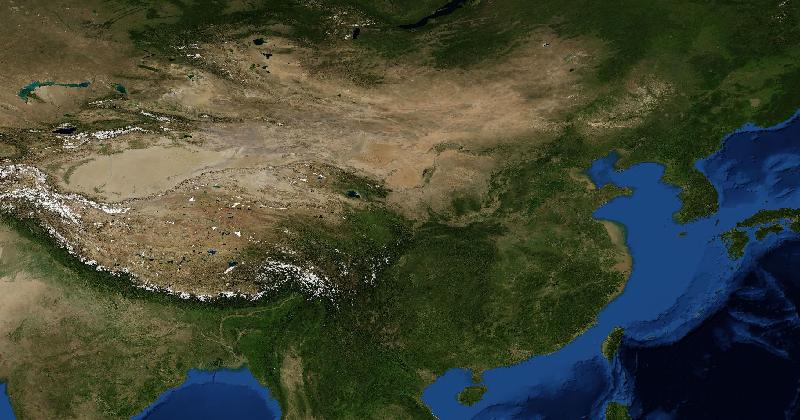
China is the fourth-largest country in the world by area, and after Russia and Canada it has the third-most varied set of landscapes you can land on in a satellite-imagery game. Within Chinese borders you can find tropical rainforest in Yunnan, the highest plateau on Earth in Tibet, the second-lowest depression on Earth in the Turpan Basin, sand seas to rival the Sahara in the Taklamakan, dense rice-paddy country in the Yangtze valley, and some of the most cratered coal-mining landscapes anywhere on the planet.
Because China is so big and so densely engineered, it shows up often in geography games and almost every frame contains some kind of strong identifying signal. This guide breaks down the half-dozen biggest Chinese aerial signatures and the regional cues that let you narrow down where in the country you have landed.
Terraced Rice Paddies on a Scale Found Nowhere Else
The single most photogenic and distinctive aerial feature of southern China is the rice terrace. Centuries of cultivation have carved entire mountainsides in Yunnan, Guangxi, Guizhou, and Sichuan into stepped contour terraces, each holding a thin film of water during the growing season. From orbit, these areas look like a fingerprint pattern of tightly nested curves following the slope contours — bright silver-blue when flooded, bright green in the growing season, golden in autumn.
Other countries have rice terraces, including the Philippines, Vietnam, Indonesia, Nepal, and Japan, but only China has them at the scale where a single satellite frame is dominated by terracing alone. The combination of terrace density, mountain steepness, and the absence of any other land use in the frame is one of the strongest China signals available. The Longji and Yuanyang terraces in particular are visible as recognisable features from orbit.
The Loess Plateau and Its Yellow Furrows
Northern central China is dominated by the Loess Plateau, a vast region covered in windblown silt up to 300 metres deep deposited from the Gobi during glacial periods. Centuries of erosion and cultivation have carved the plateau into a maze of deep gullies, hilltop terraces, and distinctive yellow-brown ridges. From orbit, it looks like a topographic map of a fractal — endless branching gullies, with farmland terraced into the ridge tops and small villages tucked into the valleys.
The colour is a giveaway. The Loess Plateau is the source of the Yellow River's famous yellow load — the loess silt washing into the river gives it the sediment concentration that makes it the muddiest major river on Earth. If a frame shows yellow-brown rolling terrain with intricate erosion patterns and terraced farmland, no settled forest cover, and a wide muddy river visible in the lower part of the frame, you are almost certainly in the Loess Plateau region — provinces like Shaanxi, Shanxi, Gansu, and parts of Ningxia and Inner Mongolia.
Chinese Megacities Have a Look Like No Others
Chinese cities, particularly the newer megacities built since the 1990s, have an aerial signature you do not see at scale anywhere else. Massive residential compounds of nearly identical high-rise towers — often 30 to 50 stories — are arranged in tight clusters with a uniform footprint and uniform spacing. Shanghai, Shenzhen, Chongqing, Wuhan, Tianjin, and Guangzhou all have districts where dozens of these compounds stretch to the horizon. The pattern is utterly different from American suburban sprawl, European mid-rise neighbourhoods, or African mixed-density growth.
Older Chinese urban cores have a different look: narrower streets, smaller building footprints, and the remnants of hutong courtyards in cities like Beijing, Pingyao, and Xi'an. New ring roads, exhibition centres, high-speed rail stations with characteristic curved roofs, and giant industrial zones with rectangular factory complexes fill out the urban edge. China's high-speed rail network is itself a giveaway when visible — the elevated viaducts running for hundreds of kilometres in nearly perfectly straight lines, the futuristic stations, and the absence of any visible road traffic on the dedicated right-of-way are unmistakable.
The Western Deserts and Tibetan Plateau
Western China is mostly empty and mostly distinctive. The Tarim Basin contains the Taklamakan Desert, one of the largest sand seas on Earth, with vast dune fields visible from orbit. The Junggar Basin to the north has its own dune fields and a famously cratered landscape near the Chinese nuclear testing sites at Lop Nur. The Tibetan Plateau spans an area larger than western Europe, averaging over 4,500 metres elevation, with high-altitude lakes, glaciers, salt flats, and grasslands that look like nowhere else.
If a frame shows enormous dune fields with no visible roads, you are likely in the Taklamakan or Gobi. If it shows turquoise high-altitude lakes, snow-capped mountain ranges in the background, and characteristic Tibetan pastoral settlements with their stone-walled enclosures, you are on the Tibetan Plateau. The northwest gets confused occasionally with Central Asian neighbours (Kazakhstan, Kyrgyzstan, Mongolia), but the absence of Cyrillic signage and the presence of bilingual Chinese-Uyghur road signs disambiguate quickly.
Regional Tells
- Yangtze River Delta: the most intensively cultivated landscape in the world, with rice paddies, fish ponds, and dense townships in nearly continuous coverage from Shanghai west.
- Pearl River Delta: similar intensity to the Yangtze Delta but with a stronger urban-industrial texture and the unmistakable proximity of Hong Kong and Macau.
- North China Plain: huge flat agricultural region in Henan, Hebei, and Shandong, with wheat in winter and corn/soybean in summer. Less terraced than the south, more like American Midwest but denser.
- Northeast (Manchuria): cooler climate, larger fields, more state-farm grids in Heilongjiang, and distinctive Russian-influenced architecture in some towns near the border.
- Hainan: tropical, with palm plantations, sandy beaches, and a small-island scale unmistakable once seen.
- Inner Mongolia: vast grasslands, scattered yurts, and the largest open-pit coal mines on Earth.
Where China Gets Confused
Chinese terraced rice paddies can be confused with Vietnam, the Philippines (Luzon's Cordillera), or Indonesia. The disambiguator is usually scale and the surrounding urban density — Chinese terrace country tends to have larger villages with more uniform housing and more visible road infrastructure. The Loess Plateau is unique enough that it is rarely confused, though some areas of Iran and Turkmenistan have superficial similarities. Chinese megacity high-rise compounds can be confused with South Korean ones (especially in Seoul satellite towns), but Korean compounds tend to be lower density and have more parkland around them.
Pro-Tier Signals
Advanced players use finer details. The colour and shape of greenhouses (white plastic tunnels in vast greenhouse zones in Shandong are visible from orbit). The presence of fish ponds laid out in rectangular grids beside rivers in the south. The characteristic blue-roofed factory buildings of southern Chinese industrial zones. The shape and density of solar farms (China has installed more solar capacity than any other country and the giant arrays are visible from orbit). And the signature pattern of new ring roads encircling cities of every size, often with the road built before the city has grown into it — producing the famous Chinese phenomenon of "ghost city" rings of empty residential towers waiting for migration.
Practise It
China is one of the highest-value countries to learn in geography games simply because of its size and the frequency with which it comes up. Each of the major regional landscapes — terraced south, Loess Plateau, North China Plain, Tibetan Plateau, western deserts, megacity belt — has a strong enough signal that within a few sessions you can confidently identify the country and narrow to a region. EarthGuessr drops you into all of these landscapes regularly, and a deliberate few rounds focusing on Chinese frames will accelerate identification dramatically.