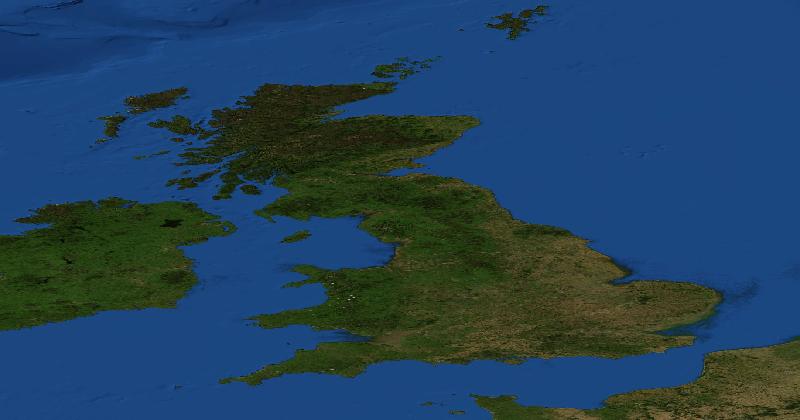
The United Kingdom is small relative to the major countries on the satellite-imagery game circuit — roughly 243,000 square kilometres, the same order of magnitude as Romania or New Zealand — but it shows up often because its landscapes are intensely cultivated, densely populated, and visually distinctive. A British satellite frame has cues that almost no other country reproduces in combination: hedgerowed fields in a fine patchwork, country lanes that wind in apparently arbitrary patterns, market towns with red-brick housing and slate or tile roofs, and a road network dominated by roundabouts at every junction.
This guide breaks down the British aerial fingerprint and how to identify the country quickly. With practice, the UK becomes one of the easier European countries to call from a single frame.
The Hedgerow Patchwork
The single most distinctive aerial feature of the British landscape is the hedgerow patchwork. British fields are small by international standards, often only a few hectares each, and almost all of them are bounded by mature hedgerows rather than fences. From orbit, this produces a fine-grained mosaic of irregular green and brown fields outlined in darker green hedges — a texture you do not see at the same scale anywhere else in the world.
France has a similar pattern in some regions (bocage country in Normandy and Brittany), but French field sizes tend to be larger and the hedgerow density less consistent. Most of continental Europe long ago consolidated farmland into bigger plots, and hedgerows were ripped out. The UK, partly because of stronger landscape protection and partly because of historical land tenure, kept its hedgerows. The result is a national signature visible from satellite altitude.
Winding Country Lanes and Roundabouts
British rural roads are distinctive. They wind in apparently arbitrary patterns, following ancient routes, parish boundaries, and field edges rather than the geometric logic of American roads. Many are sunken between high hedgebanks, narrow enough that two cars can barely pass. From orbit, this produces a dense network of fine, curving roads connecting villages, with very few long straight stretches.
More distinctively, the UK has one of the densest networks of roundabouts on Earth. Roundabouts at almost every junction outside the very largest cities — and motorway interchanges that feature multi-level stacked roundabouts at intervals you do not see in other countries. The presence of multiple roundabouts visible in a single frame is one of the strongest British identification signals available.
British Villages and Market Towns
British villages and market towns have a recognisable footprint. The historic centre features a church (usually with a square tower in southern and eastern England, a spire elsewhere), a market square, and tightly packed terraced housing. Around the centre, mid-20th-century semi-detached and detached housing in cul-de-sac estates sprawls outward in a characteristic style — curving roads, small gardens, garages — that is distinct from American or continental European suburban patterns.
Red brick is the dominant building material in southern and central England; sandstone or limestone is more common in the Cotswolds, Yorkshire, and Scotland; and slate or tile roofs predominate everywhere except in some rural Welsh and Scottish settlements where corrugated metal roofs are more common. The combination of red brick housing, slate roofs, and tight terraced layouts is one of the strongest urban signals.
Regional Tells
- Southern England: rolling chalk downland, intensive arable farmland, dense road network, large towns and the London commuter belt.
- East Anglia: very flat, large rectangular fields (more like continental Europe), fewer hedgerows, distinctive fen drainage patterns near the Wash.
- The Midlands: a mix of farmland and dense industrial/post-industrial towns, with the M6 motorway running north-south through the heart.
- Northern England: more rugged, with the Pennines as a north-south spine, smaller fields walled with dry stone rather than hedged, the moorlands of Yorkshire and the Peak District.
- Wales: mountainous, with characteristic green valleys, slate quarries, and small villages of grey stone houses with slate roofs.
- Scotland: highlands in the north, lochs (long narrow lakes), much sparser settlement, distinct from English landscapes in almost every aspect once you compare them.
- Northern Ireland: smaller-scale patchwork than Great Britain, characteristic green hills, the Mourne Mountains, and the very recognisable basalt columns of the Giant's Causeway on the north coast.
Coastlines: Some of the Most Indented on Earth
The UK has one of the most complex coastlines on Earth relative to its area — full of estuaries, bays, inlets, sea lochs, and small offshore islands. The west coast of Scotland is particularly distinctive, with hundreds of long thin lochs reaching far inland. The south coast of England has gentler chalk and sandstone cliffs (the White Cliffs of Dover being the most famous). The North Sea coast of eastern England has long sandy beaches and salt marshes.
If a frame shows a coastline with multiple complex inlets, dense rural patchwork right up to the shore, and a clearly British settlement pattern, you can usually call the UK quickly and then narrow to a specific region based on the coastline style.
Where the UK Gets Confused
The UK is sometimes confused with Ireland (which shares the patchwork-and-hedgerow look), the Netherlands and northern France (similar latitude and some shared agricultural cues), Belgium (similar dense road networks), and parts of New Zealand (which has a famously British landscape feel because of colonial-era land settlement patterns). The clearest disambiguators are usually the density of roundabouts (highest in the world in the UK), the specific style of British road signage and motorway design when visible, and the prevalence of red brick housing.
Practise on Country Lanes
Rural UK rounds with no obvious city in frame are some of the best practice material. Once the hedgerow patchwork, winding lanes, and roundabout pattern become automatic, British identification becomes one of the fastest first-second locks in European play. Spend a couple of sessions deliberately studying UK frames and the country will move from "northern Europe somewhere" to "Cotswolds, probably Gloucestershire" inside a few evenings.