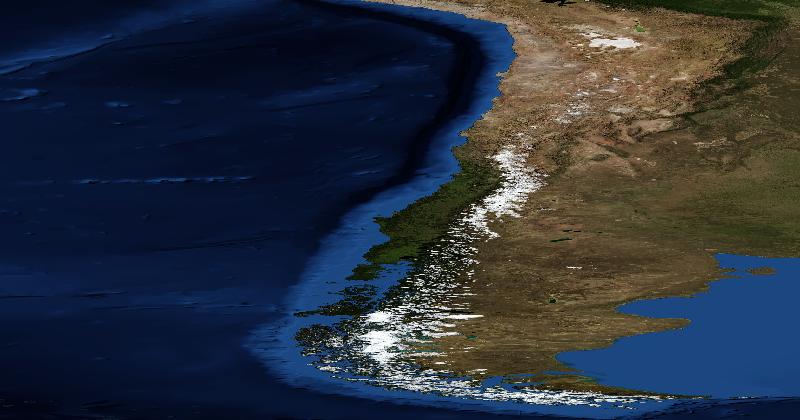
Chile is one of the most geometrically extreme countries on Earth. It stretches 4,300 kilometres from the Peruvian border in the north to Cape Horn in the south — longer than the distance from New York to Los Angeles — but its average width is only 175 kilometres. The country is pinned between the Andes on the east and the Pacific Ocean on the west, with no room to spread sideways. The result is one of the most climate-diverse single countries on the planet, spanning from the driest non-polar desert (Atacama) in the north through Mediterranean central Chile, temperate rainforest in the south, and finally glaciated fjord country at the southern tip.
For geography games, Chile is one of the easier South American countries to learn because each of its four main climate zones has a distinctive aerial signature, and the country covers a large enough area to appear often in any global rotation. This guide walks through the cues that lock Chile in fast and tell you which zone you have landed in.
The Atacama Desert: One of the Driest Places on Earth
Northern Chile is dominated by the Atacama Desert, which extends roughly from the Peruvian border south to about Copiapó — a stretch of nearly 1,500 kilometres. Parts of the Atacama have never received rainfall in recorded history, and the central core is so dry that NASA uses it as a Mars analogue. From orbit, the Atacama appears as one of the most extreme dry landscapes on Earth: pale tan and white surfaces with no vegetation, salt flats visible as bright white patches (the Salar de Atacama is one of the largest), and characteristic alluvial fans, dry river canyons, and yardang fields.
The Atacama also contains some of the largest copper mines in the world. Chuquicamata, the largest, is visible from orbit as an enormous open-pit mine with characteristic terraced walls and surrounding tailings ponds. Other mines — Escondida, Collahuasi, El Teniente — appear as similar terraced scars in mountainous terrain. The pattern of huge mines, salt flats, and absolutely no vegetation is essentially unique to the Atacama and the adjacent Bolivian and Peruvian altiplano. Centre-pivot irrigation circles appear in some oases (Pica, Calama) and along the coastal river valleys (Lluta, Camarones, Loa), but most of the desert is unbroken brown and white.
Central Chile: A Long Thin Mediterranean Valley
Central Chile from roughly Santiago south to Concepción is a long thin Mediterranean valley wedged between the coastal range and the high Andes. From orbit, it appears as one of the most intensively farmed strips of land in South America — vineyards covering huge areas of the Colchagua and Maipo valleys, fruit orchards (peaches, apples, kiwifruit, citrus) on irrigated land, and the urban sprawl of Santiago dominating the centre. The valley is visible as a clearly defined longitudinal corridor, with the Andes rising dramatically to the east (often snow-capped) and the coastal range and Pacific to the west.
Santiago itself is unmistakable from orbit. The metropolitan area sits in a basin between the main Andes and the coastal range, with the city sprawling east-west and north-south, the Mapocho River winding through, the historic core around the Plaza de Armas, the high-rise business district of Las Condes and Providencia visible as a distinctive cluster in the wealthier eastern districts, and the Andes rising abruptly behind. Air pollution is often visible in the basin as a haze. Other central Chilean cities — Valparaíso on the coast (with its famous hillside funiculars), Viña del Mar, Talca, Chillán, Concepción — have their own characteristic footprints.
Southern Chile: Lakes, Forests, and Volcanoes
South of about Concepción, Chile transitions to the Lake District (Región de los Lagos) — one of the most photogenic landscapes in South America. From orbit, this region appears as a green forested zone with a chain of large glacial lakes (Villarrica, Llanquihue, Todos los Santos, Ranco), characteristic volcanic cones rising from the surrounding terrain (Villarrica, Osorno, Calbuco are all perfectly conical and snow-capped), and the cities of Temuco, Valdivia, Osorno, and Puerto Montt distributed through the agricultural lowlands. The pattern of conical snow-capped volcanoes set against blue lakes and green forests is one of the most distinctive aerial signatures on the continent.
Further south, around Puerto Montt and Chiloé Island, the landscape transitions to temperate rainforest with dense Valdivian forest cover, characteristic small Mapuche and Chilote villages, and the start of the fragmented island-and-fjord coastline that dominates the rest of southern Chile. Chiloé itself is a large island with distinctive wooden churches (UNESCO World Heritage), palafitos (stilt houses) along the coast, and traditional farming patterns visible from orbit.
Patagonia and the Fjord Country
South of Puerto Montt, mainland Chile dissolves into a labyrinth of fjords, islands, and channels stretching south for over 1,500 kilometres to Cape Horn. This is one of the most rugged and least-populated regions on Earth — the entire Region of Aysén, covering 110,000 square kilometres, has fewer than 110,000 inhabitants. From orbit, southern Chilean Patagonia looks like a complex maze of small to medium glacial fjords, ice-capped mountains, and dense southern beech forests on the islands and coasts. The Carretera Austral road threads through this terrain along the mainland but in many places ferries are required to cross fjord mouths.
Two major ice fields dominate the southern interior. The Northern Patagonian Ice Field and the Southern Patagonian Ice Field together cover roughly 17,000 square kilometres and are the largest temperate ice masses outside Antarctica and Greenland. From orbit, they appear as enormous white plateaus with characteristic outlet glaciers reaching down to fjords and lakes (Lago Argentino and Lago Viedma in Argentina, the fjord systems of Chile). Torres del Paine National Park sits at the edge of the southern ice field with its dramatic granite towers visible from satellite altitude. The Strait of Magellan in the far south and the Beagle Channel divide the southernmost mainland from Tierra del Fuego.
Regional Tells
- Norte Grande (Atacama and northern desert): pale tan terrain, salt flats, no vegetation, huge copper mines, and a thin coastal strip with port cities (Antofagasta, Iquique, Arica).
- Norte Chico (semi-arid transition zone): increasing vegetation, valley agriculture (especially pisco grapes in the Elqui valley), and the cities of La Serena and Copiapó.
- Central Chile (Mediterranean zone): vineyards, fruit orchards, Santiago and its sprawl, Valparaíso on the coast, and the agricultural Central Valley.
- South-Central (Bío-Bío, Araucanía): coal-mining heritage around Concepción, monoculture pine and eucalyptus plantations on the coastal range, the southern Central Valley with wheat and dairy.
- Lake District: lakes, volcanoes, forests, dairy country, and the cities of Temuco, Valdivia, Osorno, and Puerto Montt.
- Northern Patagonia (Aysén): fjords, ice fields, sparse settlement, the Carretera Austral, and the city of Coyhaique.
- Southern Patagonia (Magallanes): the Strait of Magellan, the Torres del Paine, the city of Punta Arenas, and Tierra del Fuego.
Where Chile Gets Confused
Chile can be confused with several other countries depending on which region you are looking at. The Atacama can be confused with the Peruvian or Bolivian altiplano deserts — the disambiguators are usually the specific mine signatures (Chilean copper mines are larger), the absence of Andean-village patterns common in Peruvian and Bolivian deserts, and the coast (Atacama touches the Pacific directly). Central Chile can be confused with parts of California, Argentina (Mendoza), or even Mediterranean Europe — the long thin north-south orientation and the distinct coastal range are usually the giveaway. The Lake District can be confused with parts of Argentine Patagonia or even southern Germany — the conical volcanoes and the specific Mapuche-influenced settlements help. Southern Patagonian fjords can be confused with Norway, New Zealand, or southern Alaska — the specific Magellanic forest type and the Patagonian Ice Field are the strongest disambiguators.
Pro-Tier Signals
Advanced players use finer details. The specific shape of Chilean vineyard plots — typically arranged in geometric grids on terraced or rolling terrain in the Maipo, Colchagua, and Curicó valleys. The pattern of Chilean copper mine waste — characteristic green or yellow tailings ponds visible from orbit, sometimes covering many square kilometres. The shape of Chilean fish farms (salmon pens) in the southern fjords, visible as clusters of circular structures in calm fjord waters. The signature of Chilean pine and eucalyptus plantations on the coastal range south of Concepción — vast dark green geometric rectangles where native forest was replaced. The characteristic stilt-house palafitos of Chiloé Island, visible at close zoom along the coast at Castro and Mechuque. And the specific colour of Chilean glacial lakes — many have an unusual milky turquoise from glacial flour that makes them stand out from non-glacial lakes elsewhere on the continent.
Practise It
Chile is one of the most rewarding South American countries to learn for geography games because of the extreme regional variety packed into a long thin country. The Atacama, the central valley, the Lake District, and Patagonia each have signatures distinct enough to lock in fast. Spend a focused session on EarthGuessr playing Chilean rounds and the country will quickly become one of the more reliable identifications across South America — and you will be able to call not just "Chile" but "Atacama" or "Lake District" within a second or two of seeing a frame.