All posts
GeographyApril 3, 20268 min read read

How to Spot Colombia from Satellite Imagery: Three Andean Cordilleras, the Amazon, and Two Coasts

Colombia is one of the most geographically varied countries on Earth — three parallel Andean ranges, the Caribbean coast, the Pacific coast, the Amazon, and the Llanos grasslands. Here is how to identify it from a satellite frame.

How to Spot Colombia from Satellite Imagery: Three Andean Cordilleras, the Amazon, and Two Coasts

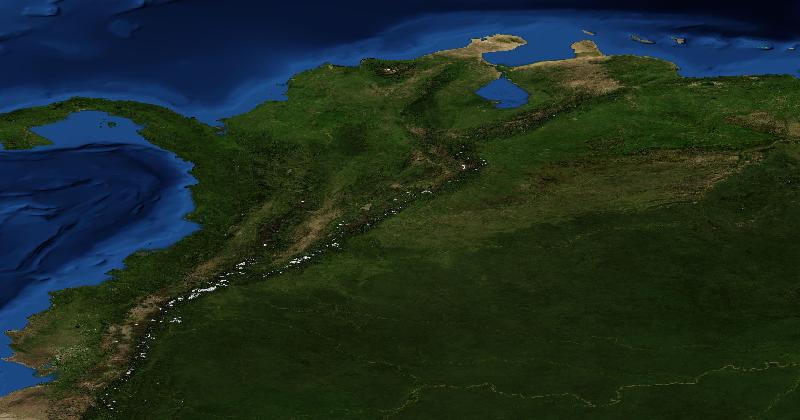
Colombia is the only South American country with coastlines on both the Caribbean and the Pacific. It covers 1.14 million square kilometres, making it the fourth-largest country on the continent, and contains an extraordinary variety of landscapes within a fairly compact footprint. The Andes split into three parallel ranges as they enter Colombia from Ecuador, separated by two great river valleys (the Magdalena and the Cauca). East of the Andes, the country flattens into the Llanos grasslands and the Amazon rainforest. To the north, the Caribbean coastal plain runs west to the isolated Sierra Nevada de Santa Marta. To the west, the Pacific coast is one of the wettest places on Earth.

For geography games, Colombia is a high-value country to learn because each of these regions has a distinctive aerial signature, and the country covers a large enough area to appear often in global rotations. This guide walks through the cues that lock Colombia in fast.

Three Andean Ranges and Two Great Valleys

The defining geographical feature of Colombia is the three-fold split of the Andes. The Cordillera Occidental runs along the western edge of the country, separating the Pacific coastal lowlands from the Cauca Valley. The Cordillera Central is the highest of the three, containing several glaciated volcanic peaks above 5,000 metres (Nevado del Ruiz, Nevado del Tolima, Nevado del Huila), and separating the Cauca Valley from the Magdalena Valley. The Cordillera Oriental is wider and lower, with the high Bogotá plateau at around 2,600 metres, the dramatic Eastern Plains escarpment dropping to the Llanos, and the country's eastern foothills toward Venezuela.

From orbit, this pattern is unmistakable: three north-south running mountain ranges with two long inhabited valleys between them. The Cauca Valley is intensively cultivated with sugar cane plantations producing the distinctive vivid green stripe between the Cordilleras Occidental and Central. The Magdalena Valley is wider, agriculturally varied (rice, oil palm, cattle), and contains the largest river in Colombia — the Magdalena, visible from orbit as a wide brown winding river running north to the Caribbean. The combination of three parallel ranges and two long fertile valleys is essentially unique to Colombia and adjacent parts of Venezuela and Ecuador.

The Coffee Triangle and the Paisa Region

The Coffee Cultural Landscape of Colombia (Paisaje Cultural Cafetero) covers parts of Caldas, Quindío, Risaralda, and Tolima, on the western slope of the Cordillera Central. From orbit, the region appears as a textured landscape of small coffee plots interspersed with banana, sugarcane, and cattle pasture, arranged on steep volcanic slopes with characteristic stepped patterns. Small towns dot the region — Manizales, Pereira, Armenia, Salento — each typically sitting on a ridge or plateau with a tight central core and surrounding agricultural smallholdings stretching down the slopes.

Medellín, the largest city in the Paisa region, sits in the Aburrá Valley in Antioquia department. From orbit, Medellín has one of the most distinctive city footprints in South America — a long thin urban area squeezed into a narrow valley with steep mountain walls on both sides, with the city extending up the slopes in characteristic informal settlements (comunas), the historic core in the centre, and the wealthier districts of El Poblado in the south. The valley shape is so confining that the urban edge climbs the surrounding mountains, and the city is connected to the surrounding region by the famous Metrocable aerial gondolas, which are visible at close zoom.

Colombian mountainous landscape with valleys
Colombia's three Andean ranges, coffee country, and varied coasts produce some of the most distinctive aerial signatures in South America.

The Caribbean Coast and the Sierra Nevada de Santa Marta

Colombia's Caribbean coast extends roughly 1,600 kilometres from the Panamanian border to the Venezuelan border. From orbit, the coast appears as a strip of warm-coloured tropical lowland between the bright turquoise Caribbean and the rising Andean foothills. Cartagena, with its famous walled historic centre, sits on a peninsula extending into the Caribbean. Barranquilla sits at the mouth of the Magdalena River. Santa Marta sits at the base of one of the most remarkable single geographical features in the country: the Sierra Nevada de Santa Marta, an isolated coastal mountain range rising to 5,775 metres at its highest points, with glaciers despite being only 42 kilometres from the Caribbean.

From orbit, the Sierra Nevada de Santa Marta is unmistakable — a roughly triangular massif of snow-capped peaks rising directly from the tropical coastal plain, with characteristic radial drainage patterns and the famous Lost City (Ciudad Perdida) and other indigenous archaeological sites in its mid-elevation forests. Other Caribbean coastal features include the Guajira Peninsula in the northeast (a dry desert peninsula extending into the Caribbean), the Gulf of Urabá at the Panamanian border, and the San Andrés and Providencia archipelago far offshore (administratively Colombian but geographically much closer to Nicaragua).

The Pacific Coast and the Chocó

The Pacific coast of Colombia, the Chocó region, is one of the wettest places on Earth — annual rainfall exceeds 8,000 millimetres in some areas, and the dense rainforest cover is unbroken across most of the region. From orbit, the Chocó appears as a vast dark green expanse, with very few roads, scattered Afro-Colombian and indigenous Embera villages along rivers, and a dramatic narrow coastal strip squeezed between the Cordillera Occidental and the Pacific. The pattern of total forest cover, river-based settlement, and extreme isolation is essentially unique to the Chocó in South America.

The major cities of the Pacific coast are Buenaventura (Colombia's main Pacific port, on a bay south of the Chocó) and Tumaco near the Ecuadorian border. The coastline itself is mangrove-dominated with characteristic estuarine deltas, dense vegetation reaching to the water's edge, and very few beaches in the conventional sense.

The Llanos and the Amazon

East of the Cordillera Oriental, Colombia transitions to the Llanos grasslands and then the Amazon rainforest. The Llanos cover roughly a quarter of the country, extending east to the Venezuelan border and forming a continuous savanna landscape with the Venezuelan Llanos beyond. From orbit, the region appears as flat to gently rolling savanna, with characteristic patterns of seasonal flooding visible in the wet season (March to October) and dry-season fires visible in the dry months. Cattle ranching is the dominant land use, with vast estancias and characteristic clusters of palm trees marking water sources.

Southeast of the Llanos, the Colombian Amazon covers roughly a third of the country — most of the departments of Amazonas, Vaupés, Guainía, Caquetá, Putumayo, and parts of Meta and Guaviare. From orbit, the Colombian Amazon appears similar to the Brazilian and Peruvian Amazon but with distinctive features: the transition from Llanos savanna to forest visible as a clear ecological boundary, the headwaters of the Amazon (the Caquetá and Putumayo rivers) running east, and characteristic rocky outcrops (tepuis-like formations) visible in the Guianan Shield areas of Vaupés.

Regional Tells

  • Caribbean coast: tropical lowland, the Magdalena River mouth at Barranquilla, the walled city of Cartagena, the Sierra Nevada de Santa Marta, and the Guajira Peninsula desert.
  • Pacific coast (Chocó): extreme rainforest cover, scattered river settlements, Buenaventura as the main port, and the Darién Gap forming the border with Panama.
  • Western Andes (Cordillera Occidental): high mountainous terrain, the Páramo de Frontino, and the Antioquia gold-mining heritage.
  • Cauca Valley: intensive sugarcane cultivation between the Cordilleras Occidental and Central, the cities of Cali and Palmira.
  • Central Andes (Cordillera Central): the Coffee Triangle, glaciated volcanoes (Nevado del Ruiz, Nevado del Tolima), and Medellín in the Aburrá Valley.
  • Magdalena Valley: the main Magdalena River, agricultural plains, the cities of Neiva and Honda, and the petroleum-producing zone around Barrancabermeja.
  • Eastern Andes (Cordillera Oriental): Bogotá and its Sabana, the dramatic eastern escarpment, the colonial cities of Tunja and Villa de Leyva, and the Sierra Nevada del Cocuy.
  • Llanos: cattle savanna, the cities of Villavicencio and Yopal, oil and gas infrastructure, and the Orinoco basin.
  • Amazon: dense rainforest, the cities of Leticia (on the tri-border with Brazil and Peru) and Puerto Inírida, and the rocky outcrops of the Guianan Shield.

Where Colombia Gets Confused

Colombia can be confused with Venezuela, Ecuador, Panama, Peru, and Brazil. The disambiguators are usually specific: the unique three-cordillera Andean pattern (shared in attenuated form with Venezuela but most fully expressed in Colombia), the Sierra Nevada de Santa Marta (essentially unique), the coexistence of both Caribbean and Pacific coasts (only Panama also has both, and Panama is much smaller), the specific style of Colombian cities (with paisa-influenced architecture in the centre and west, costeño-influenced architecture on the Caribbean), and the road network density (higher than Venezuela or Ecuador, lower than Peru). The Llanos can be confused with the Venezuelan Llanos, but the Colombian portion has slightly more developed road infrastructure.

Pro-Tier Signals

Advanced players use finer details. The specific shape and arrangement of Colombian coffee plots — typically very small (one to a few hectares), arranged on steep slopes, with characteristic shade trees mixed among the coffee bushes. The pattern of Colombian sugarcane plantations in the Cauca Valley, with characteristic mill complexes (ingenios) producing distinctive smoke plumes during the harvest. The shape of Colombian oil palm plantations in the Magdalena Medio, with regularly spaced trees in geometric grids. The signature of Colombian flower farms near Bogotá — enormous greenhouse complexes producing carnations and roses for export, visible as bright white reflective rectangles. The pattern of cocaine-related landscape modification in some remote areas, with characteristic small clearings and processing sites visible in the Putumayo and Cauca foothills. And the specific shape of the Bogotá Savanna — a high flat agricultural plain at 2,600 metres, with the city of Bogotá at its southeastern edge and characteristic dairy farms and cut-flower greenhouses extending north and west.

Practise It

Colombia is one of the most rewarding South American countries to learn for geography games. The three-cordillera pattern, the two coasts, the coffee region, and the Llanos-Amazon transition each have signatures distinct enough to lock in fast. Spend a focused session on EarthGuessr playing Colombian rounds and the country will quickly become one of the more reliable identifications across northern South America — and the regional variety will let you narrow your guess to a specific zone within a couple of seconds.

Series · Spot the Country

More from this series

View all in Spot the Country →

Ready to explore?

See the world from above and test your geography skills on a 3D globe.