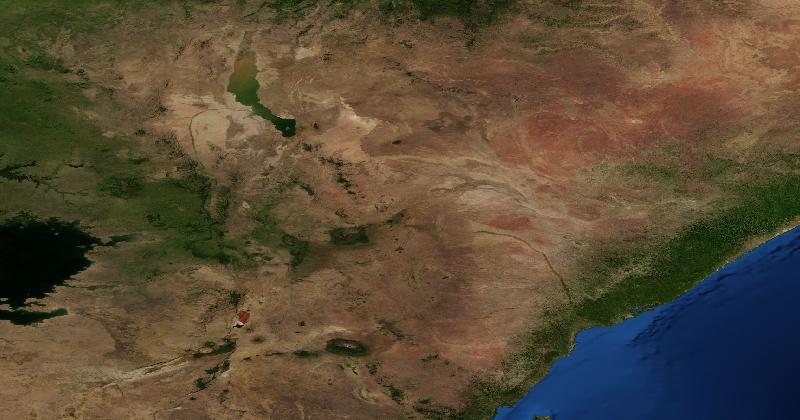
Kenya covers 580,000 square kilometres on the eastern equatorial coast of Africa, with the Indian Ocean to the southeast, Lake Victoria touching its western border, and the Great Rift Valley cutting through the middle of the country from north to south. The country contains some of the most iconic African landscapes — the savannas of the Maasai Mara, the snow-capped Mount Kenya straddling the equator, the alkaline lakes of the Rift Valley, the dense Aberdare and Mau forests, and the long sandy coast along the Indian Ocean.
For geography games, Kenya is one of the more rewarding African countries to learn because of the strength of its aerial signatures and the frequency with which it appears. This guide walks through the cues that lock Kenya in and tell you where in the country you have landed.
The Great Rift Valley
The single most distinctive geographical feature of Kenya is the Great Rift Valley cutting through the country from north to south. The rift is part of the larger East African Rift System where the African continent is slowly splitting in two — the Somali Plate pulling east from the Nubian Plate. From orbit, the Kenyan rift appears as a broad valley between two parallel escarpments, with a chain of distinctive alkaline lakes (Bogoria, Nakuru, Elementaita, Naivasha, Magadi) running along the valley floor. The lakes have a characteristic pale colour from their salinity and often appear pink from massive flamingo populations at close zoom.
Volcanism is concentrated along the rift. Mount Longonot is a dormant stratovolcano with a clearly visible crater, just south of Lake Naivasha. The Suswa volcano has a distinctive nested-caldera structure. Mount Elgon on the Ugandan border is a massive shield volcano with a 50-kilometre-diameter caldera at the summit. Mount Kenya at 5,199 metres is an old eroded volcano with characteristic radial drainage and small glaciers near the summit, visible from orbit as a distinctive isolated massif straddling the equator. The Aberdare Range west of Mount Kenya is also volcanic, forming a long ridge of high country with dense forests.
The Savannas: Iconic East African Landscape
Kenya's savannas are some of the most photographed landscapes on Earth. The Maasai Mara in the southwest, contiguous with Tanzania's Serengeti, is a vast rolling grassland with scattered acacia trees, watered by the Mara River and surrounded by gentle hills. From orbit, the Mara appears as a pale green-and-tan landscape with characteristic darker patches where forest patches or riparian vegetation cluster. The famous wildebeest migration crosses the Mara in July and August, and the patterns of animal-trampled grassland and dust trails are sometimes visible at close zoom during the migration season.
Other Kenyan savanna landscapes include Amboseli (with Mount Kilimanjaro just across the Tanzanian border dominating the southern horizon), Tsavo East and Tsavo West (covering enormous areas of southern Kenya with characteristic red soils and the distinctive Yatta Plateau lava flow), Samburu and Buffalo Springs (drier northern savannas along the Ewaso Ng'iro River), and Meru and Kora (south of Mount Kenya). The pattern of vast savannas with scattered acacias, characteristic Maasai settlements (manyattas) with circular cattle enclosures, and small game lodges scattered through wildlife reserves is one of the strongest Kenya signals available.
The Highlands and Tea Country
The Kenyan Highlands, mostly above 2,000 metres, surround Mount Kenya and the Aberdares and extend west across the Rift Valley into the Mau Escarpment and the western highlands toward Kisumu. From orbit, the highlands appear as a textured patchwork of small farms, tea plantations, coffee estates, dairy pastures, and forest fragments, with characteristic red soils visible between fields. Kenya is one of the world's largest tea producers, and the tea zones of Kericho, Limuru, Nandi, and Sotik produce some of the most aerially distinctive patches in the highlands — vivid green geometric rectangles of tea bushes covering entire hillsides, with characteristic processing factories visible as small industrial complexes at the centres of plantations.
The Aberdare Range and the slopes of Mount Kenya have dense forests (some still montane podocarpus forest, some plantation pine and cypress), with characteristic boundaries between forest and farmland visible from orbit. Smallholder coffee farms cover the slopes between roughly 1,200 and 2,000 metres in the central highlands, with characteristic small plots interspersed with banana, maize, and food crops. The pattern of Kenyan smallholder agriculture — very small fields, mixed cropping, scattered single-storey houses, dirt roads — is distinctly different from the larger commercial farm patterns of European, North American, or even South African agriculture.
The Coast: Long Sandy Beaches and Mangroves
Kenya's Indian Ocean coast runs roughly 540 kilometres from the Somali border to the Tanzanian border. From orbit, the coast appears as a tropical lowland with long sandy beaches, coral reefs visible as turquoise patches just offshore, mangrove forests in the river estuaries, and a chain of small cities and islands. Mombasa, Kenya's second-largest city, sits on an island connected to the mainland by causeways and bridges, with the historic Old Town and Fort Jesus visible at the centre. Lamu Island and the Lamu Archipelago to the north have one of the best-preserved Swahili medieval town centres in East Africa. Diani Beach south of Mombasa and Watamu and Malindi north of Mombasa are major resort areas with characteristic small hotel developments along the beach.
The Tana and Galana Rivers reach the Indian Ocean at the northern Kenyan coast, with extensive mangrove deltas and the Tana River Primate Reserve visible from orbit. South of the Sabaki River mouth, the coast becomes more developed with tourism infrastructure. The combination of long sandy beaches backed by coastal forest and dense mangrove deltas at river mouths is the characteristic Kenyan coastal aerial signature.
Kenyan Cities
Nairobi is by far the largest city in Kenya, with a metropolitan population of over 4 million. From orbit, Nairobi has a distinctive footprint — a modern central business district in the centre with characteristic high-rise buildings, the colonial-era suburbs of Westlands, Karen, and Lavington to the west, the dense informal settlements of Kibera, Mathare, and Kawangware (Kibera being one of the largest urban slums in Africa), the industrial area to the east, and the Nairobi National Park immediately south of the city — one of the few national parks bordering a capital city in the world, visible from orbit as a striking green wedge against urban sprawl. Wilson Airport for small aircraft is at the southern edge near the park; Jomo Kenyatta International Airport is further east.
Mombasa, Kisumu (on Lake Victoria), Nakuru (in the Rift Valley), Eldoret (in the western highlands), and Thika (in the central highlands near Mount Kenya) are the other major urban areas, each with characteristic footprints reflecting their economic specialisations — Kisumu's lake-based commerce, Nakuru's agricultural processing, Eldoret's grain-belt market role, and Thika's industrial outskirts of Nairobi.
Regional Tells
- Coast: long sandy beaches, mangrove deltas, Mombasa on its island, and the historic Swahili town of Lamu in the north.
- Eastern Lowlands (Tsavo): vast savannas with red soils, the Yatta Plateau lava flow, and scattered baobab trees.
- Central Highlands: tea, coffee, and dairy country with smallholder agriculture, the Aberdares and Mount Kenya massifs, and Nairobi.
- Rift Valley: alkaline lakes, volcanoes, the dramatic east-west escarpments, and the cities of Nakuru and Naivasha.
- Western Highlands: tea country of Kericho and Nandi, the Mau Forest, and the city of Eldoret.
- Lake Victoria basin: the lake itself dominates, the city of Kisumu on the lakeshore, and characteristic small Luo and Luhya villages.
- Northern arid lands: drier semi-desert country, scattered Samburu and Turkana settlements, the Chalbi Desert, and the dramatic Lake Turkana stretching far north.
- Southwest savannas: the Maasai Mara, the cross-border ecosystem with Tanzania's Serengeti, and Maasai pastoral landscapes.
Where Kenya Gets Confused
Kenya can be confused with Tanzania (which shares similar savannas, the Serengeti-Mara ecosystem, and similar coastal landscapes), Uganda (which shares Lake Victoria and similar highland agriculture), and other East African countries. The disambiguators are usually specific: the unique combination of Mount Kenya straddling the equator, the specific alkaline lake patterns of the Kenyan Rift, the distinctive Kenyan tea geometries, and the Nairobi National Park as one of the most unusual urban-wildlife boundaries on Earth. The Maasai Mara can look identical to the adjacent Serengeti — the border is genuinely invisible from orbit and only context helps. Coastal Kenya can look like northern Tanzania or southern Somalia, but the Swahili town patterns and infrastructure density usually help.
Pro-Tier Signals
Advanced players use finer details. The specific shape of Maasai manyattas — circular thorn-bush enclosures with small huts arranged inside, visible at close zoom in the southern savannas. The pattern of Kenyan greenhouse flower farms around Lake Naivasha — Kenya is one of the largest cut-flower exporters in the world, and the dense greenhouse complexes are visible as bright white rectangles around the lake. The shape of Kenyan tea factory complexes with characteristic green-and-white processing buildings at the centre of tea estates. The signature of Nairobi's matatu (minibus) routes visible as worn unpaved tracks at the edges of informal settlements. The distinctive shape of Lake Turkana — a long thin lake stretching nearly 250 kilometres north-south, with characteristic alkaline green-blue colour and volcanic islands (Central, North, and South Islands). And the specific shape of Lamu's old town with its narrow streets and characteristic Swahili coral-stone houses.
Practise It
Kenya is one of the most rewarding African countries to learn for geography games. The Rift Valley, the savannas, the highlands, the coast, and the arid north each have distinctive signatures. Spend a focused session on EarthGuessr playing Kenyan rounds and the country will quickly become one of the more reliable identifications across East Africa — and the regional variety will let you narrow your guess to a specific zone within a couple of seconds.