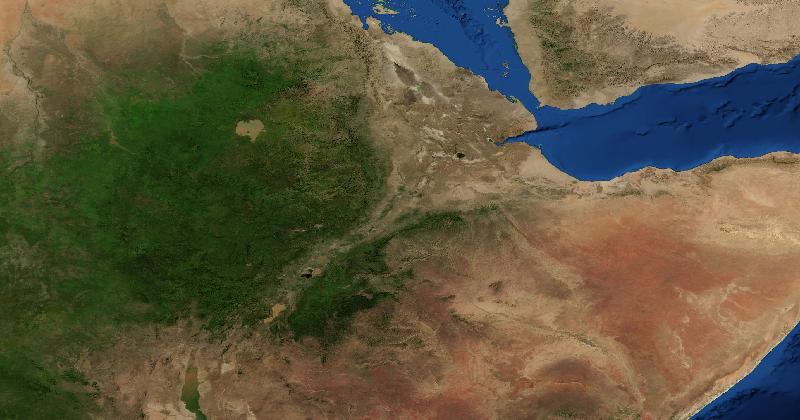
Ethiopia covers 1.1 million square kilometres in the Horn of Africa, making it the tenth-largest country on the continent and one of the most populous countries in Africa with over 120 million people. The country sits on the Ethiopian Highlands, a massive raised plateau formed by volcanic activity over millions of years, cut by the Great Rift Valley running through the centre. The result is one of the most topographically dramatic countries on the continent — average elevation is over 1,300 metres, with peaks above 4,500 metres in both the Simien and the Bale mountains, and the Danakil Depression dropping to 125 metres below sea level in the northeast.
For geography games, Ethiopia is a high-value country to learn because of its size, the strength of its aerial signatures, and the frequency with which it appears. This guide walks through the cues that lock Ethiopia in fast.
The Ethiopian Highlands: An African Plateau Unlike Any Other
The defining geographical feature of Ethiopia is the highland plateau. Covering most of the country and averaging 2,000 to 3,000 metres elevation, the highlands are one of the largest continuous areas of high-altitude terrain on the continent. From orbit, the highlands appear as a textured zone of dissected plateaus, with characteristic flat-topped mesas (ambas) separated by deep gorges and river canyons, intensive small-scale agriculture covering most of the slopes and plateau tops, and scattered eucalyptus and remaining natural forest patches.
Ethiopian highland agriculture has one of the most distinctive aerial signatures in Africa: very small field sizes, mixed cropping (with characteristic teff fields producing the staple injera bread, plus wheat, barley, sorghum, chickpea, and others), almost no mechanisation visible, scattered small thatch-roofed and corrugated-iron-roofed houses, and dense networks of footpaths and tracks connecting rural settlements. The pattern is very different from the larger commercial farms of Kenya's central highlands or the savanna agriculture further south.
The Simien and Bale Mountains
The Simien Mountains in northern Ethiopia rise to Ras Dashen at 4,550 metres, the highest peak in the country and one of the highest in Africa. From orbit, the Simien appear as a dramatic scarp where the high plateau drops away in cliffs and pinnacles toward the Tekeze River valley. The characteristic eroded escarpment with hundreds of finger-like ridges and isolated pinnacles is one of the most photogenic landscapes in Africa, and from satellite altitude the pattern of light-coloured rocky scarp meeting dark forested plateau is essentially unique to the region.
The Bale Mountains in southeastern Ethiopia are also volcanic in origin, with Tullu Demtu at 4,377 metres being the second-highest peak in the country. The Bale plateau (the Sanetti Plateau) is the largest continuous area above 4,000 metres in Africa, with characteristic Afroalpine moorland visible from orbit as pale tan grasslands dotted with giant lobelia plants. The escarpment from the Bale plateau dropping down to the Rift Valley and the Harenna Forest is one of the most dramatic terrain transitions in East Africa. Other Ethiopian highland massifs — the Choke Mountains, the Guna Mountains, Mount Guguftu — have their own distinctive signatures.
The Great Rift Valley Through the Centre
The Ethiopian Rift Valley runs north-south through the centre of the country, dividing the highlands into two main blocks — the northwestern highlands (including the Simien and the Lake Tana basin) and the southeastern highlands (including the Bale and Arsi). From orbit, the Rift Valley appears as a long broad lowland between two parallel escarpments, with a chain of alkaline lakes (Zwai, Langano, Abijatta, Shalla, Awasa, Abaya, Chamo) running along the valley floor, and characteristic volcanic cones (Aluto, Korbetti, Boset) rising from the valley.
The Awash River drains the central portion of the Rift Valley northeast toward the Danakil Depression, with the Awash National Park visible from orbit. The southern Rift Valley contains the lakes of the Great Rift Valley National Parks of Nechisar and Lake Chamo, with the dramatic Bridge of God isthmus separating Lakes Abaya and Chamo. The Ethiopian Rift then opens out northeastward into one of the most extreme landscapes on Earth.
The Danakil Depression: One of the Hottest Places on Earth
The Danakil Depression in northeastern Ethiopia is one of the lowest, hottest, and most geologically active places on Earth. From orbit, the Danakil appears as a vast salt-and-volcanic lowland: bright white salt flats (the Dallol salt pans visible as some of the most colourful natural features on Earth at close zoom, with yellow, orange, and green hydrothermal pools), characteristic basalt lava fields, the active Erta Ale volcano with its famous lava lake, and the Afar Triangle where three tectonic plates meet.
Surface temperatures in the Danakil are some of the highest measured on Earth — averaging above 50°C in some periods — and the region is essentially uninhabited except for the small Afar nomadic salt-mining communities. The aerial signature is unmistakable: bright white salt flats, colourful hydrothermal pools, dark basalt lava fields, and almost no vegetation. The combination is essentially unique to the Afar region of Ethiopia and adjacent parts of Eritrea and Djibouti.
Lake Tana and the Blue Nile
Lake Tana in the northwestern highlands is the largest lake in Ethiopia and the source of the Blue Nile. From orbit, Lake Tana is unmistakable — a roughly circular lake covering 3,156 square kilometres at 1,800 metres elevation, with numerous small islands containing ancient Ethiopian Orthodox monasteries (some over 1,000 years old). The Blue Nile flows out of the southeastern corner and quickly descends in a series of cascades (the famous Blue Nile Falls near Bahir Dar) before cutting a deep gorge through the highlands toward Sudan.
The Blue Nile Gorge is one of the most dramatic single canyons on Earth — up to 1,500 metres deep and 25 kilometres wide in places, visible from orbit as a deep cut through the northwestern highland plateau. The Blue Nile carries the bulk of the Nile's sediment load (the famous brown waters of the Nile come from Ethiopian volcanic soil), and downstream the Grand Ethiopian Renaissance Dam — the largest hydroelectric project in Africa — is visible near the Sudanese border as a vast reservoir filling behind the dam.
Regional Tells
- Northwestern highlands: Lake Tana, the Blue Nile gorge, the Simien Mountains, the historic city of Gondar, and the densely cultivated highland agriculture.
- Northern highlands (Tigray): rugged terrain with characteristic monolithic churches carved into cliffs, the historic city of Aksum with its famous obelisks, and the mountains rising toward Eritrea.
- Eastern highlands: the historic walled city of Harar, the chat (qat) growing region around Dire Dawa, and the Awash River valley.
- Rift Valley: alkaline lakes, volcanic cones, the cities of Awasa and Zwai, and the new flower-export industry around the lakes.
- Southeastern highlands: the Bale Mountains with their Afroalpine plateau and Harenna Forest, the Arsi-Bale highlands, and the cities of Bale Robe and Goba.
- Southern lowlands: the Omo Valley with characteristic indigenous Mursi, Hamar, and Karo communities, the Omo and Mago National Parks, and the dramatic southern Rift Valley terrain.
- Danakil Depression and Afar: salt flats, lava fields, Erta Ale volcano, the Dallol hydrothermal area, and the Awash River reaching the depression.
- Western lowlands (Gambella): tropical lowland with seasonal floodplains of the Baro and Akobo rivers, very different vegetation from the highlands.
- Somali Region (Ogaden): vast semi-arid lowlands extending toward Somalia, with characteristic Somali pastoral settlements and seasonal river systems.
Where Ethiopia Gets Confused
Ethiopia can be confused with Kenya (which shares the Rift Valley), Eritrea (which shares the northern highlands and the Danakil), Somalia (for the eastern lowlands), and Sudan (for the western lowlands). The disambiguators are usually specific: the unique density and pattern of Ethiopian highland agriculture (much smaller field sizes and higher population density than equivalent Kenyan landscapes), the specific shape of Ethiopian Orthodox churches (visible at close zoom as characteristic round buildings with conical or domed roofs), the eucalyptus groves around almost every Ethiopian highland village (introduced by Emperor Menelik in the 19th century and now visible from orbit), the Simien and Bale escarpments (uniquely Ethiopian), and the Danakil Depression (essentially unique to the Afar triple-junction region).
Pro-Tier Signals
Advanced players use finer details. The specific shape of Ethiopian rural villages — typically clusters of round thatched-roof tukul houses arranged in loose patterns, with characteristic small church compounds at the centre. The pattern of Ethiopian eucalyptus groves around villages and along roads, often visible from orbit as dark green geometric patches. The shape of Ethiopian Orthodox churches with their characteristic round or octagonal architecture and conical roofs — quite different from the rectangular basilica plans of most other Christian traditions. The pattern of Ethiopian coffee plantations in the southwest (Yirgacheffe, Sidamo, Limu) — Ethiopia is the origin of coffee and produces some of the most distinctive coffee in the world, with characteristic shade-grown small plots. The pattern of teff fields — the smallest cereal grain in the world, grown almost exclusively in Ethiopia, with characteristic pale tan colour at harvest. The shape of Ethiopian highland erosion features — the famous "badlands" of severely eroded terrain around overgrazed areas. And the specific shape of the new Ethiopian dams — particularly the Grand Ethiopian Renaissance Dam on the Blue Nile near the Sudanese border.
Practise It
Ethiopia is one of the most rewarding African countries to learn for geography games because of the dramatic terrain variation and the strength of its aerial signatures. The highlands, the Rift Valley, the Simien and Bale escarpments, and the Danakil Depression each have distinctive looks. Spend a focused session on EarthGuessr playing Ethiopian rounds and the country will quickly become one of the more reliable identifications across the Horn of Africa.