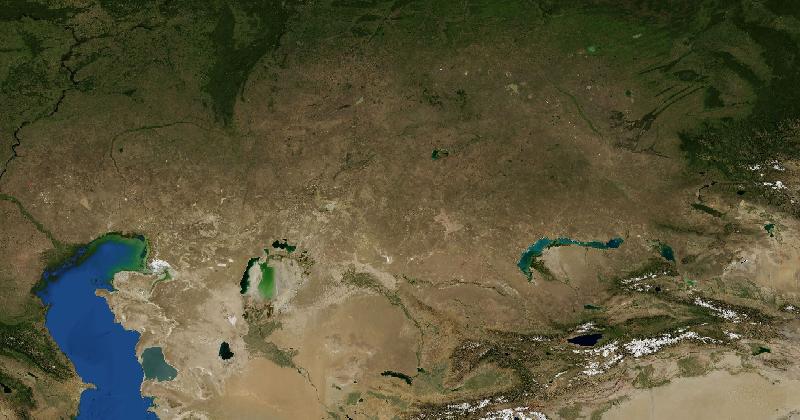
Kazakhstan is the ninth-largest country on Earth by area at 2.72 million square kilometres — slightly larger than Argentina, slightly smaller than India, and comparable in size to all of western Europe. Despite this size, the population is just under 20 million, making Kazakhstan one of the most sparsely populated large countries on the planet. The country covers most of the Eurasian steppe between Russia to the north, China to the east, the Caspian Sea to the west, and the four Central Asian -stans (Kyrgyzstan, Uzbekistan, Turkmenistan, and a tiny border with Tajikistan) to the south.
For geography games, Kazakhstan is one of the more challenging countries to identify because its landscapes can look similar to those of southern Russia, Mongolia, or neighbouring Central Asian states. But the country has distinctive aerial signatures that lock it in once you know what to look for. This guide walks through them.
The Steppe: One of the Largest Grasslands on Earth
The dominant landscape of northern and central Kazakhstan is the steppe — a vast continuous grassland that extends from the Ukrainian-Russian border in the west across all of southern Russia and through northern Kazakhstan to Mongolia and northeastern China in the east. The Kazakh portion of this Eurasian steppe is the largest area of continuous grassland on Earth, covering roughly a million square kilometres. From orbit, the steppe appears as a vast pale green-and-tan landscape with very few trees, scattered small villages, and characteristic patterns where Soviet-era agricultural development carved out enormous wheat fields in the more productive zones.
Northern Kazakhstan was the centre of the Soviet Virgin Lands Campaign in the 1950s, which converted millions of hectares of native steppe into wheat fields. From orbit, the resulting agricultural landscape is distinctive: huge fields (often 100 to 500 hectares or larger), arranged in characteristic Soviet kolkhoz patterns, with characteristic shelterbelt windrows of trees planted between fields for erosion control. The pattern is similar to that of southern Russia and Ukraine but at slightly larger field scale and with somewhat sparser settlement. The agricultural belt is concentrated in the northern provinces — North Kazakhstan, Akmola, Kostanay, Pavlodar — and contrasts sharply with the unbroken native steppe further south.
The Semi-Desert and Desert South
Southern Kazakhstan transitions through semi-desert into true desert. The Betpak-Dala plain in south-central Kazakhstan is a vast semi-desert covering roughly 75,000 square kilometres of clay and saxaul-covered terrain. The Kyzylkum (Red Sands) extends into Kazakhstan from Uzbekistan and forms a large area of sand dunes in the south. The Muyunkum desert south of Lake Balkhash is a sand sea with distinctive dune patterns. The Ustyurt Plateau in the west between the Caspian and Aral Seas is a vast limestone plateau with dramatic escarpments and almost no vegetation or settlement.
The most distinctive feature of the Kazakh deserts from orbit is the Aral Sea — once the fourth-largest lake in the world, but reduced by Soviet-era irrigation projects to roughly 10 percent of its original area. From orbit, the dried-out former lake bed of the Aral (now called the Aralkum Desert) is visible as a vast white-and-salt-encrusted basin north of the small remaining North Aral Sea on the Kazakh side. The retreat of the Aral is one of the most dramatic anthropogenic landscape changes visible from orbit anywhere on Earth.
The Mountains in the East and Southeast
Eastern and southeastern Kazakhstan contains some of the highest mountains in Central Asia. The Tien Shan ranges along the Kyrgyz, Chinese, and far southeastern Kazakh border rise to Khan Tengri at 7,010 metres and Mount Pobedy at 7,439 metres — among the highest peaks outside the Himalayas-Karakoram-Hindu Kush system. From orbit, the Tien Shan appear as a complex zone of glaciated mountains, with characteristic deep glacial valleys, alpine lakes, and snow lines visible at high elevations. The Zailiysky Alatau range near Almaty and the Dzungarian Alatau further east are smaller spurs of the Tien Shan, with characteristic forested slopes giving way to alpine meadows and glacial peaks.
The Altai Mountains in the far northeast on the Russian, Chinese, and Mongolian border contain Mount Belukha at 4,506 metres, the highest peak in Siberia and a distinctive glaciated double-peak visible from satellite altitude. The Altai have a different feel from the Tien Shan — older mountains with rounded peaks, dense Siberian-style forests in many areas, and characteristic alpine meadows and lakes. Between the Altai and the Tien Shan, the smaller Tarbagatai, Saur, and other ranges form a complex of mid-elevation mountains.
The Caspian and the Western Plains
Western Kazakhstan is dominated by the Caspian Sea and the surrounding lowlands. The Caspian, the largest inland body of water on Earth, has Kazakhstan along most of its northeastern coast. From orbit, the Kazakh Caspian coast appears as a thin strip of shallow brackish water with characteristic deltas where the Ural and Emba rivers reach the sea, and an extensive offshore zone of oil and gas infrastructure. The Tengiz oil field and the offshore Kashagan field are some of the largest oil fields on Earth and are visible from orbit as clusters of platforms, processing facilities, and pipeline networks.
Inland from the Caspian, the Caspian Depression is one of the lowest large areas on Earth, dropping to 132 metres below sea level. The Mangyshlak Peninsula has dramatic chalk and limestone cliffs visible from orbit. The Atyrau and Aktau regions have characteristic oil-industry landscapes — pumpjack fields, refineries, and the cities themselves with distinctive Soviet-era urban grids modified by post-independence growth.
Kazakh Cities
Kazakhstan has two major cities. Almaty in the southeast was the Soviet-era capital and remains the largest city, sitting at the foot of the Zailiysky Alatau mountains. From orbit, Almaty has a distinctive footprint — a grid-planned city extending across the flat plain at the foot of dramatic snow-capped mountains, with the historic Soviet centre in the middle, the wealthier southern districts climbing the mountain slopes, and characteristic post-independence high-rise developments scattered through the city. The Kok Tobe TV tower and the surrounding hills are visible at close zoom.
Astana (formerly Nur-Sultan, now reverting to Astana) is the new capital, built up since 1997 in the centre of the northern steppe. From orbit, Astana has one of the most striking urban footprints of any new capital city on Earth — a planned city on flat steppe with characteristic geometric layout, the Bayterek tower and Khan Shatyr entertainment centre as visible landmarks, and the Ishim River dividing the historic right-bank old town from the planned left-bank new city. Other Kazakh cities — Shymkent in the south, Karaganda in the centre, Atyrau on the Caspian, Pavlodar and Oskemen in the east — have distinctive Soviet-era urban patterns modified by post-independence growth.
Regional Tells
- Northern Kazakhstan: agricultural steppe with huge wheat fields, the cities of Petropavl, Kostanay, and Pavlodar, and the Russian border zone.
- Central steppe (Sary-Arka): vast native grasslands, the Karagandy mining and industrial region, and the new capital of Astana on the Ishim River.
- Southern Kazakhstan: irrigated agriculture in the Syr Darya valley, the city of Shymkent, the historic Silk Road sites of Turkistan and Otrar, and the cotton-growing zones near the Uzbek border.
- Aral region: the dried-out Aralkum Desert, the small remaining North Aral, and characteristic former fishing villages now stranded far from any water.
- Southeast: Almaty in its mountain-foot setting, the Tien Shan, Lake Balkhash (a long thin lake distinctive on satellite imagery), and the Charyn Canyon as a smaller Grand Canyon analogue.
- Eastern mountains: the Altai, the Tarbagatai, and the historic city of Oskemen on the Irtysh River.
- Western lowlands: the Caspian coast, the oil-industry zones of Atyrau and Aktau, the Mangyshlak Peninsula, and the Ustyurt Plateau.
- Baikonur and the space-launch zone: distinctive launch pads and infrastructure of the Baikonur Cosmodrome visible from orbit in the central south.
Where Kazakhstan Gets Confused
Kazakhstan can be confused with southern Russia (which shares the steppe), Mongolia (which has similar steppe and mountains), Uzbekistan and Turkmenistan (which share desert landscapes), and Xinjiang in China. The disambiguators are usually specific: the unique scale of Kazakhstan's wheat-belt fields (larger than equivalent Russian fields, smaller than Mongolian collective patterns), the Aral Sea desiccation (essentially unique to Kazakhstan and Uzbekistan), the Tien Shan visible to the southeast, the distinctive shape of Lake Balkhash (one of the longest lakes in Asia, with the western half freshwater and the eastern half saline), the Baikonur Cosmodrome infrastructure (one of the most recognisable single sites in the country), and the specific urban patterns of Astana and Almaty.
Pro-Tier Signals
Advanced players use finer details. The specific shape of Kazakh yurts and pastoral camps in the more nomadic southern regions — small white round structures visible at close zoom in pastoral areas. The pattern of Kazakh oil-industry infrastructure with characteristic Soviet-era pumpjacks, gas-oil separation plants, and pipeline networks. The shape of the Baikonur Cosmodrome — the launch pads, the historic Gagarin's Start launch complex, the assembly buildings, and the surrounding roads are all visible from orbit. The signature of the Semipalatinsk Test Site in the northeast, where Soviet nuclear tests left distinctive crater landscapes visible from satellite altitude. The pattern of Kazakh kolkhoz centres — typically a small group of Soviet-era buildings surrounded by enormous fields, often visible in the agricultural northern regions. And the specific colour and shape of Lake Balkhash — long, thin, with a narrow constriction in the middle separating freshwater from saline halves.
Practise It
Kazakhstan is one of the more challenging Central Asian countries to learn for geography games, partly because of its sheer size and partly because its landscapes blend with neighbouring countries. But once you have studied the steppe-belt agriculture, the deserts, the Tien Shan and Altai mountains, the Caspian, and the Aral Sea, the country becomes a fast lock. Spend a focused session on EarthGuessr playing Kazakh rounds and the regional variety will become familiar.