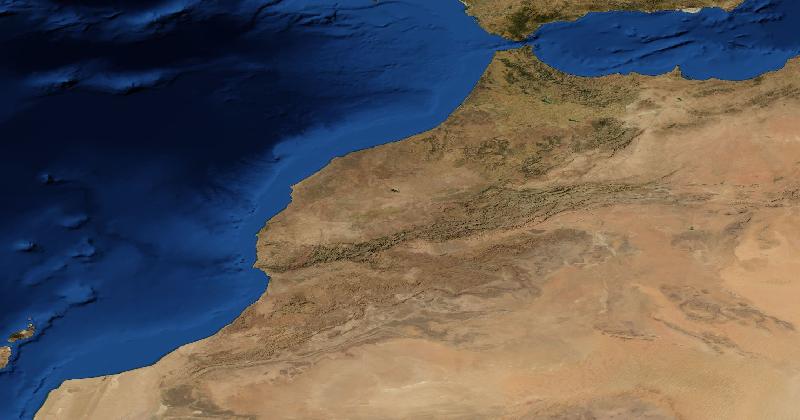
Morocco covers roughly 446,000 square kilometres in the northwestern corner of Africa, bounded by the Mediterranean to the north, the Atlantic to the west, Algeria to the east, and the disputed Western Sahara to the south. The country has one of the most varied geographies in North Africa, containing within its borders the snow-capped High Atlas mountains, the southern reaches of the Sahara, the Mediterranean Rif coast, the fertile Atlantic plains, and a 1,800-kilometre Atlantic coastline.
For geography games, Morocco is a high-value country to learn because each of its regions has a distinctive aerial signature and the country appears regularly in any global rotation. This guide walks through the cues that lock Morocco in fast.
The Atlas Mountains
Morocco's defining geographical feature is the Atlas Mountain system, divided into three main ranges. The Rif in the north runs along the Mediterranean coast, with elevations up to about 2,500 metres and a characteristically rugged, deeply incised terrain. The Middle Atlas in the centre is a broad highland plateau with the country's largest cedar forests, distinctive Berber villages, and characteristic karst landscapes around Ifrane and Azrou. The High Atlas in the south is the tallest range, with Jebel Toubkal at 4,167 metres being the highest peak in North Africa, snow-capped for much of the year and visible from orbit as a series of high snowy peaks rising from the surrounding plateaus.
South of the High Atlas, the Anti-Atlas forms a lower, more arid range that transitions to the Sahara proper. From orbit, the Moroccan Atlas system appears as a complex zone of folded mountains running roughly southwest to northeast, separating the wetter Atlantic-facing regions of the north and west from the drier Saharan regions of the south and east. The contrast in colour between the green northern slopes and the brown-and-red southern slopes is visible from satellite altitude.
The Saharan South
South of the Anti-Atlas, Morocco transitions to true Sahara. From orbit, this region appears as classic desert landscape: pale tan and red surfaces, very little vegetation, distinctive ergs (sand seas) like the Erg Chebbi near Merzouga and the Erg Chigaga near M'hamid, and characteristic rocky plateaus (hamadas) between the sand seas. The combination of red sand dunes against brown rocky plateaus is one of the most distinctive Moroccan Saharan signals. The Drâa Valley running roughly east to west south of the Anti-Atlas is one of the most photogenic single landscapes in Morocco — a thin green ribbon of palm groves and kasbahs (mud-brick fortified villages) winding through otherwise brown desert.
The Drâa is the longest river in Morocco at roughly 1,100 kilometres, and from orbit you can follow it as a thin green line of palmeraies (date palm groves) and small irrigated agricultural plots, with characteristic kasbahs and ksour (fortified villages) at intervals. The kasbahs are visible at close zoom as small rectangular mud-brick clusters with characteristic flat roofs and crenellated tower walls. The road south through the Drâa Valley — the famous road to Zagora — connects a series of palm-grove oases.
The Atlantic Coast and the Fertile Plains
Morocco's Atlantic coast runs roughly 1,800 kilometres from the Strait of Gibraltar in the north to the disputed Western Sahara border in the south. The coast has a characteristic Atlantic surf signature — long sandy beaches, occasional rocky headlands, and a parallel band of low coastal dunes. The Gharb plain in the north (around Kenitra), the Doukkala plain (around El Jadida), the Chaouia plain (around Casablanca), and the Souss plain (around Agadir) are some of the most agriculturally productive areas in Morocco, with intensive cultivation of cereals, sugar beet, citrus, olives, and vegetables visible from orbit as geometric patchworks of varied colour.
Casablanca is by far the largest city in Morocco, with a metropolitan population of around 4 million. From orbit, Casablanca has a distinctive footprint — a colonial-era central business district laid out by the French in the 1910s and 1920s with characteristic Art Deco grid streets, the historic Old Medina visible as a denser irregular pattern on the coast, the new Hassan II Mosque with its enormous minaret visible from satellite altitude, the port and industrial zone to the south, and extensive suburban and informal settlement expansion eastward toward Mohammedia and southward toward Bouskoura.
Moroccan Medinas and Imperial Cities
Moroccan cities have a uniquely distinctive aerial signature because of the contrast between historic medinas and modern colonial-era and post-independence districts. Fes has one of the largest preserved medieval medinas in the world — Fes el-Bali, with over 9,000 narrow streets and alleys, is visible from orbit as an extraordinarily dense irregular urban pattern with characteristic green-roofed mosques and madrasas scattered throughout. Marrakech in the south has a smaller but equally distinctive medina with the Koutoubia Mosque, the Djemaa el-Fna square, and the surrounding ramparts visible from satellite altitude.
Meknes, Rabat, Tetouan, Chefchaouen, Salé, Essaouira, and Tangier each have their own characteristic medinas surrounded by modern districts. Chefchaouen in particular has the distinctive blue-painted town centre that produces a strikingly blue patch visible at close zoom — the result of a century-old tradition of painting most buildings various shades of blue. The combination of historic medina-and-modern-district urban patterns is essentially unique to Morocco at this scale and density.
Regional Tells
- Northern Morocco (Tangier-Tetouan-Al Hoceima): Mediterranean coast, the Rif mountains, the blue town of Chefchaouen, and the historic Spanish-influenced cities.
- Central plains (Casablanca-Settat, Rabat-Salé-Kenitra): the Atlantic coast cities, the Gharb and Chaouia plains, intensive agriculture, and the country's economic core.
- Middle Atlas: cedar forests around Ifrane and Azrou, karst landscapes, Berber villages, and characteristic mountain lakes.
- High Atlas: snow-capped peaks, Berber villages on the slopes, the dramatic Tizi n'Tichka pass road, and Toubkal National Park.
- Southern oases (Drâa, Dadès, Ziz, Todra valleys): palm groves, kasbahs and ksour, and the gateway to the Sahara.
- Sahara (eastern and southern): dunes, hamadas, the Erg Chebbi and Erg Chigaga sand seas, and remote oasis towns.
- Souss and the south (Agadir, Souss-Massa): Atlantic coast, the agricultural Souss plain, argan tree country, and the southern beach resorts.
Where Morocco Gets Confused
Morocco can be confused with Algeria, Tunisia, Spain (across the Strait of Gibraltar), Mauritania, and parts of Egypt or Libya. The disambiguators are usually specific: the unique Atlas mountain pattern (the High Atlas is taller and snowier than Algerian or Tunisian equivalents), the distinctive medinas with their characteristic green-roofed mosques and dense irregular street patterns, the specific kasbah-and-palmeraie pattern of the Drâa Valley and other southern oases, and the long Atlantic coast (Morocco being one of the few North African countries with both Mediterranean and Atlantic frontages). Algerian and Tunisian landscapes can be similar in places but with subtly different settlement patterns and less developed road infrastructure overall.
Pro-Tier Signals
Advanced players use finer details. The specific shape of Moroccan kasbahs and ksour — typically rectangular mud-brick clusters with characteristic crenellated towers at the corners, often visible at close zoom in the Drâa and Dadès valleys. The pattern of Moroccan argan tree groves in the Souss region — the spiny argan tree grows only in southwest Morocco and produces the famous argan oil, with characteristic scattered tree distribution visible from orbit. The shape of Moroccan olive groves in the Meknes region and the citrus and vineyard plantations near Casablanca and Rabat. The signature of Moroccan phosphate mining at Khouribga and Bou Craa — Morocco has the largest phosphate reserves in the world. The pattern of Moroccan medina-walls — most historic cities have visible ramparts from orbit, with characteristic gates and bastions. And the specific shape of Moroccan riads — traditional courtyard houses with internal gardens, sometimes visible at close zoom in medinas.
Practise It
Morocco is one of the most rewarding African countries to learn for geography games. The Atlas mountains, the Saharan oases, the imperial cities, and the two coasts each have signatures distinct enough to lock in fast. Spend a focused session on EarthGuessr playing Moroccan rounds and the country will quickly become one of the more reliable identifications across North Africa.