All posts
GeographyApril 25, 20268 min read read

How to Spot Greece from Satellite Imagery: Olive Groves, White Villages, and 6,000 Islands

Greece has one of the most island-strewn coastlines on Earth, white-painted villages clinging to cliffs, and olive groves carpeting entire regions. Here is how to identify Greece from a satellite frame — and how to tell mainland from the Aegean and Ionian islands.

How to Spot Greece from Satellite Imagery: Olive Groves, White Villages, and 6,000 Islands

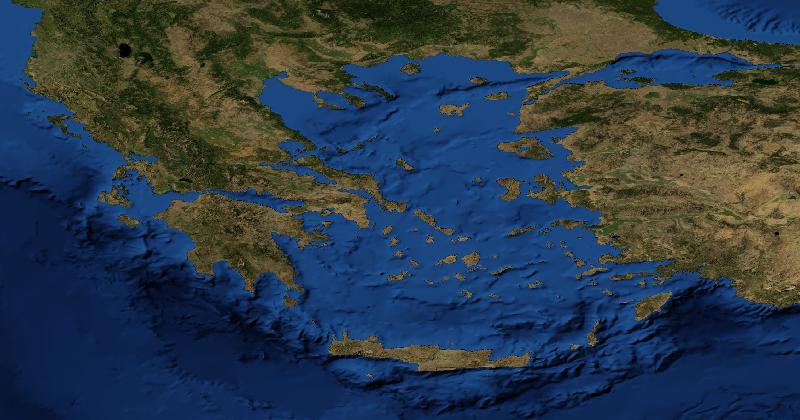
Greece is one of the most island-rich countries on Earth. The country includes roughly 6,000 islands and islets in total, of which about 200 are inhabited. Add to this a deeply indented mainland coast (Greece has the eleventh longest coastline in the world despite being a relatively small country), a mountainous interior covering most of the country, and a Mediterranean climate that produces some of the most photogenic landscapes in Europe, and you get a country that is highly distinctive from satellite altitude.

For geography games, Greece is a high-value country to learn. It shows up often, and the regional landscapes — Crete, the Aegean islands, the Ionian islands, the Peloponnese, central Greece, the Pindus mountains, and Macedonia and Thrace in the north — each have distinctive aerial signatures. This guide walks through the cues that lock Greece in fast.

The Aegean Islands: One of the Densest Island Clusters on Earth

The Aegean Sea between mainland Greece and Turkey is one of the most island-dense seas on the planet. The Cyclades, Dodecanese, North Aegean, Sporades, and other groups produce a satellite signature unlike almost anywhere else: dozens of small to medium islands of pale brown or pale green colour, typically with bright white settlements visible as small clusters along the coasts. The islands are mostly limestone or volcanic in origin, with arid vegetation, terraced agriculture clinging to slopes, and surrounding waters that are some of the most strikingly turquoise on Earth.

Several islands have particularly distinctive signatures. Santorini in the Cyclades is unmistakable — a crescent-shaped island with the volcanic caldera at its centre, the dark island of Nea Kameni in the middle of the caldera, and the bright white villages of Fira and Oia along the western cliffs. Mykonos is another famously white-villaged Cycladic island. Rhodes in the Dodecanese has the historic walled medieval city visible from orbit as a distinctive dense urban core. Crete, the largest Greek island, has its own scale of variety — mountains, gorges, beaches, and the four main cities of Heraklion, Chania, Rethymno, and Agios Nikolaos.

Olive Groves Everywhere

Greece is one of the largest olive oil producers in the world, with olive groves covering huge areas of the country. From orbit, Greek olive groves have a similar pattern to Spanish or Italian ones — regularly spaced silver-green trees on terraced or rolling hillsides — but the surrounding context is different. Greek olive groves tend to be smaller plots, set in mountainous terrain, with characteristic white villages perched on hillsides nearby, and the surrounding vegetation is sparser due to the drier Mediterranean climate.

The Peloponnese in particular has olive groves stretching from coast to mountain in many areas — Kalamata in the south is famous for its olives, the Mani peninsula has olive groves clinging to rocky terrain, and Messenia has some of the largest contiguous olive areas in the country. Crete is similarly olive-dominated. The combination of dense olive groves on slopes, white villages clustered around hilltops, and the Mediterranean colour palette is one of the strongest Greece signals available.

Greek island landscape with white village and blue sea
Greece's combination of densely packed islands, bright white villages, and Mediterranean olive groves produces a uniquely recognisable aerial signature.

The Mountainous Mainland

Roughly 80 percent of mainland Greece is mountainous, dominated by the Pindus range running down the centre of the country from the Albanian border in the north to the Peloponnese in the south. From orbit, the Pindus appear as a series of north-south running ridges with deep forested valleys between them, sparsely populated, with characteristic stone-built villages tucked into the few flat areas. Mount Olympus on the eastern edge of the range is the highest peak in Greece at 2,917 metres and is visible from orbit as a distinctive massif rising from the Thessalian plain.

Northern Greece has additional ranges — the Rhodope mountains along the Bulgarian border, the Vermio and Voras mountains in western Macedonia, and a complex of ranges through Thrace. The Greek mountains are typically more arid than equivalent altitudes in central Europe, with bare rocky summits, scattered conifer forests on north-facing slopes, and tobacco, cotton, and corn agriculture in the surrounding lowlands of Thessaly, Macedonia, and Thrace.

Greek Cities and the Athens Footprint

Athens dominates Greek urban life, with the metropolitan area home to roughly a third of the country's population. From orbit, Athens has a distinctive footprint — the historic core around the Acropolis (visible from orbit as a distinctive flat-topped hill in the city centre), the dense low-rise apartment city extending across the Attica basin, the surrounding mountains of Hymettus, Pentelicus, and Parnitha bounding the urban area, and the port of Piraeus extending into the Saronic Gulf. The new Athens airport east of the city in the Mesogeia plain is also unmistakable.

Thessaloniki is the second-largest Greek city, sitting at the head of the Thermaic Gulf in northern Greece with a distinctive harbour footprint and the White Tower as a recognisable landmark from close zoom. Smaller cities — Patras on the Peloponnese, Heraklion on Crete, Larissa in Thessaly, Volos on the Pagasetic Gulf — have their own characteristic mid-sized footprints, typically with a compact historic core surrounded by mid-rise apartment blocks.

Regional Tells

  • Attica (Athens region): the Acropolis, the Athens basin, Mount Hymettus, and the Saronic Gulf with the islands of Aegina and Salamis.
  • Peloponnese: the Mani and Messenia peninsulas with olive groves, the Argolid with Mycenae and Epidaurus, the Achaia mountains, and the Corinth Canal at the northeast.
  • Central Greece: Mount Parnassus and Delphi, the Thessalian plain (one of Greece's largest agricultural areas), and the Meteora rock pinnacles with their famous monasteries.
  • Northern Greece (Macedonia and Thrace): more agricultural, with cotton and tobacco fields, the Halkidiki peninsula with its three southward-pointing fingers, and Mount Athos at the tip of one of them.
  • Epirus: mountainous, sparsely populated, with the dramatic Vikos Gorge and the Pindus mountains.
  • Crete: largest Greek island with mountains, gorges (Samaria, Imbros), and the four main cities along the north coast.
  • Aegean islands: Cyclades with their characteristic bright white villages, Dodecanese with more variety in colour, Sporades with denser vegetation, and the North Aegean islands closer to the Turkish coast.
  • Ionian islands: greener and lusher than the Aegean islands, more rounded shapes, and influenced by Italian colonial architecture in places (Corfu, Kefalonia, Zakynthos).

Where Greece Gets Confused

Greece can be confused with Turkey (especially the Aegean coast), Italy (similar Mediterranean climate and olive landscapes), Croatia and Albania, or even Spain and Portugal. The disambiguators are usually specific: the characteristic bright white painted villages of the Cyclades (not found in Turkey or Italy at this density), the small-scale islands clustered densely in the Aegean (not matched anywhere else), the specific style of Orthodox church architecture visible from orbit in many villages, the characteristic blue domes and white walls of churches in the Cyclades, and the particular shape of olive grove plots in Greek terrain.

Pro-Tier Signals

Advanced players use finer details. The shape and colour of Greek monastery clusters — particularly the Meteora monasteries perched on top of sandstone pinnacles, and the dozens of monasteries of Mount Athos visible as distinctive small clusters scattered along the peninsula. The pattern of Greek harbour breakwaters and the specific small-boat marina layouts. The characteristic colour and texture of Greek terraced agriculture — both olive groves and small vineyards. The distinctive shape of Greek archaeological sites visible from orbit — Delphi, Olympia, Mycenae, Epidaurus, and many others have geometric Roman or Greek footprints clearly distinguishable from surrounding modern development. And the specific way Greek roads wind through mountainous terrain, with very tight hairpin turns visible from satellite altitude in many areas.

Practise It

Greece is one of the most rewarding Mediterranean countries to learn for geography games. The island density, the white villages, the olive groves, and the mountainous mainland each contribute strong signals. Spend a focused session on EarthGuessr playing Greek rounds and you will quickly internalise the regional differences — and within a few sessions, Greece becomes one of the easier southern European countries to call within a second of seeing a frame.

Series · Spot the Country

More from this series

View all in Spot the Country →

Ready to explore?

See the world from above and test your geography skills on a 3D globe.