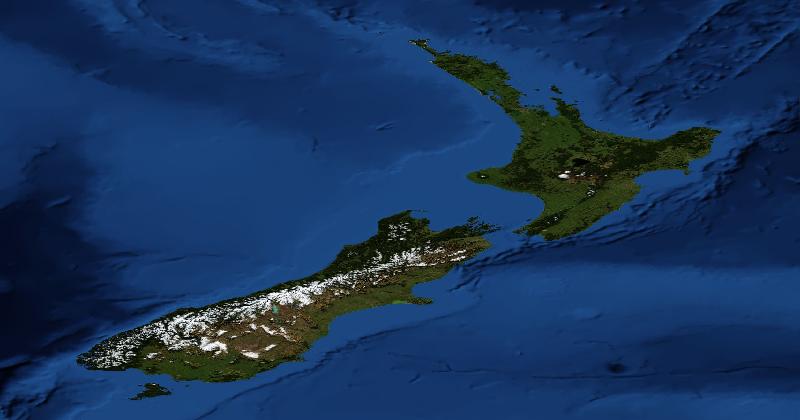
New Zealand sits roughly 2,000 kilometres east of Australia in the southwest Pacific. The country consists of two main islands — the North Island and the South Island — separated by Cook Strait, plus Stewart Island in the far south and a handful of smaller offshore islands. Total area is about 268,000 square kilometres, roughly the size of the UK plus Iceland, but spread out along 1,600 kilometres of north-south extent. That north-south orientation combined with the country's mountainous spine produces a remarkable variety of landscapes within a small national footprint.
For geography games, New Zealand shows up regularly and is rewarding to learn because each major region has a distinctive aerial signature. This guide walks through the cues that lock the country in fast and tell you which island and region you have landed in.
The Two-Island Outline
If you can see the country's outline at all, you have an almost instant lock. New Zealand's two main islands are unmistakable: the North Island is roughly the shape of an irregular fish with the long Northland peninsula stretching northwest, the East Cape jutting east, and Wellington at the southern tip. The South Island is more rectangular, with the Southern Alps running down the western side, the deeply indented Fiordland coast in the southwest, and the rolling Canterbury Plains on the east. Cook Strait separates the two islands at their nearest points by only about 22 kilometres.
In most satellite-imagery game frames, however, you do not see the outline — you see a small patch of land. That makes the internal signatures more important. The good news is that those signatures are strong enough that New Zealand is one of the more identifiable countries in any global rotation.
The Southern Alps and Fiordland
The Southern Alps run almost the full length of the South Island, with Aoraki/Mount Cook at 3,724 metres being the highest peak. The range is sharply glaciated, with characteristic U-shaped valleys, hanging valleys, glacial lakes, and active glaciers reaching down to remarkably low elevations on the western flanks (the Franz Josef and Fox glaciers descend almost to sea level through temperate rainforest, an unusual combination found in few places on Earth). From orbit, the range appears as a dramatic line of snow-capped peaks running northeast to southwest, with steep glaciated terrain on the western side and gentler tussock-covered slopes descending east to the Canterbury Plains.
Fiordland in the southwest corner is one of the most rugged and least-populated parts of any developed country. Multiple deep glacially carved fjords (called sounds in New Zealand) cut into the coast, with Milford Sound being the most famous and accessible. From orbit, Fiordland looks like a dense cluster of fingers reaching inland, with steep forested mountain walls between them, very few visible roads, and almost no settlement. The pattern is similar to Norway's fjord coast or Chile's southern coast but more compact and concentrated in a smaller area.
The Canterbury Plains and Rolling Sheep Country
East of the Southern Alps, the Canterbury Plains form one of the largest areas of flat agricultural land in New Zealand. From orbit, they appear as a vast patchwork of rectangular fields, dairy paddocks, and irrigated farmland, with characteristic centre-pivot irrigation circles becoming increasingly common in recent years as dairy has expanded across the region. The plains are bounded by the Southern Alps to the west and the Pacific to the east, with Christchurch sitting on the central east coast.
The rest of New Zealand's agricultural landscape is mostly rolling green hill country, dominated by sheep and dairy farms. Field boundaries are often marked by long lines of poplars or pine shelterbelts rather than hedgerows or fences alone. Pastures are intensely green much of the year thanks to the mild temperate climate, and the contrast with the lighter exotic forest plantations (mostly Monterey pine) gives many rural frames a characteristic patchwork of dark plantation rectangles, pale yellow tussock or pasture, and bright green dairy paddocks.
The North Island: Volcanoes and Geothermal Country
The North Island has its own distinctive look. The central volcanic plateau around Lake Taupo is dominated by three large volcanoes — Tongariro, Ngauruhoe, and Ruapehu — visible from orbit as snow-capped cones rising from a high plateau of tussock and pumice. Lake Taupo itself is the largest lake in New Zealand, occupying a caldera from a massive eruption 26,500 years ago, and visible as a roughly oval lake covering 616 square kilometres.
The Rotorua region just north of Taupo is one of the most active geothermal areas in the world, with characteristic steam plumes visible from orbit on cool mornings, brightly coloured hot pools, and unusual mineral terraces. The Coromandel Peninsula east of Auckland has a forested mountainous interior and one of the most indented coastlines in the country. The Northland peninsula stretching toward the subtropics has long sandy beaches (Ninety Mile Beach is unmistakable), kauri forests, and a generally tropical feel. And the Bay of Plenty, the Waikato, and the Manawatu have their own dairy-and-cropland signatures.
New Zealand Cities and Settlement
New Zealand's population of just over 5 million is concentrated in a few main urban areas. Auckland on the North Island is by far the largest, with roughly 1.7 million people in the metropolitan area, sprawling across an isthmus with harbours on both east and west sides and a distinctive cluster of small volcanic cones visible across the city. Wellington at the southern tip of the North Island is wedged between hills and the harbour, with a compact downtown and the airport extending into the harbour. Christchurch is the largest South Island city, with its characteristic grid plan reflecting the planned Anglican settlement, the Avon River winding through, and the post-earthquake reconstructed centre clearly visible.
Smaller cities — Hamilton, Tauranga, Dunedin, Palmerston North, Napier, Nelson, Invercargill, Queenstown — have their own distinctive footprints. Queenstown in particular is one of the most photogenic small cities visible from orbit, set on the shore of Lake Wakatipu with the Remarkables mountain range rising directly behind. Dunedin sits at the head of a long fjord-like harbour with the Otago Peninsula extending southeast.
Regional Tells
- Auckland and Northland: subtropical, mangrove estuaries, kauri forests, and the Auckland isthmus with volcanic cones.
- Bay of Plenty and Coromandel: rugged coastlines, geothermal areas inland, dairy and kiwifruit orchards.
- Central North Island: volcanoes, Lake Taupo, geothermal Rotorua, and dairy country in the Waikato.
- Lower North Island: Wellington and the windswept Wairarapa, dramatic coastline, and the Tararua and Ruahine ranges.
- Top of the South: Marlborough's vineyards (some of the largest wine-growing areas in New Zealand), Nelson's bays and beaches, and the Marlborough Sounds.
- West Coast (South Island): temperate rainforest, glaciers, dramatic mountains, and very sparse settlement.
- Canterbury and the East: braided rivers from the Alps to the Pacific, sheep and dairy farms, Christchurch, and the Banks Peninsula.
- Otago and Southland: tussock country, Queenstown, Fiordland, and the Southland plains.
Where New Zealand Gets Confused
New Zealand is most often confused with Tasmania, parts of the UK and Ireland (which share rolling green country), British Columbia, southern Chile, or even Patagonia. The disambiguators are usually specific: the unique pattern of exotic pine plantations versus native forest, the distinctive poplar shelterbelts, the characteristic mixed sheep-and-dairy landscape, and the particular blue-green water colour of Pacific waters around the islands. Subtropical Northland can be confused with parts of New South Wales or Hawaii, but the distinctive vegetation and small settlement style usually resolves it.
Pro-Tier Signals
Advanced players use finer details. The specific colour and arrangement of New Zealand woolsheds (large rectangular farm buildings with characteristic curved corrugated iron roofs). The shape and layout of vineyard areas in Marlborough (densely planted, geometrically precise, with characteristic shelter belts of pine on the windward edges). The distinctive grey colour of the gravel-bedded braided rivers running from the Southern Alps across the Canterbury Plains. The pattern of New Zealand's exotic pine plantations — typically Pinus radiata — which appear as dark green geometric rectangles much darker than the surrounding pasture. The unique road style with characteristic two-lane bridges over braided rivers, often single-lane with passing bays. And the specific lake colour — many New Zealand glacial lakes have a remarkable turquoise hue from glacial flour suspended in the water.
Practise It
New Zealand is one of the most visually distinctive countries to learn for geography games. The Southern Alps, Fiordland, the volcanic North Island, the agricultural plains, and the indented coastlines each have signatures that lock in fast. Spend a focused session on EarthGuessr playing New Zealand rounds and the country will quickly become one of your most reliable Pacific-region identifications — and one of the most visually rewarding regions to play.